Wednesday, September 7, 2016

Why the Retirement Train Wrecked

I was recently contacted by Northwestern University MBA student, Jared Scharen, about writing a guest post for his eRetirements blog. The following post first appeared there. I hope you will visit his blog.


My first job out of college, with a degree in computer science, was with staid General Electric's Information Systems Division in 1975. I was promptly taken under the wing of a few GE lifers whose first advice was this: “Never change employers. Stick with GE for your entire career and they will pay for an excellent pension for your retirement.”

At the ripe old age of 21, retirement wasn't on my radar. I stuck with GE for three whole years. Since the 1980's, defined benefit pension plans have all but evaporated, replaced by defined contribution plans like 401(k)'s. That's retirement planner-speak for the burden of funding retirement being shifted from your employer, like GE, to you and me.

Whereas the 1975-vintage GE retirement plan guaranteed eventual retirement benefits, new plans define how much you can contribute to the plan with tax advantages and your eventual retirement income depends on how well you invest those contributions. Defined benefit "pension" plans like GE's are nearly extinct, as you can see from the following graph published by the Employee Benefit Research Institute (EBRI).


The terms "defined benefit plan" and "defined contribution plan" can be confusing. A defined benefit plan, sometimes referred to as a pension, says, "Work for us for 30 years and we will pay for your retirement. Let us worry about where the money comes from to pay for it." A defined contribution plan, like an IRA or 401(k), says, "You can save for retirement and we will give you a tax break on those savings. You can use this money to help pay for retirement and the amount available to do that when you retire depends on your personal investment results."

401(k) plans were created during the Reagan administration and quickly began to replace defined benefit pensions. While it is tempting to imagine conspiracies at play to transfer the risk of retirement funding from corporations to employees, it appears that defined contribution plans were a random development that just happened to meet the interests of large companies that wanted to shed the burden of their employee pension plans. Pension plans weren't perfect, either – some became “mobbed up” and others simply made promises they couldn't keep. Several failed.

The notion that we are in a retirement-funding crisis is well documented. John Bogle, the storied founder and retired CEO of Vanguard Investments has referred to our retirement system as a “train wreck” waiting to happen. Labor economist, Teresa Ghilarducci, has testified many times before Congress on the nature of what she refers to as “Our Ridiculous Approach to Retirement.”

As Ghilarducci explains, we need to save 20 times our annual income (in some cases more) in financial assets to fund retirement. Retirement researcher, Wade Pfau, finds that in some cases employees will need to save upwards of 20% of their income throughout their career. These are staggering numbers for families trying to pay the mortgage and put a couple of kids through college. The results are seen in EBRI's Retirement Readiness Rating™ that "finds that nearly one-half (47.2 percent) of the oldest cohort (Early Baby Boomers) are simulated to be 'at risk' of not having sufficient retirement resources to pay for 'basic' retirement expenditures and uninsured health care costs."

Families need to earn enough over a 35-year career not only to support themselves for those three and a half decades, but also to help fund perhaps three more decades in retirement. Most Americans will receive Social Security benefits, but they are meant to replace only about 30% of pre-retirement income.

The “train wreck” we face is the result primarily of four trends. First, life expectancy at birth has increased from 47.3 years in 1900 to 68 years in 1950 to 78.2 years in 2009. Because we essentially pay for retirement by the year (a three-year retirement is far cheaper than a 30-year retirement, right?), these extra years of life for the typical retiree dramatically increase the overall cost.

A second contributor has been the stagnation of middle class incomes over the past 30 years. At the same time we shifted the enormous burden of personally saving enough money to fund retirement from corporations to individuals, after-inflation incomes for all but the highest-paid of the middle class flat-lined, as shown in this chart from the Economic Policy Institute.


(Note: Some economists question this income stagnation. I'll let you do your own research and make your own assessment, but I am personally convinced that it is all too real.)

A third contributor to the train wreck is medical cost inflation. Medical services are, as you might expect, disproportionately used by the elderly and represent a substantial risk to retirement finances. As I mentioned above, retirees are living longer and people who live longer consume more medical services than those who don't. The following chart from Business Insider shows both the stagnation of income for many in the middle class alongside the tremendous increase in medical costs since 1980.


A final contributor to the train wreck of retirement finance has been under-saving by Baby Boomers. (Before you complain about Boomers, note that studies like the  EBRI's Retirement Readiness Rating™ referenced above indicate that Gen X'ers and subsequent cohorts are in even worse shape.) In addition to stagnant incomes and a huge savings burden, we Boomers didn't recognize the importance of the sea-change from company-provided pensions to 401(k) plans quickly enough. Those few of us who did save enough didn't do so because we foresaw the retirement funding problem. We saved in 401(k) plans because we had high incomes and the plans offered substantial tax savings.

Most Boomers, in my experience, reached age 60 with very little idea how their retirements would be funded, except for some vague notion that they had earned Social Security benefits.

Corporations stopped pooling retirement risk for us and left us to handle it on our own. This put a tremendous savings burden on the middle class. Costs went up dramatically while incomes remained flat, so there wasn't much left to save. We enjoyed longer lifespans so retirement costs even more. Most of us had no idea this was transpiring.

Train wreck.

This explains the roots of the retirement finance “train wreck”, or “Our Ridiculous Approach to Retirement”, but it doesn't explain the challenge of retirement planning. In essence, we have about thirty or so years of career that must not only pay for those thirty years of supporting a family but also generate enough additional wealth to fund perhaps thirty or more years of retirement.

Fortunately, we don't have to generate that entire retirement income while we are working because we can invest our retirement savings and hopefully watch them grow, taking advantage of the time value of money. A dollar earned today and invested might be worth $7 or $8 in thirty years. (Of course, halfway through our careers we have only 15 years of job earnings remaining, so a dollar saved then is worth only $2.80, and right before we retire a dollar saved is worth about a dollar.) If our investments are successful both while we are contributing to our 401(k) plans and after we retire, we can generate a lot of the income from earnings. We need only save an adequate nest egg.

Unfortunately, that's far easier said than done.


Friday, August 26, 2016

The HECM for Purchase Program Simplifies Home Buying for Retirees

Jim Dean is a HECM loan originator who contributed a great deal to my first two posts on reverse mortgages. I asked Jim to pen the following guest post to explain the HECM for Purchase Program. In a previous post, I recommended a brief one-page overview of HECM for Purchase at Dr. Jack Guttentag's website (link below). Jim delves much deeper into the program.

"H4P", as Jim sometimes refers to it, is a program that can help retirees solve some of the problems of buying a home by using home equity when we no longer have work income to qualify for a conventional mortgage or refinance.


Buying a house is an expensive proposition, even when interest rates, both on investments and on mortgages, are at or near to historic lows. Buyers generally have two options. If they have the liquid resources, they can pay cash for the house. But most home buyers do not have or choose not to deploy that much of their liquid resources. Instead, they leverage "other people's money" – they take out a mortgage and make monthly payments. Persons 62 years of age and older have a third option. They can purchase the home using a down payment and a HECM reverse mortgage.

Paying cash means that one foregoes the earnings that the liquid resources might otherwise have generated. Taking out a 30-year mortgage entails paying interest for the privilege of leveraging other people's money. The mandatory monthly mortgage payment also imposes a significant cash flow restraint during the lifetime of the mortgage since it is typically paid from income.

A house is not a liquid asset and its value is determined by market conditions at the time and place of sale. That value is largely out of the homeowner's control.

Determining the earnings the cash buyer might have received had she invested the cash instead of using it as a down payment is difficult, as one can only speculate what the earnings opportunities might be 10, 20 or more years from now. A very rough and conservative approximation would be the interest rate being paid on the 30 year Treasury bonds – 2.27% annually at the moment.

The interest payments on a 30-year mortgage are more easily quantified. A 30-year fixed rate mortgage at 3.5% for $240,000 (80% of the cost of a $300,000 house), if held to maturity, would entail payments totaling $387,973, of which $147,973 would be interest.

As I stated above, persons 62 years of age and older have a third option of purchasing the home using a down payment and a HECM reverse mortgage. The HECM requires a larger down payment than a regular mortgage, but the reverse mortgage does not require any payment of principal and interest while the home is the primary residence of at least one borrower. The larger down payment does result in more foregone earnings than a regular mortgage would, but less than an all-cash purchase would entail.

Interest accrues on borrowed funds but does not have to be paid until the home is no longer the primary residence of either spouse. The only required payment of the reverse mortgage is the equity upon departure from the home; hence, it need not impact cash flow during residence. Whether there is equity in the house at the ultimate sale depends on two factors: market value of the house and the mortgage balance.

If the house has appreciated in value at an average rate greater than the accruing interest and ongoing Mortgage Insurance Premium on the HECM, then the owner's equity is increasing; if not, it is decreasing. Although the market value is largely beyond the control of the homeowner (he or she can influence it somewhat by maintenance and renovations during occupancy), the ultimate debt level depends on how the borrower has managed the HECM. The FHA insurance makes the HECM a non-recourse loan, meaning that if the accrued debt exceeds the market value at the end of the loan, no other assets or persons are obligated to cover the shortfall.

The HECM for Purchase borrower has several decisions to make. The first is whether to select the fixed-rate or the adjustable-rate HECM. Reverse mortgages work differently than forward mortgages. In the forward world, a rising interest rate means a higher monthly payment obligation with an adjustable rate mortgage, but in the reverse mortgage world, higher interest rates mean a debt and unused Line of Credit that is rising more rapidly. Thus, the ending mortgage debt would be higher but the value of residual equity would still be determined by the ultimate market value of the house.

It is important that the prospective borrower understands how both the fixed-rate and the adjustable-rate HECM work.

The fixed-rate HECM is a closed-end loan, requiring disbursement of all available funds at closing. By analogy, it is similar to a home equity loan. The interest rate is fixed for the life of the loan, and will not change. Partial repayment at any time is acceptable, but would be similar to prepayment on a forward mortgage – prepayments reduce the ultimate amount of interest charged, but the funds cannot be re-drawn. Prepayments fall into a liquidity trap. In the home equity borrowing market, consumers have more often "voted with their feet" in favor of the adjustable rate HELOC.

In the present market, the fixed-rate HECM with an interest rate of 5.06% offers the borrower the largest net (after closing costs) amount. In addition, all HECMs are assessed an ongoing Mortgage Insurance Premium of 1.25% annually on the loan balance. So, the fixed-rate loan with no prepayments is negatively amortizing at an annual rate of 6.31%. If the house is located in a market that consistently sees housing appreciation greater than 6.31% per year, the homeowner's equity is increasing; otherwise, equity is decreasing.

The analog to the adjustable-rate HECM is the Home Equity Line of Credit (HELOC). Both are open-ended lines of credit, with the ability to repay the debt and later redraw the funds, thereby avoiding a liquidity trap (the HELOC only during the “Draw Period”, typically about 10 years; the HECM during the lifetime tenancy of at least one borrower).

Both fixed rate and adjustable rate HECMs charge an initial Mortgage Insurance Premium at closing. This premium is either 0.5% or 2.5% of the appraised value of the house and is distinct from the ongoing Mortgage Insurance Premium of 1.25% per year on the loan balance, which applies to all HECM loans.

The lower rate applies to draws of 60% or less of the eligible loan amount in the first year of the mortgage. Draws above 60% fall into the higher risk category and are charged the 2.5% rate. Since the only funds available on the closed-end, fixed rate HECM must be taken at closing, opting for a draw at or below the 60% threshold, while it reduces the premium by 2%, also substantially reduces the funds available to the mortgagor by 40%.

Since the balance of the funds is available on the adjustable rate HECM after a required 12-month delay, the HECM for Purchase mortgagor can reduce closing costs substantially if they so choose, albeit at the cost of increasing their down payment.

For example, a 62-year old buyer using either the fixed or the adjustable rate HECM to purchase a primary residence could borrow a maximum gross amount of $157,200 in today's interest rate environment. After financing the 2.5% premium and the various associated closing costs of the purchase, that borrower would have an approximate net amount to apply towards the $300,000 purchase price of $144,000, requiring a down payment of approximately $156,000.

The adjustable-rate borrower (but not the fixed-rate borrower) would have another option that would reduce the initial Mortgage Insurance Premium by $6000 (2% of the $300,000 value). They could opt to only borrow 60% of their eligible amount at closing, or $94,320. Then their down payment would be proportionally higher and closer to 71% of the purchase price. The remaining 40% borrowing limit of the HECM, $62,880, would go into their Line of Credit, and would be available 12 months after mortgage closing.

Finally, since the adjustable-rate HECM offers benefits from making optional payments, by enhancing liquidity through the increasing Line of Credit and by potential tax deduction of mortgage interest and mortgage insurance premiums, the borrower should consider which lender margin to request. In contrast to the refinance HECM, lender/broker credits for closing costs are not allowed on the HECM for Purchase but the lender's margin will influence how rapidly the debt and unused Line of Credit will rise. If the borrower expects to make optional payments, selecting a higher margin will maximize credit line growth and interest, thereby offering a higher itemized deduction. That deduction can be timed to coincide with periods of higher income when the deduction would be more valuable.


REFERENCES

Dr. Jack Guttentag, the Mortgage Professor website, an overview of the  HECM for Purchase program.


Tuesday, August 23, 2016

Ten Strategies for Using a Reverse Mortgage to Help Fund Retirement

In my last post, The Mortgage is Dead; Long Live the (Reverse) Mortgage, I wrote about retirement researchers' renewed interest in an improved reverse mortgage product, the Home Equity Conversion Mortgage, or HECM. The post spawned a great conversation in the comments area that pointed out, among other things, just how complicated these products are. But, that complexity contributes to the HECM's versatility.

There is more than one way to use a HECM in retirement and there is more than one kind of HECM. HECMs can be fixed rate or variable rate and there are several ways the proceeds can be distributed. There is even a HECM program that makes it easier for seniors to buy a new home when they don't have adequate income to qualify for a conventional mortgage.

This post is a summary of strategies – not an exhaustive list, by the way – compiled from the books, research papers and blog posts referenced in the endnotes below, that retirees might use to incorporate a HECM into a retirement plan.

As I suggested in the series of posts beginning with A Model of Retirement Planning, Part 1, approaching a retirement plan from a strategic perspective has several advantages. In effect, strategic planning identifies and answers the larger problems first (What do I want to achieve? What do I want to protect? What do I want to leave to my heirs?) and only then considers the best tactics to achieve those objectives (Should I use a reverse mortgage, equities or an annuity?). Once you have identified your strategic goals, some of these HECM strategies might help you achieve them.

Refinance Strategy

Do you currently make a monthly mortgage payment to the bank and would prefer that they send you a check every month, instead? If this sounds like magic or the late-night rantings of Fred Thompson, it isn't. The difference is that a conventional mortgage is building the equity in your home while the reverse mortgage is essentially spending it. Retirees who want to pass their home without debt to heirs should go the conventional route, while those who are happier depleting some or all of the home's equity to pay bills will favor the reverse mortgage alternative.

Refinancing is probably the most common use of HECMs. A retiree can refinance an existing conventional mortgage with a HECM and exchange her monthly mortgage payments for monthly loan distribution checks to spend as she sees fit. This is a double win for a retiree who currently holds a conventional mortgage – consumption is increased by spending home equity while expenses are reduced by eliminating the conventional mortgage payments.

The downside of the reverse mortgage is that spending the equity will have an impact on heirs, though they will have the opportunity to pay off the HECM and keep the home by arranging their own mortgage if your estate cannot. This is the strategy discussed by reverse mortgage originator, Jim Dean, in the comments section following my previous post. It is also thoroughly covered in Shelley Giordano's book, What' the Deal with Reverse Mortgages? (available at Amazon, see link below).

Credit Line Growth Strategy

A unique feature of HECMs is that the line of credit automatically grows over time by roughly the loan's interest rate and it increases with the age of the younger borrower. The longer you wait to spend the proceeds after taking out the mortgage, the larger your line of credit will be when you do spend it. This feature can be used to increase borrowing by taking out the loan early in retirement and spending the money years later.

As retirement researcher, Wade Pfau points out in Incorporating Home Equity into a Retirement Income Strategy, “. . . opening the line of credit at the start of retirement and then delaying its use until the portfolio is depleted creates the most downside protection for the retirement income plan. This strategy allows the line of credit to grow longer, perhaps surpassing the home’s value before it is used, providing a bigger base to continue retirement spending after the portfolio is depleted.” This strategy can be combined with others to increase the amount that could be borrowed later in retirement, for example, to pay for long-term care.

Income Strategy of Last Resort

The most common use of home equity by retirees today is probably to support spending when resources run low at the end of retirement. This was the common wisdom prior to recent research. The new research, however, suggests that spending from the HECM early in retirement rather than as a last resort tends to lead to better outcomes. When the spending will occur later in retirement, the research suggests it’s better to lock in the HECM early and let the line of credit grow. This is especially true in today’s low-interest rate environment that will contribute to growth of the line of credit as rates rise. According to Pfau, “the strategy for using home equity as a last resort supports the smallest increase in success.”

Term and Tenure Strategy

Tenure payments are one of the options for HECMs. These are monthly payments issued to the borrower for as long as he or she lives in the home. They are similar to an annuity, except that annuities pay as long as the annuitants are still living.

Another major difference between tenure payments and an annuity is that the retiree may “leave money on the table” if she dies soon after purchasing an annuity. If that happens with a HECM, there will be no such loss because the borrower will simply have borrowed less of her home equity. With tenure payments, the borrowed amount may eventually exceed the value of the home, but the borrower will never need to repay more than the home's then-current value.

A paper by Gerald Wagner entitled, “The 6.0 Percent Rule”, explains the value of the term and tenure options of HECM loan disbursements in greater detail.

HECM for Home Purchase Strategy

After you retire, you may find it difficult to qualify for a loan no matter how high your credit score because you won't have adequate income. (Former Federal Reserve Chairman, Ben Bernanke, says he was once turned down when trying to refinance.) A HECM has less rigorous credit qualification because it is backed by the home that you already own and it might be the answer to your problem.

HECM for Home Purchase is an FHA program that allows seniors, age 62 or older, to purchase a new principal residence using loan proceeds from the reverse mortgage. The program was designed to allow seniors to purchase a new principal residence and obtain a reverse mortgage within a single transaction and avoid double closing costs. The program was also designed “to enable senior homeowners to relocate to other geographical areas to be closer to family members or downsize to homes that meet their physical needs.”

According to Jack Guttentag, author of the Mortgage Professor's website, “Prior to the HECM for Purchase program, the senior who wanted to purchase a house but could not afford to pay all-cash had to take out a forward mortgage to buy the house, then repay it by drawing on a reverse mortgage. Because the senior had to qualify for the forward mortgage in the same way as any other home purchaser, insufficient income or poor credit could bar the way. Furthermore, the senior who did qualify had to pay settlement costs on both the forward mortgage and the HECM. The new HECM for purchase program eliminates these problems.”

The Mortgage Professor website provides a nice overview of the HECM for Purchase program (link below) and the alternatives a retiree should consider.

Emergency Backup Strategy

A HECM can be established to act as an emergency fund. As described above in the Credit Line Growth Strategy, it might be wise to secure the mortgage early in retirement to allow the credit limit to grow over time.

Long-Term Care Strategy

Some retirees who find long-term care insurance unaffordable or flawed plan to tap home equity to pay for those potential expenses. A HECM line of credit is a good way to achieve this. Again, securing the mortgage in early retirement will maximize the amount of credit available when needed.

Divorce Settlement Strategy

Divorce can have a huge impact on retirement security and the incidence of elder divorce is growing. To show the broad range of retirement strategies afforded by reverse mortgages, consider this possible strategy for providing equal housing after divorce suggested by Giordano.

“For clients who qualify, a reverse mortgage can provide two options that may restore desirable housing to both spouses. By providing financing without a monthly debt obligation, each former spouse can enjoy equal housing without necessarily requiring portfolio distributions. Retirement security is enhanced for both without downgrading the living situation for either”, says Giordano.

A HECM might allow the couple to split the equity of the existing home, which one former spouse can then own, while providing funding for the second spouse to make a down payment on another home. The second spouse might also then combine that down payment with a HECM for Purchase mortgage, enabling both former spouses to own their homes without making mortgage payments. This may be a much better solution than liquidating the original home so the assets can be evenly split.

Social Security Bridge Strategy

Retirees are repeatedly told that they can mitigate longevity risk by delaying their Social Security benefits claiming age. Most households, though, claim Social Security benefits at earlier ages, probably because they need the benefits right away. (The most popular age to claim benefits is the earliest, 62.)

HECMs should be considered as a possible source of funding to help bridge the gap while you delay those benefits. Tom Davison provides a case study of this strategy at his Tools for Retirement Planning blog (link below).

Davison's case study assumes that the retiree plans to live in the home throughout retirement, so it is worth a note of caution here. For strategies that spend from a HECM early in retirement, like this one, the borrower will need to repay the loan if she decides to change housing later in retirement. Retirees who believe they might not stay in the current home throughout retirement need to perform further analysis before deciding on the strategy.

HECM Stock Purchase Strategy

One dangerous strategy, used so often that FINRA felt the need to warn against it (see Betting the Ranch, below), involves obtaining a line of credit secured by the investor's home to buy stocks. If you must buy stocks on margin – and I generally recommend that you don't – pledge the equities as security, not your home. If the market crashes you will go broke faster, but you will lose your stocks and not your home.

(Update: I asked FINRA if their Betting the Ranch warning applied equally to HECMs and conventional mortgages and they referred me to a newer warning entitled Avoiding a Reversal of Fortune (link below) that addresses the issues specific to HECMs. Short answer: it does.)

What To Do

Given the wealth of strategies, how should you integrate a HECM into your retirement plan? Very carefully.

Most every reverse mortgage expert with whom I spoke mentioned that careful planning is needed to integrate a reverse mortgage into a retirement plan. Giordano pointed out that spending proceeds early in retirement cuts off some later options. Davison noted that just because the Social Security Bridge strategy can improve benefits doesn't mean that using the Credit Line Growth strategy and spending later in retirement won't be even better for some households, so multiple strategies should be compared.

I have a couple of concerns. First, this product is very complex. After two months of research, I have not mastered the subject. Second, as Giordano explains in her book's Chapter 13, How Do I Discuss This With My Financial Adviser?, advisers may not recommend them for various reasons even if they are in your best interests. Many advisers don’t understand them. Other advisers are not allowed by their compliance officers to offer them.

Your options are to find an adviser who does understand them and is willing to recommend them if they are the best solution for you, or to invest a lot of time understanding them yourself. Given the potential benefits, I think either path is worth the effort.


Ten strategies for using a reverse mortgage in retirement.
[Tweet this]


The Federal Government offers two major programs to assist with funding retirement: Social Security and the Home Equity Conversion Mortgage. These are especially helpful for retirees who weren't able to accumulate large retirement accounts.

There are many ways to employ a reverse mortgage in a retirement plan. Given that so many households have most of their wealth tied up in home equity, it is becoming urgent that we find ways to spend that equity. The new and improved HECM offers several opportunities.

There are some risks, however. I'll cover those in my next post, The Risks of Reverse Mortgages.

Special thanks to Shelley Giordano, Jim Dean and Tom Davison for their help with this post!


REFERENCES

What's the Deal with Reverse Mortgages? by Shelly Giordano, available at Amazon.


Tom Davison's Tools for Retirement Planning website extensively covers reverse mortgages.


The Home Equity Conversion Mortgages for Seniors portal at the HUD website


The Mortgage Professor website post on the HECM for Purchase program


HECM for Purchase program at the HUD website


A Model of Retirement Planning, Part 1 describes a strategic approach to retirement planning


The Mortgage is Dead; Long Live the (Reverse) Mortgage, the first post of this series on reverse mortgages


Incorporating Home Equity into a Retirement Income Strategy, research by Wade Pfau.


“The 6.0 Percent Rule.” (downloads PDF) demonstrates the value of term and tenure payments.


Betting the Ranch: Risking Your Home to Buy Securities, FINRA warning regarding investors obtaining lines of credit secured by their homes for the specific purpose of investing in securities. Replaced by HECM-specific Avoiding a Reversal of Fortune.


Reversing the Conventional Wisdom: Using Home Equity to Supplement Retirement Income, Sacks and Sacks (2012)


Standby Reverse Mortgages: A Risk Management Tool for Retirement Distributions, Salter, Pfeiffer, and Evensky (2012)


HECM Reverse Mortgages: Now or Last Resort?, Pfeiffer, Salter, and Evensky (2013)


AARP Reverse Mortgage Pamphlet (downloads PDF)


Why Ben Bernanke Can’t Refinance His Mortgage.


Gray divorce on the rise with longevity trend from InvestmentNews.com.


Reverse Mortgage Funds Social Security Delay, a case study by Tom Davison at the ToolsForRetirementPlanning.com blog.


Friday, August 5, 2016

The Mortgage is Dead; Long Live the (Reverse) Mortgage

The word "mortgage" comes from the Latin mort, meaning death, and "gage", roughly meaning a pledge to repay.

(I use these little tidbits to rationalize my choice to take four years of Latin in high school instead of learning a language I might actually use.)

So, a mortgage is the eventual "killing" of an obligation to repay something, usually referring to a home loan. Some families work hard to pay off their mortgage before retiring. Some of them should now consider applying for a different kind, a "reverse" mortgage.

The typical American family's home equity constitutes the bulk of its retirement wealth. (Home equity is the amount of money you would have left if you sold your home and paid off all mortgages.)

The Motley Fool reported in 2015 that the median net worth for Americans aged 65-69 was about $194,226 and that roughly 77% of that wealth was tied up in home equity. Most families can't afford to ignore more than three-quarters of their wealth as a potential source of retirement funding.

Fortunately, there are ways to turn that illiquid equity into a spendable asset.


One way is to sell your home and pay off the mortgage and then reduce housing costs. This only works, of course, if you can find a significantly cheaper place to live. Reducing housing costs could be accomplished by downsizing (buying a less expensive home), renting a less expensive property, moving in with relatives, or relocating to a less expensive area. The remaining capital from the sale, minus the substantial transaction costs, can then be invested or used to purchase an annuity to generate retirement income.

Finance writers love to say that "you can’t spend pieces of your home to pay bills.” But, a second way to increase retirement cash flow and consumption from home equity, the oft-maligned reverse mortgage, enables you to spend little pieces of your home indirectly.

Borrowing a reverse mortgage isn't exactly like spending home equity directly because you will have to pay closing costs to obtain the loan and you will have to pay interest on the loan. And, of course, you or your estate will have to repay that loan.

Your choice among selling and downsizing, taking out a reverse mortgage, and leaving your home equity untouched will depend primarily on whether you:

  • Intend to sell your home at some point and live somewhere else (it may be better to sell and downsize when you're ready),
  • Want to keep your present home for the rest of your life but are not concerned about leaving an unencumbered home to your heirs (consider a reverse mortgage), or
  • Want to live in your present home for the rest of your life and then leave it unencumbered by debt to your heirs (just leave the equity untouched).
Note that you can leave the home to your heirs with the reverse mortgage option, but the loan will have to be paid from other estate resources or your heirs can arrange for a new mortgage – they can keep the home, but the reverse mortgage will have to be repaid.

Most reverse mortgages are offered through the Home Equity Conversion Mortgages (HECM) program administered by the Housing and Urban Development Department (HUD) and the Federal Housing Authority (FHA). A HECM reverse mortgage can be paid out in five different ways, according to HUD:

  • Tenure- equal monthly payments as long as at least one borrower lives and continues to occupy the property as a principal residence. (Like a life annuity, but ends when the home is no longer occupied as opposed to annuitants no longer living.)
  • Term- equal monthly payments for a fixed period of months.
  • Line of Credit- unscheduled payments or in installments, at times and in an amount of your choosing until the line of credit is exhausted. (Useful as an emergency fund.)
  • Modified Tenure- a combination of line of credit and Tenure.
  • Modified Term- a combination of line of credit and Term.

There are several unique advantages to a HECM reverse mortgage.

The main benefit of a HECM reverse mortgage is that it enables the retiree to spend home equity without selling or otherwise giving up title to their home.

There are no prepayment penalties. The lender charges interest but it doesn’t have to be paid until the mortgage is due. Fees, interest payments and the balance on your old mortgage can all be financed with the new loan if you are granted a large enough loan. In fact, one of the benefits of a reverse mortgage for borrowers with a relatively small balance on their original mortgage is that they will no longer have to make mortgage payments. They can begin to receive a monthly check, instead.

HECM reverse mortgages are non-recourse loans. That means the borrower will not owe more than the property's value when sold or at death. Technically, it means that the lender's only recourse for settling the loan is the home itself. A lender cannot demand repayment from your other assets.

There are downsides.

The reverse mortgage must be repaid when both spouses die or sell the home, or when both spouses move out of the home for a year or more. If you decide to sell your home or are forced by a financial setback to downsize, your mortgage will become due and payable. The non-recourse feature means the outstanding debt can’t exceed the sale proceeds from the house, but if you set up the HECM to make tenure payments, those payments will stop and you may find them difficult to replace.

Retirement researcher, Wade Pfau, notes in Incorporating Home Equity Into a Retirement Income Strategy, that high costs can be an issue. It’s worthwhile for potential borrowers to shop around. Typical closing costs, according to a number of sources including AARP, run from $2,000 to $4,000, but most costs can be financed by the loan, in other words these costs, like interest payments, can be added to the loan balance and will not be due until the loan itself is due.

The borrower is responsible for paying property taxes, insuring the home and maintaining it. Failure (or inability in a financial crisis) to do so is grounds for the lender to call the loan. Of course, that's also true of a conventional mortgage.

Some misunderstand that the borrower loses title to the home when she takes a reverse mortgage. The lender does place a lien against the property ensuring the reverse mortgage will be repaid when the home is sold, but home ownership does not change.

I have read of family issues raised by children who expected to inherit a home only to find that their parents had spent the equity and the home needed to be sold to repay the reverse mortgage, or the heirs needed to take out a new mortgage. This is more a family issue than a financial one. Having this family discussion early on should set proper expectations.

Lastly, a potential downside of HECM reverse mortgages is the maximum loan amount, currently $625,500. Retirees with more home equity than that might free up more by selling and downsizing.

Recent research has changed some opinions on reverse mortgages.

Although reverse mortgage have gotten bad press over the years, Pfau and others have a better opinion of HECMs as a result of research beginning in 2012 and program changes in 2013.  “I think it’s really important for advisors who may have done their due diligence about reverse mortgages 10 or 15 years ago to look at what all has changed starting in 2012 and to do their due diligence over,” Pfau recently stated at ThinkAdvisor.com.

Harold Evensky has said that the motivation for the reverse mortgage research at Texas Tech came about when home equity lines of credit (HELOC) kept getting canceled during the financial crisis in 2008. A HECM reverse mortgage, unlike a HELOC, is guaranteed to be available when you need it.

Bankrate.com provides a nice overview of how reverse mortgages work but a more detailed explanation can be found at Tom Davidson's Tools for Retirement Planning blog. Here's a simple example.

Let's say your home is valued at $700,000 and you owe $100,000 on your home's mortgage leaving you with $600,000 equity. You could borrow a $200,000 reverse mortgage and the lender would immediately pay off your $100,000 existing mortgage, leaving you $100,000 (less fees) to borrow. Your old mortgage payments go away.

You could annuitize the $100,000 with tenure payments, effectively replacing your monthly mortgage payments with a monthly check to spend for as long as you live in the home. You still own your home, though the lender will place a lien on the title. Your estate must repay the mortgage, but only the part that doesn’t exceed the home’s then-current market value. If the estate cannot cover the outstanding balance, your heirs may be able to arrange for a new mortgage if they want to keep the home.

Pfau also points out the advantages of applying for a reverse mortgage early in retirement and not spending the money right away. The HECM credit line grows over time. To quote Pfau from Forbes magazine, “Should the borrower live in the home long enough, the loan balance will likely grow to exceed the value of the home.”

Who might use a reverse mortgage? 

The latest research is usually adamant that reverse mortgages aren't for everyone. Every article you read about these products states that, but very few tell you who they are for:

  • You must be at least 62 years of age.
  • You will need to have paid off your mortgage, or nearly so, or have adequate additional liquid assets available to pay off existing liens since the first thing you must do with a reverse mortgage is to pay off your existing mortgage.
  • You must be willing to hold a mortgage on your home – perhaps not attractive to people who once worked hard to become mortgage-free.
  • You must be able to pay property taxes, keep up with homeowners insurance, and pay for regular maintenance on the home.
  • You should want to age in-place in your current home. You can change your mind later, but when you sell your home you will need to repay the reverse mortgage.
  • You must accept the risk that your estate won't have adequate resources to pay off the reverse mortgage without selling your home.
  • The home must be at least one spouse's principal residence.

Reverse mortgages are extremely complicated and the expenses can be substantial. If you think this might be an attractive alternative to consider, I recommend you find a good, unbiased financial planner to guide you and that you shop around for rates.

Furthermore, you need to fully understand what could happen to borrowers in the worst-case financial outcomes. A retired borrower with other financial pressures might need to sell the home earlier than planned. In that event, the HECM will become due and payable when they move out and they could see the reverse mortgage called at the worst possible time. Those lenient repayment terms might disappear when they're needed most. I'll post about that one day soon.

Lastly, some researchers have recently recommended using reverse mortgages to reduce sequence of returns risk and permit higher withdrawal rates. As I have previously hinted, I'm not on board with that concept, at least not yet. I'll post about that soon, too.

Reverse mortgages have gotten a bad rap, but recent research suggests that they are worth a second look. They're complicated, some uses are risky, and they’re not appropriate for every household. But bottom line, if a lot of your wealth is tied up in home equity, a reverse mortgage can help you increase retirement cash flow and consumption without selling your home.


You worked really hard to pay off your mortgage before you retired. Want another one?
[Tweet this]


Wade Pfau referenced several recent papers on this topic. If you're interested in the research, check out the following:

Reversing the Conventional Wisdom: Using Home Equity to Supplement Retirement Income, Sacks and Sacks (2012)


HECM Reverse Mortgages: Now or Last Resort?, Pfeiffer, Salter, and Evensky (2013)

The 6% Rule, Wagner (2013)

AARP Reverse Mortgage Pamphlet (downloads PDF)

Friday, July 29, 2016

Exit Row Strategies

Back in the 70's, there was a short-lived comedy called Chico and the Man, starring comedian, Freddie Prinze. After Prinze's untimely death, I watched a made-for-TV movie about his life called, "Can You Hear the Laughter?"

In that movie, Prinze' character counseled a friend in L.A. whom he had asked to visit him in New York. The friend replied that he couldn't because of his fear of flying.

"What are you afraid of, dying in a plane crash?" I recall Prinze' character asking.

"Of course," replied the friend.

"No problem! Sit in an exit row next to the window. Look out the window. If the plane starts to crash, wait 'til it's like, three feet above the ground and jump out!"

I refer to these as "Exit Row Strategies". They get a few laughs when uttered by a comedian, but they shouldn't be part of retirement planning. The best-known Exit Row Strategy is market timing. Invest in stock markets and sell before a major market decline. Tons of research shows that market timing doesn't work – people tend to jump out (or in) at the worst time. (Here's Morningstar's take.)

Similar advice says, "Don't buy an annuity until you see your invested retirement savings fall in value." In other words, bet it all on the market. If that doesn't work out, dive out the window onto a soft, cushy annuity just before your portfolio hits the ground.

In my last post, The Whoosh! of Exponential Retirement, I described the nature of exponential change. It can seem like nothing changes much for a very long time, only to have events whoosh! by us at the end. The higher the exponent, the faster the growth and the greater the whoosh! effect – the effect of 3% annual inflation doesn't whoosh! nearly as loudly as the effect of 8% annual portfolio growth when we save for retirement.


Retirement risk happens fast. Don't count on having time to jump out its way.
[Tweet this]


Here's a description of how saving for retirement, portfolio depletion and bankruptcy can feel. Imagine you're standing on a station platform in Omaha and you see a train in the distance. Actually, you see a dot on the horizon at the end of a very long, straight stretch of track. You watch for what seems like forever, but the dot doesn't get much bigger. After a long period of waiting, the train finally becomes bigger and bigger and suddenly it passes you on the platform unbelievably fast. (No problem – not your train.)

Seemingly out of nowhere, you are bankrupt. Or, you met your retirement savings goals in the last decade before retiring. (Remember from my last post that exponential change can be bad or good.)

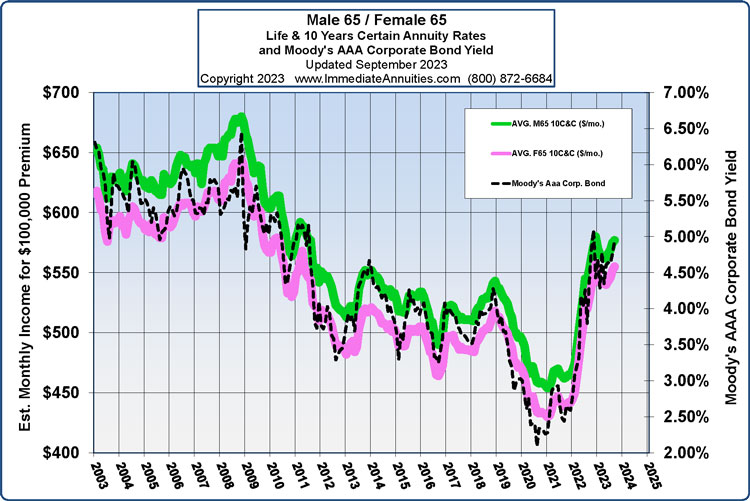
How are Exit Row Strategies risky in real life? Let's imagine that you retire in 2005 with $500,000 saved and are debating whether to annuitize some of it. You can purchase a life annuity that pays $625 monthly ($7,500 annually) per $100,000 contract, based on the chart below from immediateannuities.com, so if you annuitize the entire $500,000, you could receive $37,500 annually for as long as you live.


You figure you need $25,000 to support your lifestyle, so you think you have lots of margin for error and you invest it all in stocks. If and when your portfolio declines to $333,333, you plan to buy an annuity with a 7.5% payout that pays the $25,000 minimum you figure you need in the worst case.

(Note that you are guessing that the payout will still be 7.5% when you buy sometime in the future. This illustrates another risk in planning to buy immediate annuities in the future: annuity payouts are based on interest rates and both are impossible to predict, as is how much principal you will have on hand to purchase them. Annuity payouts increased from 2005 to 2009, but they declined dramatically after that. Also, annuities get cheaper as you age, so your future annuity payout will also depend on when you eventually decide to buy. That's a lot of guessing.)

Unexpected (by anyone), the Great Recession hits two years later and the market falls 50% in just 18 months.

Sadly, your portfolio declines nearly 50% to $250,000 over the next 18 months and you can now only purchase about $18,750 of guaranteed annual income at 2007 annuity payout rates. On the positive side, annuity payouts increased 8% from 2005 (about 7.1%) to 2009 (8.1%), so you could actually buy $20,250 of annual income. But, that's still 19% less than you need.

Your losses whooshed! right by before you could jump out the exit window. Doesn't that $37,500 of guaranteed annual income look pretty good now? Rather than planning a last minute bail-out, a more prudent move might have been to nail down the $25,000 income you needed when you could in 2005 (nail down a floor, get it?) with $333,333 of your savings and take a shot at upside with the remaining $166,667.

"But wait," I can hear risk-takers protesting, "I can just wait until the market recovers!"

Maybe, and I would guess it probably will, but as I explained in Even Your Portfolio Heals More Slowly as You Get Older, recovering from bear market losses while you are still working, earning income, and buying stocks at discounted prices is one thing.  Recovering those losses after you start spending in retirement using stocks that have fallen in value and having no income to buy discounted stocks is quite another. This analysis is all about the income side and totally ignores the risk that you will have unforeseen major expenses just when your portfolio has declined.

Exit Row Strategies are a lot harder to implement in a crisis than you might think and, by their nature, they are always executed in a crisis.

Some recent work by Wade Pfau and by Barry and Stephen Sacks regarding the use of reverse mortgages to fund retirement is the opposite of an Exit Row Strategy. The studies suggest that applying for a reverse mortgage early in retirement has significant benefits over using home equity as a last resort late in retirement. (Setting up the mortgage early makes perfect sense to me. Using it to mitigate sequence risk is a step farther than I am willing to go at present.)

The train analogy isn't perfect, of course, because the train isn't actually accelerating exponentially, it just feels that way to a distant observer. But, it loosely ties back to the speed of the approaching ground for Freddie's friend and to an old baseball joke. ("The ball kept getting bigger and bigger. . . and then it hit me. . .")

This post isn't about reverse mortgages, investing or annuities, though, it's about taking risk that you believe you can foresee and therefore somehow deftly avoid.

Life comes at us fast.

We can't depend on having time to jump out of its way at the last second.


In a USA Today interview and a paper, It's Time to Retire Ruin (Probabilities), Dr. Moshe Milevsky explains why "probability of ruin" isn't a good retirement management tool. I wrote about this in Time to Retire Probability of Ruin. (Don't let the similarity of titles fool you, Milevsky does a much better job.)

Now that you paid off your mortgage before retiring, are you ready for a new one? Check out my next post, The Mortgage is Dead; Long Live the (Reverse) Mortgage.

Friday, July 22, 2016

The Whoosh! of Exponential Retirement

I recently read a couple of articles on artificial intelligence, one an interview with historian, Yuval Noah Harari, and the other written by computer science geek (like me), Tim Urban. I was intrigued not by the technology discussion, but by the discussion of the exponential nature of human history.
Quick math refresher. An exponential curve is a function that increases by a power of x (2, 4, 8, 16, 32 . . .). A linear curve (a straight line) increases by a factor of x (2, 4, 6, 8 ,10 . . .). The following graph shows four exponential curves with growth rates of 3%, 7%, 15% and 55% per period. The 55% growth rate is extreme but comes into play shortly.


Urban explains the exponential nature of human development in an interesting way that I will summarize here. An adult from 1750 would be overwhelmed if he were transported forward by time machine 266 years to 2016. To achieve a similar state of awe in 1750, a person living in that year might have to have been transported back 14,000 years in time, according to Urban.

Meanwhile, we Baby Boomers would probably have been shocked back in 1960 to see what life would be like today, 56 years later.

In 1985, there were no cell phones, let alone smartphones, my Telemail email account was a rarity (most people had no idea what email was), global terrorism wasn't nearly the issue in the U.S that it is today, the Cold War had just ended, personal computers stored data on 10-megabyte hard disk drives (1/100,000th the capacity of today's one-terabyte hard drives), and driverless cars were a pipe dream.

In the early 1990's, I flew the supersonic Concorde from London to New York. My grandfather rode to school on a horse. In 1991, the Cold War ended.

Urban also includes the following illustration of exponential growth courtesy of MotherJones.com. I won't repeat the entire explanation here since it's explained well at the MotherJones.com post, but here's the gist. If you started refilling a dry Lake Michigan in 1940 by adding 1 ounce of water and then doubled that amount every 19 months, after 70 years you wouldn't have much more than a very large, extremely shallow puddle. But, “by 2020, you have about 40 feet of water. And by 2025 you're done.” Exponential growth can crawl along glacially for a long time and then whoosh! right by you.


If I handled such large numbers correctly, the annual growth rate in the Lake Michigan demo is about 55% a year. Not many things grow that fast for any sustained period, let alone 85 years, but the whoosh! effect is pretty dramatic at this rate. The greater the growth rate, the more dramatic the difference between “waiting forever while nothing much happens” and “whooshing! by”.

Consider it an exaggeration for effect.

The demo also explains rather dramatically why a bear market late in our careers can be devastating. Half of the six quadrillion-gallon lake is filled in the last 18 months of the 85-year process. Your 401(k) growth is not nearly so dramatic, but your balance could double in the last 10 years of your career. Not as awesome a whoosh! as filling a lake at 55% annual growth, but still, one you don't want to miss.

As you can see, the length of time required to inspire awe becomes shorter and shorter at an amazingly fast pace. That's the nature of exponential growth. The implication for retirees is that if human development (and computer development, as the AI argument goes) continue at this incredible rate of growth, it is not only unreasonable to believe that you can predict how your life will change over a 30-year retirement, but it will become more and more unreasonable for future generations to do so.


We retirement planners are massively overconfident in our ability to predict the future.
[Tweet this]


Still, nothing much grows this fast for very long.

Exponential growth usually doesn't last forever. Whether or not these exponential growth rates of human development and computer technology can continue is unknown and unknowable, but highly questionable. Moore's Law is showing signs of age.

Microsoft went through a super growth phase, as most successful startups do, but as annual revenues became huge, it became harder and harder to increase them exponentially. Microsoft reported $119M in revenues in 1984 and $95B in 2015, according to WolframAlpha.com. It's much easier to grow $119M by 20%, increasing sales by $24M, than to grow $95B 20%, increasing sales by $19B. Super-growth can't last forever.

A company can grow revenues 100% in a year when previous year sales were a million dollars. When sales are in the billions, 8% growth would be good. Pretty soon, if you're McDonalds, you need to sell hamburgers on Mars to create any kind of real growth. If the curve of history continues at an exponential growth rate, we will soon be awestruck annually and that doesn't seem reasonable.

Reasonable exponential growth in investment portfolios can continue for a long time – Harvard's endowment is an example – but probably not forever. As William Bernstein has reminded us, cataclysmic change can occur in a few decades, as Germany demonstrated twice in the first half of the 20th century, ending all growth, at least for a while.

There is bad exponential growth, as well. Exponential growth of malignant tumors, for example, is self-limiting. Exponential growth in cost is also bad. Inflation grows exponentially, but currently at only about 1% a year, which is manageable. Health care costs are growing around 3.6% annually and are quickly becoming unmanageable, as seen in the following chart from whitehouse.gov.


Change can seem to whoosh! This is the fallacy of retirement strategies that suggest trying risky things and then bailing out if and when you see danger approaching. If you've read my posts on elder bankruptcy, they don't seem to result from a long, slow degradation of one's standard of living, but as a quick and deadly combination of correlated setbacks.

In Why Retirees Go Broke, I wrote about the positive feedback loops that characterize elder bankruptcies, referencing the research work of Dr. Deborah Thorne. These loops start slowly, gather speed and then whoosh! by. The two families I watched go into bankruptcy during the Great Recession went from comfortable middle class to insolvency in less than a year.

Exponential curves are representative of several retirement finance components. The current rate of change of our society makes planning a 30-year retirement mostly guesswork. On the other hand, exponential growth of investments enables many households to save enough to retire comfortably. I often hear clients who have saved a sizable nest egg say, “I'm not sure how this happened. I didn't really have a lot of savings until the end of my career.”

It isn't voodoo. The Rule of 72 tells us that a portfolio earning 7% annually will double in value about every decade. It will seem to grow slowly for many years and then – if you're lucky enough to avoid a bear market just before retirement – your nest egg balance will appear to whoosh! by in the exhilarating final decade of your career. On the other hand, if the bear gets you just before retirement, the biggest part of the whoosh! will fizzle. It will sound more like "who?"

Aging after you retire feels exponential, too. By age 70, most retirees stop traveling internationally. By age 80 most stop traveling domestically. By age 90, the roughly 30% of us who are still around may rarely travel much beyond the backyard.

These rapid changes affect retirement planning. We shouldn't plan on spending the same amount when we're 80 as we do at 65, though David Blanchett (downloads PDF) and Sudipto Banerjee (downloads PDF) have shown that spending typically declines roughly 1.5% to 2% a year as we age. That's exponential growth, but so slow it's almost linear.


What does this mean for retirement planning? A few things, I think.

First, when you're “standing on an exponential curve”, it probably looks linear into the immediate past and future. Don't fall for projecting this straight line. Interest rates are historically low and have been since December 2008. You might assume that they will stay that way for the rest of your retirement now, but that is highly unlikely. One day they will increase, and it will seem to happen quickly. The following diagram from Urban's post explains.


Second, and more important, I have recently explained in several ways that trying to predict an individual's retirement wealth several years into the future is impossible. Our limited data on historical market returns is such a small sample that our estimates of return have a huge confidence interval. Our future liabilities are probably more uncertain than market returns. The length of our retirement is unknowable.

Moshe Milevsky has written that we can be 95% certain that a shortfall probability of 15% actually lies somewhere between 5% and 25%. Gordon Irlam showed us an example in which the optimal asset allocation has a huge 95th-percentile confidence interval of 10% to 82%. Simulations are informative but not predictive.

The exponential nature of societal change provides more evidence that predicting our financial situation 30 years or more into the future is a fool's errand. Let's face it – we have no more idea what life will be like in 2046 than we could foresee today in 1986. With exponential change, the next 30 years will see a lot more changes than the last 30.

Lastly, when you see computer output that appears to predict your wealth from age 65 to 95, make sure you understand precisely what you are seeing. It's a pro forma wealth statement that shows one example of what might happen. (If you want a chuckle, ask the provider for a guarantee.) This shouldn't be the central tenet of your retirement plan. If you base your retirement plan on your ability to predict the future, you are likely to be sorely disappointed.

We humans are massively overconfident in our abilities to predict the future, and we retirement planners (ourselves included) are even more overconfident in our ability to predict the future wealth of a single retiree.


What does an 80's comedian have in common with bad retirement advice? Check out my next post, Exit Row Strategies.


Thursday, July 7, 2016

Managing Risk Is a Strategic Objective, Part 8

In the model for strategic retirement planning, avoiding risks are strategic objectives. I have addressed them separately so far purely for organizational reasons because there are important distinctions between risks and objectives.

Objectives tend to be positive desires. I want to fund travel and maintain my standard of living. Risks tend to be stated negatively. I want to avoid going broke as the result of unexpected medical expenses and I want to avoid outliving my wealth.

Desires tend to be more personal. I want to retire in Florida. I don't want to burden my three children.

The Mission Statement is where we create our own personal definition of success. Desires in the Mission Statement identify those objectives we believe would make our retirement a financial success if they are met. Risks are those outcomes that we believe would make retirement successful if they can be avoided.

Risks tend to be the bad outcomes that most or all retirees face. Not everyone has children or wants to retire in Florida, but no one wants to go bankrupt, see their purchasing power eroded by inflation, or go broke late in life as the result of long-term care expenses.

Whether we sort these into two different lists for organization purposes or combine them all as simply strategic objectives, they need to be treated the same in the negotiation process (remember what is desired and what is possible?). In other words, they all belong in the Mission Statement, even though we may create the lists separately because that's the way we think. I want to retire in Florida and I don't want to be wiped out by inflation are both strategic objectives.

The negotiation process is where we reconcile what we want with what we can afford. As an example of the negotiation process, we might desire not to be bankrupted by long-term care costs but we may not have adequate wealth to make the premium payments for LTC insurance. In the negotiation process, we might need to change our insurance strategy to a Medicaid strategy and create more modest strategic objectives accordingly.

What, then, are the common financial risks of retirement?

During a panel discussion a few years back, my friend and colleague, Robert Powell, waved a list of retirement risks at me while asking a question. I recently got around to asking him for a copy of the list and he referred me to a piece written by the Society of Actuaries (download PDF). It lists fifteen risks and I think it's a great place to start. These include:


Society of Actuaries Retirement Risks List
Longevity The risk of outliving retirement resources
Inflation Loss of purchasing power.
Interest Rates Lower interest rates make retirement less affordable.
Market Risk Loss of invested retirement savings.
Business Continuity An annuity provider or pension plan goes out of business.
Employment Loss of supplemental job income.
Public Policy Loss of social program benefits or tax increases.
Unexpected Health Care Costs A major cause of bankruptcy.
Lack of Access to Caregivers Unavailability or unaffordability.
Loss of Independence Accident, illness or chronic disease.
Change in Housing Needs Housing that doesn't accommodate physical decline.
Death of Spouse Can be a major financial setback.
Other Change in Marital Status Divorce can be a major financial setback.
Family Member Needs Family members outside the retired household need support.
Bad Advice, Fraud, Theft Can result from declining mental acuity. 

Probability of Ruin estimates (or attempts to estimate) the probability that a retiree will deplete a portfolio of investment savings invested in stocks and bonds, but there are worse things than depleting a portfolio. Losing one's standard of living, for example, would be worse. With an adequate floor of safe income, a retiree could deplete a savings portfolio and still maintain his or her standard of living. In fact, depleting a savings portfolio and living out one's final years funded by pensions and Social Security benefits is a rational strategy.


Are these common financial risks addressed by your retirement plan?
[Tweet this]


Bankruptcy, or insolvency, would be worse than either of these outcomes so the list of financial risks in retirement should include the major risks of bankruptcy. I previously wrote about an elder bankruptcy study by Dr. Deborah Thorne in Why Retirees Go Broke. Dr. Thorne's study identifies the following reasons that bankrupt elder Americans cited as the cause for their insolvency:

Cited Reasons for Bankruptcy from Thorne Study
Credit Card Interest and Fees
Illness and Injury Duplicate
Income Problems Duplicate
Aggressive Debt Collection
Housing Problems Duplicate

These reasons should be included in a comprehensive list of retirement financial risks, though some overlap items in the SOA list. Only “Credit Card Interest and Fees” and “Aggressive Debt Collection” are not included in the SOA list. I would personally add "Legal Liability" to the lists and encourage retirees to consider relatively inexpensive Umbrella Liability Insurance policies.

Lastly, the Institute for Financial Literacy also provides a list of financial risks of retirement cited by bankruptcy filers that includes:


Bankruptcy Reasons Cited by Institute for Financial Literacy
Divorce (15.1%) Duplicate
Birth or Adoption of Child (9.7%)
Death of Family Member (7.5%) Duplicate
Retirement (forced or poorly timed, 6.7%)
Identity Theft (1.9%) Duplicate

The only risks cited by IFL not arguably cited by the SOA or Thorne Study are "Birth or Adoption of a Child" and "Retirement, forced or poorly timed".

I'm going to modify the plan outline I proposed in The Retirement Plan I Would Want, Part 7 just a skosh by rolling Risk Mitigation objectives into the Mission Statement:

I. Mission Statement
Desired Objectives
A. Strategic Objective One
     a. Recommended strategy to achieve objective one
     b. Alternative strategies
     c. Justification for strategic choice

B. Strategic Objective Two, etc.

Risk Mitigation Objectives

C. Strategic Objective Three
     a. Recommended strategy to achieve objective three
     b. Alternative strategies
     c. Justification for strategic choice
The risks I identified above should be included under the Risk Mitigation Objectives heading. I've probably missed a few risks and hope to see the omissions noted in your comments. Otherwise, this should offer you a fairly comprehensive list of potential financial risks of retirement. Are they addressed in your retirement plan?


Tuesday, June 28, 2016

The Retirement Plan I Would Want - Part 7

In recent posts, beginning with A Model of Retirement Planning – Part 1, I've explored a strategic approach to retirement planning based on the Pearce-Robinson model for strategic business planning. I'll pick that up now, after a two-week interruption to visit Machu Picchu, to have a shaman in the Amazon basin release my negativity, and to catch and eat two piranha. (Despite what you may have heard, they're pretty tasty. Wonder if that's what they say about us?)

The typical retirement plan report is centered around a spreadsheet that purports to anticipate our future wealth annually for the next three decades despite all evidence that such forecasts are well beyond human capabilities. Even if these forecasts were credible, such a presentation makes it difficult to explain or understand the underlying strategy and it places too much planning focus on terminal wealth.


The typical retirement plan is centered around an overconfident pro forma projection of future wealth.
[Tweet this]


Dr. Moshe Milevsky recently wrote a piece entitled, "It’s Time to Retire Ruin (Probabilities)" (download PDF). In it, he states, "there are misguided notions that (1) people with sizable nest eggs will “outlive their assets,” (2) one can actually place a probability on this event, and therefore (3) one should manage financial assets and use insurance products to minimize this metric."

Milevsky provides an example Monte Carlo outcome with a "15% probability of ruin" that might have a 95% confidence interval of 5% to 25%. In other words, the probability of ruin probably falls not at precisely 15%, but between 5% and 25% in 95% of simulations. This broad interval is the result of sampling error given the limited amount of historical market return data at our disposal. (I wrote a similar argument last year in Time to Retire the Probability of Ruin?, but Milevsky does a better job.)

The bottom line is that it is impossible to predict your finances well into the future with any accuracy whatsoever and analyzing a retirement plan using such a projection as the central assumption is unwise. We end up with retirees looking at their plans and saying, "Wow! In thirty years, I'll still have $10,264.32 in my bank account! I'm set."

Furthermore, retirement plans organized around pro forma projections of future retirement wealth are somewhat opaque when it comes to understanding the underlying strategies and tactics that generated the projections, or even the objectives they attempt to achieve. As a result, they are difficult to explain in a holistic way and more difficult to understand.

A strategic plan for retirement would address these issues by clearly linking strategies and tactics to desired and achievable strategic objectives so planner and retiree understand both what the plan hopes to achieve and how it proposes to achieve it.

After the loss of my negativity (can't say I miss it), I have concluded that my next step should be to consider how the process would work in real life. One way to do that is to identify what I would personally want to see in a retirement plan that someone developed for me.

The first thing I would expect from a planner is to hear my Mission Statement repeated back to me in the planner's own words to assure me that the most important goals of my retirement had been accurately communicated.

Next, I would want the planner to explain her recommended strategies to achieve each of the goals of the mission statement. Addressing the goals one by one, I would want to hear not only how the goal would be achieved, but why the selected strategy is the best choice. For me, that would include a brief explanation of alternative choices and why they were rejected. I want to understand what decisions were made on my behalf.

For a mission statement that includes a guaranteed lifelong minimum standard of living objective, for example, I'd like to hear, "The best choice is a fixed annuity. The second-best choice, given your other goals, is a TIPs-bond ladder. I recommend the annuity because it is possible to outlive the bond ladder, but not the annuity. However, you have expressed concerns about purchasing an annuity, so you have a choice to make."

The strategic planning process I have suggested incorporates the possibility that strategic objectives may need to be revised in an iterative process bounded by what is possible and what is desirable and this might be one of those times. Unless you are quite wealthy, it may not be possible to achieve both your goal of guaranteed lifetime income and your goal of avoiding annuities, for example.

Achieving desired and achievable goals is a key part of the plan; understanding risks is another. I would expect a planner to present the important risks of the retirement plan and to explain how each will be addressed. There are four basic ways to address financial risks: accept them, avoid them, mitigate them or insure against them. 

While most retirement planning literature today focuses on risk of ruin, the probability of depleting a portfolio of retirement savings isn't the worst possible outcome. In fact, depleting the portfolio before the end of life can be a rational strategy. Losing one's standard of living is a worse outcome and bankruptcy is the worst. I would want to see the estimated probabilities of all three. 

Today's retirement plans inevitably include Monte Carlo simulations and those do provide some valuable information. One thing I can guarantee about a pro forma plan for thirty years of retirement, though, is that your actual retirement is unlikely to closely follow those projections. The projections are informative but not predictive. I would look at them if they were included in an appendix.

Lastly, the process includes an annual review, so a retirement plan should include the tactical objectives to be achieved in the first year. This part of the process ensures that our plan stays on track.

This all suggests an outline for a retirement plan that looks something like this:

I. Mission Statement

A. Strategic Objective One
     a. Recommended strategy to achieve objective one
     b. Alternative strategies
     c. Justification for strategic choice

B. Strategic Objective Two, etc.

II. Risk Analysis

A. Risk One
     a. Recommended strategy to mitigate (avoid, insure, accept)
     b. Alternative mitigation strategies
     c. Justification for strategic choice

B. Risk Two, etc.

III. First Year Tactical Objectives for Annual Review

IV. First Year Action Plan

IV. Appendices

A. Household resources understood by planner (See Blanchett and Straehl for a detailed explanation, download PDF)
     a. Financial Assets
     b. Human Capital
     c. Pension Wealth
     d. Housing Wealth

B. Budget expectations understood by planner

C. Major planning assumptions

D. Monte Carlo Simulation Results

E. Tactical Plans (Tax plan, Investment plan, etc.)

Where are the traditional retirement plan chapters like a Tax Plan, Investment Plan, and an Estate Plan?

Tax plans, investment plans, and estate plans are tactical plans, not strategic objectives. No retiree really wants an estate plan, we want to efficiently transfer our terminal wealth to our heirs and that strategic objective probably demands some kind of estate plan. We don't want a tax plan, we want to meet our strategic spending objectives and that probably requires a tax plan, the point being that we want to satisfy our major strategic objectives and these tactical plans are means to achieving those ends, not ends themselves. They belong in the appendices.

These tactical plans will be developed by a good retirement planner and should be part of the report but they should be explained to us, the retirees, in terms of the objectives they attempt to achieve and not as standalone plans.

Ultimately, a strategic plan replaces an overconfident pro forma projection of future wealth as its centerpiece with a logical mapping of strategies to objectives, clearly defining the objectives and clearly showing the rationale for the strategies. It should also draw the planner's focus toward meeting key plan objectives and away from increasing the probability that the portfolio balance after thirty years will be greater than zero. Lastly, a strategic plan should address critical risks, especially risks that don't show up in Monte Carlo simulations because they are too random to model with probabilities.

I find the focus on the retiree's strategic objectives to be the major advantage of a strategic planning approach. By its nature, the plan explains how the various tactical plans work together to achieve strategic objectives and I suspect that will provide an explanation for the retiree that is far more understandable: "this is what you said you wanted to achieve and here is a plan that shows, point by point, your best shot at achieving it."

I'll give risk mitigation a deeper look next time in Managing Risk Is a Strategic Objective, Part 8.