Friday, July 29, 2016

Exit Row Strategies

Back in the 70's, there was a short-lived comedy called Chico and the Man, starring comedian, Freddie Prinze. After Prinze's untimely death, I watched a made-for-TV movie about his life called, "Can You Hear the Laughter?"

In that movie, Prinze' character counseled a friend in L.A. whom he had asked to visit him in New York. The friend replied that he couldn't because of his fear of flying.

"What are you afraid of, dying in a plane crash?" I recall Prinze' character asking.

"Of course," replied the friend.

"No problem! Sit in an exit row next to the window. Look out the window. If the plane starts to crash, wait 'til it's like, three feet above the ground and jump out!"

I refer to these as "Exit Row Strategies". They get a few laughs when uttered by a comedian, but they shouldn't be part of retirement planning. The best-known Exit Row Strategy is market timing. Invest in stock markets and sell before a major market decline. Tons of research shows that market timing doesn't work – people tend to jump out (or in) at the worst time. (Here's Morningstar's take.)

Similar advice says, "Don't buy an annuity until you see your invested retirement savings fall in value." In other words, bet it all on the market. If that doesn't work out, dive out the window onto a soft, cushy annuity just before your portfolio hits the ground.

In my last post, The Whoosh! of Exponential Retirement, I described the nature of exponential change. It can seem like nothing changes much for a very long time, only to have events whoosh! by us at the end. The higher the exponent, the faster the growth and the greater the whoosh! effect – the effect of 3% annual inflation doesn't whoosh! nearly as loudly as the effect of 8% annual portfolio growth when we save for retirement.


Retirement risk happens fast. Don't count on having time to jump out its way.
[Tweet this]


Here's a description of how saving for retirement, portfolio depletion and bankruptcy can feel. Imagine you're standing on a station platform in Omaha and you see a train in the distance. Actually, you see a dot on the horizon at the end of a very long, straight stretch of track. You watch for what seems like forever, but the dot doesn't get much bigger. After a long period of waiting, the train finally becomes bigger and bigger and suddenly it passes you on the platform unbelievably fast. (No problem – not your train.)

Seemingly out of nowhere, you are bankrupt. Or, you met your retirement savings goals in the last decade before retiring. (Remember from my last post that exponential change can be bad or good.)

How are Exit Row Strategies risky in real life? Let's imagine that you retire in 2005 with $500,000 saved and are debating whether to annuitize some of it. You can purchase a life annuity that pays $625 monthly ($7,500 annually) per $100,000 contract, based on the chart below from immediateannuities.com, so if you annuitize the entire $500,000, you could receive $37,500 annually for as long as you live.
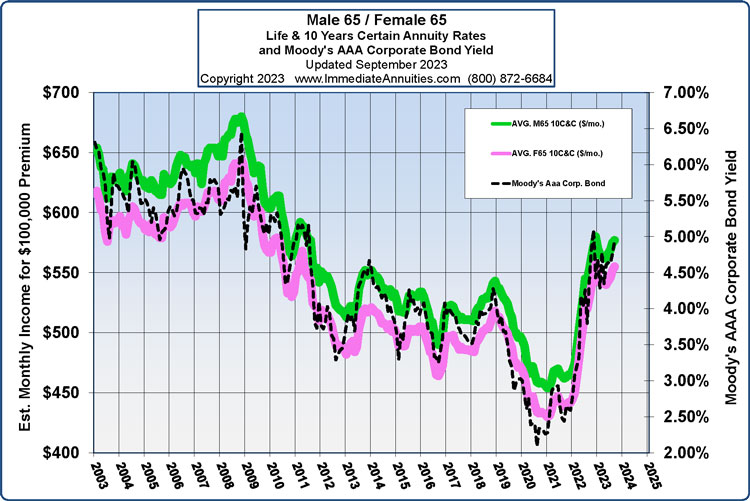

You figure you need $25,000 to support your lifestyle, so you think you have lots of margin for error and you invest it all in stocks. If and when your portfolio declines to $333,333, you plan to buy an annuity with a 7.5% payout that pays the $25,000 minimum you figure you need in the worst case.

(Note that you are guessing that the payout will still be 7.5% when you buy sometime in the future. This illustrates another risk in planning to buy immediate annuities in the future: annuity payouts are based on interest rates and both are impossible to predict, as is how much principal you will have on hand to purchase them. Annuity payouts increased from 2005 to 2009, but they declined dramatically after that. Also, annuities get cheaper as you age, so your future annuity payout will also depend on when you eventually decide to buy. That's a lot of guessing.)

Unexpected (by anyone), the Great Recession hits two years later and the market falls 50% in just 18 months.

Sadly, your portfolio declines nearly 50% to $250,000 over the next 18 months and you can now only purchase about $18,750 of guaranteed annual income at 2007 annuity payout rates. On the positive side, annuity payouts increased 8% from 2005 (about 7.1%) to 2009 (8.1%), so you could actually buy $20,250 of annual income. But, that's still 19% less than you need.

Your losses whooshed! right by before you could jump out the exit window. Doesn't that $37,500 of guaranteed annual income look pretty good now? Rather than planning a last minute bail-out, a more prudent move might have been to nail down the $25,000 income you needed when you could in 2005 (nail down a floor, get it?) with $333,333 of your savings and take a shot at upside with the remaining $166,667.

"But wait," I can hear risk-takers protesting, "I can just wait until the market recovers!"

Maybe, and I would guess it probably will, but as I explained in Even Your Portfolio Heals More Slowly as You Get Older, recovering from bear market losses while you are still working, earning income, and buying stocks at discounted prices is one thing.  Recovering those losses after you start spending in retirement using stocks that have fallen in value and having no income to buy discounted stocks is quite another. This analysis is all about the income side and totally ignores the risk that you will have unforeseen major expenses just when your portfolio has declined.

Exit Row Strategies are a lot harder to implement in a crisis than you might think and, by their nature, they are always executed in a crisis.

Some recent work by Wade Pfau and by Barry and Stephen Sacks regarding the use of reverse mortgages to fund retirement is the opposite of an Exit Row Strategy. The studies suggest that applying for a reverse mortgage early in retirement has significant benefits over using home equity as a last resort late in retirement. (Setting up the mortgage early makes perfect sense to me. Using it to mitigate sequence risk is a step farther than I am willing to go at present.)

The train analogy isn't perfect, of course, because the train isn't actually accelerating exponentially, it just feels that way to a distant observer. But, it loosely ties back to the speed of the approaching ground for Freddie's friend and to an old baseball joke. ("The ball kept getting bigger and bigger. . . and then it hit me. . .")

This post isn't about reverse mortgages, investing or annuities, though, it's about taking risk that you believe you can foresee and therefore somehow deftly avoid.

Life comes at us fast.

We can't depend on having time to jump out of its way at the last second.


In a USA Today interview and a paper, It's Time to Retire Ruin (Probabilities), Dr. Moshe Milevsky explains why "probability of ruin" isn't a good retirement management tool. I wrote about this in Time to Retire Probability of Ruin. (Don't let the similarity of titles fool you, Milevsky does a much better job.)

Now that you paid off your mortgage before retiring, are you ready for a new one? Check out my next post, The Mortgage is Dead; Long Live the (Reverse) Mortgage.

Friday, July 22, 2016

The Whoosh! of Exponential Retirement

I recently read a couple of articles on artificial intelligence, one an interview with historian, Yuval Noah Harari, and the other written by computer science geek (like me), Tim Urban. I was intrigued not by the technology discussion, but by the discussion of the exponential nature of human history.
Quick math refresher. An exponential curve is a function that increases by a power of x (2, 4, 8, 16, 32 . . .). A linear curve (a straight line) increases by a factor of x (2, 4, 6, 8 ,10 . . .). The following graph shows four exponential curves with growth rates of 3%, 7%, 15% and 55% per period. The 55% growth rate is extreme but comes into play shortly.


Urban explains the exponential nature of human development in an interesting way that I will summarize here. An adult from 1750 would be overwhelmed if he were transported forward by time machine 266 years to 2016. To achieve a similar state of awe in 1750, a person living in that year might have to have been transported back 14,000 years in time, according to Urban.

Meanwhile, we Baby Boomers would probably have been shocked back in 1960 to see what life would be like today, 56 years later.

In 1985, there were no cell phones, let alone smartphones, my Telemail email account was a rarity (most people had no idea what email was), global terrorism wasn't nearly the issue in the U.S that it is today, the Cold War had just ended, personal computers stored data on 10-megabyte hard disk drives (1/100,000th the capacity of today's one-terabyte hard drives), and driverless cars were a pipe dream.

In the early 1990's, I flew the supersonic Concorde from London to New York. My grandfather rode to school on a horse. In 1991, the Cold War ended.

Urban also includes the following illustration of exponential growth courtesy of MotherJones.com. I won't repeat the entire explanation here since it's explained well at the MotherJones.com post, but here's the gist. If you started refilling a dry Lake Michigan in 1940 by adding 1 ounce of water and then doubled that amount every 19 months, after 70 years you wouldn't have much more than a very large, extremely shallow puddle. But, “by 2020, you have about 40 feet of water. And by 2025 you're done.” Exponential growth can crawl along glacially for a long time and then whoosh! right by you.


If I handled such large numbers correctly, the annual growth rate in the Lake Michigan demo is about 55% a year. Not many things grow that fast for any sustained period, let alone 85 years, but the whoosh! effect is pretty dramatic at this rate. The greater the growth rate, the more dramatic the difference between “waiting forever while nothing much happens” and “whooshing! by”.

Consider it an exaggeration for effect.

The demo also explains rather dramatically why a bear market late in our careers can be devastating. Half of the six quadrillion-gallon lake is filled in the last 18 months of the 85-year process. Your 401(k) growth is not nearly so dramatic, but your balance could double in the last 10 years of your career. Not as awesome a whoosh! as filling a lake at 55% annual growth, but still, one you don't want to miss.

As you can see, the length of time required to inspire awe becomes shorter and shorter at an amazingly fast pace. That's the nature of exponential growth. The implication for retirees is that if human development (and computer development, as the AI argument goes) continue at this incredible rate of growth, it is not only unreasonable to believe that you can predict how your life will change over a 30-year retirement, but it will become more and more unreasonable for future generations to do so.


We retirement planners are massively overconfident in our ability to predict the future.
[Tweet this]


Still, nothing much grows this fast for very long.

Exponential growth usually doesn't last forever. Whether or not these exponential growth rates of human development and computer technology can continue is unknown and unknowable, but highly questionable. Moore's Law is showing signs of age.

Microsoft went through a super growth phase, as most successful startups do, but as annual revenues became huge, it became harder and harder to increase them exponentially. Microsoft reported $119M in revenues in 1984 and $95B in 2015, according to WolframAlpha.com. It's much easier to grow $119M by 20%, increasing sales by $24M, than to grow $95B 20%, increasing sales by $19B. Super-growth can't last forever.

A company can grow revenues 100% in a year when previous year sales were a million dollars. When sales are in the billions, 8% growth would be good. Pretty soon, if you're McDonalds, you need to sell hamburgers on Mars to create any kind of real growth. If the curve of history continues at an exponential growth rate, we will soon be awestruck annually and that doesn't seem reasonable.

Reasonable exponential growth in investment portfolios can continue for a long time – Harvard's endowment is an example – but probably not forever. As William Bernstein has reminded us, cataclysmic change can occur in a few decades, as Germany demonstrated twice in the first half of the 20th century, ending all growth, at least for a while.

There is bad exponential growth, as well. Exponential growth of malignant tumors, for example, is self-limiting. Exponential growth in cost is also bad. Inflation grows exponentially, but currently at only about 1% a year, which is manageable. Health care costs are growing around 3.6% annually and are quickly becoming unmanageable, as seen in the following chart from whitehouse.gov.


Change can seem to whoosh! This is the fallacy of retirement strategies that suggest trying risky things and then bailing out if and when you see danger approaching. If you've read my posts on elder bankruptcy, they don't seem to result from a long, slow degradation of one's standard of living, but as a quick and deadly combination of correlated setbacks.

In Why Retirees Go Broke, I wrote about the positive feedback loops that characterize elder bankruptcies, referencing the research work of Dr. Deborah Thorne. These loops start slowly, gather speed and then whoosh! by. The two families I watched go into bankruptcy during the Great Recession went from comfortable middle class to insolvency in less than a year.

Exponential curves are representative of several retirement finance components. The current rate of change of our society makes planning a 30-year retirement mostly guesswork. On the other hand, exponential growth of investments enables many households to save enough to retire comfortably. I often hear clients who have saved a sizable nest egg say, “I'm not sure how this happened. I didn't really have a lot of savings until the end of my career.”

It isn't voodoo. The Rule of 72 tells us that a portfolio earning 7% annually will double in value about every decade. It will seem to grow slowly for many years and then – if you're lucky enough to avoid a bear market just before retirement – your nest egg balance will appear to whoosh! by in the exhilarating final decade of your career. On the other hand, if the bear gets you just before retirement, the biggest part of the whoosh! will fizzle. It will sound more like "who?"

Aging after you retire feels exponential, too. By age 70, most retirees stop traveling internationally. By age 80 most stop traveling domestically. By age 90, the roughly 30% of us who are still around may rarely travel much beyond the backyard.

These rapid changes affect retirement planning. We shouldn't plan on spending the same amount when we're 80 as we do at 65, though David Blanchett (downloads PDF) and Sudipto Banerjee (downloads PDF) have shown that spending typically declines roughly 1.5% to 2% a year as we age. That's exponential growth, but so slow it's almost linear.


What does this mean for retirement planning? A few things, I think.

First, when you're “standing on an exponential curve”, it probably looks linear into the immediate past and future. Don't fall for projecting this straight line. Interest rates are historically low and have been since December 2008. You might assume that they will stay that way for the rest of your retirement now, but that is highly unlikely. One day they will increase, and it will seem to happen quickly. The following diagram from Urban's post explains.


Second, and more important, I have recently explained in several ways that trying to predict an individual's retirement wealth several years into the future is impossible. Our limited data on historical market returns is such a small sample that our estimates of return have a huge confidence interval. Our future liabilities are probably more uncertain than market returns. The length of our retirement is unknowable.

Moshe Milevsky has written that we can be 95% certain that a shortfall probability of 15% actually lies somewhere between 5% and 25%. Gordon Irlam showed us an example in which the optimal asset allocation has a huge 95th-percentile confidence interval of 10% to 82%. Simulations are informative but not predictive.

The exponential nature of societal change provides more evidence that predicting our financial situation 30 years or more into the future is a fool's errand. Let's face it – we have no more idea what life will be like in 2046 than we could foresee today in 1986. With exponential change, the next 30 years will see a lot more changes than the last 30.

Lastly, when you see computer output that appears to predict your wealth from age 65 to 95, make sure you understand precisely what you are seeing. It's a pro forma wealth statement that shows one example of what might happen. (If you want a chuckle, ask the provider for a guarantee.) This shouldn't be the central tenet of your retirement plan. If you base your retirement plan on your ability to predict the future, you are likely to be sorely disappointed.

We humans are massively overconfident in our abilities to predict the future, and we retirement planners (ourselves included) are even more overconfident in our ability to predict the future wealth of a single retiree.


What does an 80's comedian have in common with bad retirement advice? Check out my next post, Exit Row Strategies.


Thursday, July 7, 2016

Managing Risk Is a Strategic Objective, Part 8

In the model for strategic retirement planning, avoiding risks are strategic objectives. I have addressed them separately so far purely for organizational reasons because there are important distinctions between risks and objectives.

Objectives tend to be positive desires. I want to fund travel and maintain my standard of living. Risks tend to be stated negatively. I want to avoid going broke as the result of unexpected medical expenses and I want to avoid outliving my wealth.

Desires tend to be more personal. I want to retire in Florida. I don't want to burden my three children.

The Mission Statement is where we create our own personal definition of success. Desires in the Mission Statement identify those objectives we believe would make our retirement a financial success if they are met. Risks are those outcomes that we believe would make retirement successful if they can be avoided.

Risks tend to be the bad outcomes that most or all retirees face. Not everyone has children or wants to retire in Florida, but no one wants to go bankrupt, see their purchasing power eroded by inflation, or go broke late in life as the result of long-term care expenses.

Whether we sort these into two different lists for organization purposes or combine them all as simply strategic objectives, they need to be treated the same in the negotiation process (remember what is desired and what is possible?). In other words, they all belong in the Mission Statement, even though we may create the lists separately because that's the way we think. I want to retire in Florida and I don't want to be wiped out by inflation are both strategic objectives.

The negotiation process is where we reconcile what we want with what we can afford. As an example of the negotiation process, we might desire not to be bankrupted by long-term care costs but we may not have adequate wealth to make the premium payments for LTC insurance. In the negotiation process, we might need to change our insurance strategy to a Medicaid strategy and create more modest strategic objectives accordingly.

What, then, are the common financial risks of retirement?

During a panel discussion a few years back, my friend and colleague, Robert Powell, waved a list of retirement risks at me while asking a question. I recently got around to asking him for a copy of the list and he referred me to a piece written by the Society of Actuaries (download PDF). It lists fifteen risks and I think it's a great place to start. These include:


Society of Actuaries Retirement Risks List
Longevity The risk of outliving retirement resources
Inflation Loss of purchasing power.
Interest Rates Lower interest rates make retirement less affordable.
Market Risk Loss of invested retirement savings.
Business Continuity An annuity provider or pension plan goes out of business.
Employment Loss of supplemental job income.
Public Policy Loss of social program benefits or tax increases.
Unexpected Health Care Costs A major cause of bankruptcy.
Lack of Access to Caregivers Unavailability or unaffordability.
Loss of Independence Accident, illness or chronic disease.
Change in Housing Needs Housing that doesn't accommodate physical decline.
Death of Spouse Can be a major financial setback.
Other Change in Marital Status Divorce can be a major financial setback.
Family Member Needs Family members outside the retired household need support.
Bad Advice, Fraud, Theft Can result from declining mental acuity. 

Probability of Ruin estimates (or attempts to estimate) the probability that a retiree will deplete a portfolio of investment savings invested in stocks and bonds, but there are worse things than depleting a portfolio. Losing one's standard of living, for example, would be worse. With an adequate floor of safe income, a retiree could deplete a savings portfolio and still maintain his or her standard of living. In fact, depleting a savings portfolio and living out one's final years funded by pensions and Social Security benefits is a rational strategy.


Are these common financial risks addressed by your retirement plan?
[Tweet this]


Bankruptcy, or insolvency, would be worse than either of these outcomes so the list of financial risks in retirement should include the major risks of bankruptcy. I previously wrote about an elder bankruptcy study by Dr. Deborah Thorne in Why Retirees Go Broke. Dr. Thorne's study identifies the following reasons that bankrupt elder Americans cited as the cause for their insolvency:

Cited Reasons for Bankruptcy from Thorne Study
Credit Card Interest and Fees
Illness and Injury Duplicate
Income Problems Duplicate
Aggressive Debt Collection
Housing Problems Duplicate

These reasons should be included in a comprehensive list of retirement financial risks, though some overlap items in the SOA list. Only “Credit Card Interest and Fees” and “Aggressive Debt Collection” are not included in the SOA list. I would personally add "Legal Liability" to the lists and encourage retirees to consider relatively inexpensive Umbrella Liability Insurance policies.

Lastly, the Institute for Financial Literacy also provides a list of financial risks of retirement cited by bankruptcy filers that includes:


Bankruptcy Reasons Cited by Institute for Financial Literacy
Divorce (15.1%) Duplicate
Birth or Adoption of Child (9.7%)
Death of Family Member (7.5%) Duplicate
Retirement (forced or poorly timed, 6.7%)
Identity Theft (1.9%) Duplicate

The only risks cited by IFL not arguably cited by the SOA or Thorne Study are "Birth or Adoption of a Child" and "Retirement, forced or poorly timed".

I'm going to modify the plan outline I proposed in The Retirement Plan I Would Want, Part 7 just a skosh by rolling Risk Mitigation objectives into the Mission Statement:

I. Mission Statement
Desired Objectives
A. Strategic Objective One
     a. Recommended strategy to achieve objective one
     b. Alternative strategies
     c. Justification for strategic choice

B. Strategic Objective Two, etc.

Risk Mitigation Objectives

C. Strategic Objective Three
     a. Recommended strategy to achieve objective three
     b. Alternative strategies
     c. Justification for strategic choice
The risks I identified above should be included under the Risk Mitigation Objectives heading. I've probably missed a few risks and hope to see the omissions noted in your comments. Otherwise, this should offer you a fairly comprehensive list of potential financial risks of retirement. Are they addressed in your retirement plan?


Tuesday, June 28, 2016

The Retirement Plan I Would Want - Part 7

In recent posts, beginning with A Model of Retirement Planning – Part 1, I've explored a strategic approach to retirement planning based on the Pearce-Robinson model for strategic business planning. I'll pick that up now, after a two-week interruption to visit Machu Picchu, to have a shaman in the Amazon basin release my negativity, and to catch and eat two piranha. (Despite what you may have heard, they're pretty tasty. Wonder if that's what they say about us?)

The typical retirement plan report is centered around a spreadsheet that purports to anticipate our future wealth annually for the next three decades despite all evidence that such forecasts are well beyond human capabilities. Even if these forecasts were credible, such a presentation makes it difficult to explain or understand the underlying strategy and it places too much planning focus on terminal wealth.


The typical retirement plan is centered around an overconfident pro forma projection of future wealth.
[Tweet this]


Dr. Moshe Milevsky recently wrote a piece entitled, "It’s Time to Retire Ruin (Probabilities)" (download PDF). In it, he states, "there are misguided notions that (1) people with sizable nest eggs will “outlive their assets,” (2) one can actually place a probability on this event, and therefore (3) one should manage financial assets and use insurance products to minimize this metric."

Milevsky provides an example Monte Carlo outcome with a "15% probability of ruin" that might have a 95% confidence interval of 5% to 25%. In other words, the probability of ruin probably falls not at precisely 15%, but between 5% and 25% in 95% of simulations. This broad interval is the result of sampling error given the limited amount of historical market return data at our disposal. (I wrote a similar argument last year in Time to Retire the Probability of Ruin?, but Milevsky does a better job.)

The bottom line is that it is impossible to predict your finances well into the future with any accuracy whatsoever and analyzing a retirement plan using such a projection as the central assumption is unwise. We end up with retirees looking at their plans and saying, "Wow! In thirty years, I'll still have $10,264.32 in my bank account! I'm set."

Furthermore, retirement plans organized around pro forma projections of future retirement wealth are somewhat opaque when it comes to understanding the underlying strategies and tactics that generated the projections, or even the objectives they attempt to achieve. As a result, they are difficult to explain in a holistic way and more difficult to understand.

A strategic plan for retirement would address these issues by clearly linking strategies and tactics to desired and achievable strategic objectives so planner and retiree understand both what the plan hopes to achieve and how it proposes to achieve it.

After the loss of my negativity (can't say I miss it), I have concluded that my next step should be to consider how the process would work in real life. One way to do that is to identify what I would personally want to see in a retirement plan that someone developed for me.

The first thing I would expect from a planner is to hear my Mission Statement repeated back to me in the planner's own words to assure me that the most important goals of my retirement had been accurately communicated.

Next, I would want the planner to explain her recommended strategies to achieve each of the goals of the mission statement. Addressing the goals one by one, I would want to hear not only how the goal would be achieved, but why the selected strategy is the best choice. For me, that would include a brief explanation of alternative choices and why they were rejected. I want to understand what decisions were made on my behalf.

For a mission statement that includes a guaranteed lifelong minimum standard of living objective, for example, I'd like to hear, "The best choice is a fixed annuity. The second-best choice, given your other goals, is a TIPs-bond ladder. I recommend the annuity because it is possible to outlive the bond ladder, but not the annuity. However, you have expressed concerns about purchasing an annuity, so you have a choice to make."

The strategic planning process I have suggested incorporates the possibility that strategic objectives may need to be revised in an iterative process bounded by what is possible and what is desirable and this might be one of those times. Unless you are quite wealthy, it may not be possible to achieve both your goal of guaranteed lifetime income and your goal of avoiding annuities, for example.

Achieving desired and achievable goals is a key part of the plan; understanding risks is another. I would expect a planner to present the important risks of the retirement plan and to explain how each will be addressed. There are four basic ways to address financial risks: accept them, avoid them, mitigate them or insure against them. 

While most retirement planning literature today focuses on risk of ruin, the probability of depleting a portfolio of retirement savings isn't the worst possible outcome. In fact, depleting the portfolio before the end of life can be a rational strategy. Losing one's standard of living is a worse outcome and bankruptcy is the worst. I would want to see the estimated probabilities of all three. 

Today's retirement plans inevitably include Monte Carlo simulations and those do provide some valuable information. One thing I can guarantee about a pro forma plan for thirty years of retirement, though, is that your actual retirement is unlikely to closely follow those projections. The projections are informative but not predictive. I would look at them if they were included in an appendix.

Lastly, the process includes an annual review, so a retirement plan should include the tactical objectives to be achieved in the first year. This part of the process ensures that our plan stays on track.

This all suggests an outline for a retirement plan that looks something like this:

I. Mission Statement

A. Strategic Objective One
     a. Recommended strategy to achieve objective one
     b. Alternative strategies
     c. Justification for strategic choice

B. Strategic Objective Two, etc.

II. Risk Analysis

A. Risk One
     a. Recommended strategy to mitigate (avoid, insure, accept)
     b. Alternative mitigation strategies
     c. Justification for strategic choice

B. Risk Two, etc.

III. First Year Tactical Objectives for Annual Review

IV. First Year Action Plan

IV. Appendices

A. Household resources understood by planner (See Blanchett and Straehl for a detailed explanation, download PDF)
     a. Financial Assets
     b. Human Capital
     c. Pension Wealth
     d. Housing Wealth

B. Budget expectations understood by planner

C. Major planning assumptions

D. Monte Carlo Simulation Results

E. Tactical Plans (Tax plan, Investment plan, etc.)

Where are the traditional retirement plan chapters like a Tax Plan, Investment Plan, and an Estate Plan?

Tax plans, investment plans, and estate plans are tactical plans, not strategic objectives. No retiree really wants an estate plan, we want to efficiently transfer our terminal wealth to our heirs and that strategic objective probably demands some kind of estate plan. We don't want a tax plan, we want to meet our strategic spending objectives and that probably requires a tax plan, the point being that we want to satisfy our major strategic objectives and these tactical plans are means to achieving those ends, not ends themselves. They belong in the appendices.

These tactical plans will be developed by a good retirement planner and should be part of the report but they should be explained to us, the retirees, in terms of the objectives they attempt to achieve and not as standalone plans.

Ultimately, a strategic plan replaces an overconfident pro forma projection of future wealth as its centerpiece with a logical mapping of strategies to objectives, clearly defining the objectives and clearly showing the rationale for the strategies. It should also draw the planner's focus toward meeting key plan objectives and away from increasing the probability that the portfolio balance after thirty years will be greater than zero. Lastly, a strategic plan should address critical risks, especially risks that don't show up in Monte Carlo simulations because they are too random to model with probabilities.

I find the focus on the retiree's strategic objectives to be the major advantage of a strategic planning approach. By its nature, the plan explains how the various tactical plans work together to achieve strategic objectives and I suspect that will provide an explanation for the retiree that is far more understandable: "this is what you said you wanted to achieve and here is a plan that shows, point by point, your best shot at achieving it."

I'll give risk mitigation a deeper look next time in Managing Risk Is a Strategic Objective, Part 8.

Friday, May 27, 2016

The Intersection of What's Desired and What's Possible, Part 6

Those of you who have been following this series of posts, beginning with A Model of Retirement Planning, Part 1, know that in my last post, A Mission Statement for Retirement, Part 5, I borrowed a mission statement from the strategic planning process for businesses. I tweaked it a bit so that in the retirement plan context it explains what we hope to achieve with a retirement plan.

But, as a famous financial planner who attended the London School of Economics once informed us Boomers, “You can’t always get what you want.” To put it simply, our ability to achieve our financial desires in retirement are constrained by the state of our household’s financial resources and the outlook for the economy.

The strategic planning process for businesses proposed by Pearce and Robinson explains that the correct choice of business strategies lies at the intersection of “what is possible” and “what is desired.” The proposed strategic retirement planning process has different blocks than Pearce and Robinson's for businesses, but the principles are quite similar. Their diagram looks like this (click to enlarge).


The possibilities for a business’ strategic choices are bounded by the external environment (competitors, regulators, etc.) on one side and an internal analysis (the company's strengths and weaknesses) on the other. The internal analysis is essentially a review of strengths, weakness, opportunities and threats, commonly called a SWOT analysis. The company mission statement identifies what the company hopes to achieve.

An analogous strategic retirement planning process also needs to find its strategies at the intersection of what is possible and what is desired. In our case, the external environment is essentially the economy and it includes those factors that affect all households (“systematic” factors) – the realm of game theory’s “nature” – such as capital markets, changes in tax laws, changes to the Social Security program, interest rates, changes in our health care system and health insurance availability.


Our internal analysis (or “household wealth analysis”) will review our resources for funding retirement including savings, pensions, our health, options for employment, our household's expected Social Security benefits and insurance, for example. It will also include a strengths and weaknesses analysis. In other words, the internal (household) analysis identifies the assets and skills available to us to fund retirement, which determines the limits of what is achievable by our individual household. These factors are referred to as “unsystematic.”

Having “longevity genes” is an internal financial weakness because it increases the odds of a long, expensive retirement. Having lots of children and grandchildren who may need our financial help is a weakness. Having under-saved for retirement is a weakness while having over-saved is a strength. Financial expertise is an obvious strength while the lack thereof is an obvious weakness. Having a job you can keep, or perform part-time, as you age is a strength while employment as a construction worker might be a weakness because your profession might be limited by age and health.

Opportunities and threats are external to the household. Political movements to limit Social Security benefits are external threats to your retirement finances. The current and future capital markets can be opportunities or threats; the current low-interest rate environment is an external threat. Sequence risk is an external threat, as is inflation. These external or "systematic" factors would impact everyone’s financial situation regardless of their household’s strengths and weaknesses.

In retirement planning, we typically think of financial risks. Weaknesses are our internal risks; threats are our external risks.

The challenge of retirement planning is to find a strategy (and there may be several) that meets the desires of our mission statement but also falls within the limits imposed on us by the economy and our household’s resources.

The benefit of a strategic plan is that it focuses priority on meeting the most important financial goals of retirement (maintaining standard of living, avoiding bankruptcy, leaving a legacy, aging in place, etc.) and relegates the technicalities, such as asset allocation, safe spending rates, insurance and tax management to a supporting role.


Good retirement strategies are found at the intersection of what's desired and what's possible.
[Tweet this]


While we may find several strategies that meet the strategic objectives of our mission statement and also fall within the bounds imposed on us by the economy and our household's resources, there may also be none that does. For example, imagine that you have saved only $50,000 for retirement but "desire" to spend $100,000 a year. There is no strategy that will meet that goal. As that great British financial guru (no, not Keynes) went on to suggest, “if you try sometimes you might find you get what you need.”

If there is no reasonable strategy to be found, we will need to create a more modest mission statement that is more about what we need than what we want. The creation of the mission statement and strategy selection are an iterative process through which we create a mission (our goals) and then determine if we can develop an acceptable strategy to meet that mission. If we cannot, we create a more modest mission statement and repeat the process.

On the upside, strategy selection might also show that our mission statement was initially unnecessarily conservative, in which case we can increase its scope and search for strategies again. I would argue that Mick, for example, has probably ended up with more than he initially wanted and could upgrade his expectations, though I concede that having too much success is a poor starting point for a good blues song.

Having discussed the mission statement in my previous post, we need to add two more lists to our plan: an assessment of the economy and an assessment of our household resources.

An assessment of the external environment, the economy, will include our estimate of future market returns, inflation expectations, tax expectations, and interest rate expectations, for example.

(An excellent place to find current information on interest rates, annuity payouts, and inflation expectations is Wade Pfau's Retirement Income Dashboard. For market valuations, I like Robert Shiller's CAPE Ratio. The ratio is currently around 26, with a long-term mean of 16, so the market appears to be over-valued in historic terms, at present. The Society of Actuaries created an excellent summary of retirement risks entitled, "Managing Post-Retirement Risks: A Guide to Retirement Planning.")

We also need to add an internal household wealth analysis, using wealth in the broadest terms to include human capital and knowledge, that identifies our resources for funding retirement. I have listed some possible contents for the mission statement, analysis of the economy and household wealth analysis here.

Once the mission statement, assessment of the economy and household wealth analysis are complete the real planning can begin. (Until now, we have only defined our goals and the constraints for a plan.) This is where the skill, experience and knowledge of a good retirement planner come into play because this is the point at which we must imagine a retirement income strategy that meets our mission objectives within the constraints of what is possible given our wealth and the current economy.

I have mentioned that there may be many acceptable strategies that meet our criteria with a high probability of success and that any of them is a rational choice. Let’s refer to this as the “best strategy set.”

It will be difficult to accurately assess the probability of success for each acceptable strategy, so we should select a strategy from this best strategy set without trying to narrow down the best individual strategy. The selection of one from among these many may depend on individual preferences. For example, we may find a strategy that uses annuities and one that does not, both with about equal probabilities of success. Some retirees will prefer the former and some the latter though both meet the strategic objectives with similar risk.

This may sound like a planner should imagine several good strategies and work with the client to select one, but that would be an inefficient approach. Instead, the planner should make her best efforts to identify a single strategy within the best strategy set. The strategy can then be reviewed with the client to determine if there are aspects of the plan with which the client is uncomfortable. The planner can then suggest alternatives and verify that the new candidate plan indeed falls within the best strategy set. The planner may also explore possibilities within the best strategy to improve on the current strategy selection.

The last step of the creation of the initial retirement plan is to establish objectives by which the plan’s progress can be measured over the coming year.

To review the high-level process of strategic retirement planning as proposed, the steps are as follows.
1. Household develops a Mission Statement explaining their strategic objectives for retirement.
2. Planner works with household to identify retirement resources (RIIA refers to this as the “household balance sheet”) including internal strengths and weaknesses.
3. Planner provides an analysis of household wealth and an analysis of economic outlook for key variables.
4. Planner searches for a strategy that meets the objectives stated in the Mission Statement within the constraints of the economic outlook and household wealth analysis.
5a.) If no acceptable strategy is found, planner and household review and reduce the scope of the mission statement and planner repeats step 4.

5b.) If the scope of the mission can be met and unallocated resources remain, planner and household review and increase (if clients desire) the scope of the mission statement and planner repeats step 4.

6. Household reviews the strategy for possible concerns.

7. Planner reviews the strategy for possible improvements.

8. Planner develops objectives by which the plan’s progress can be measured over the coming year.
Of course, you might be both the planner and the client.

If I appear to dismiss the complexity and challenge of step 4 for many households, during which the planner searches for suitable strategies, that is not my intent. This is clearly the step in which retirement planning training, skill, and experience are brought to bear. The strategic approach is intended only to place the search for a retirement income strategy within a strategic framework to better define its objectives and constraints.

You may be asking yourself how this approach is different than other retirement planning processes. Why not just sit down and try to make all the pieces fit into a workable plan? First, it's a better process because we get a better answer when we ask a better question.

Second, strategic planning focuses on developing a top-down strategy that begins with your most important retirement goals and the major constraints on meeting those goals. Tactics are addressed only as the means to achieve strategic goals. The choice of asset allocations, for example, is considered within the context of the entire plan and not on its own merits.

The top-down strategy is important when we consider that nearly every tactical decision we make in retirement planning affects most other aspects of the plan. For example, selecting a sustainable spending rate independently because we are comfortable with the resulting probability of depleting our savings portfolio has other ramifications. That decision may also affect (or be affected by) our asset allocation, our floor strategy, our estate plan and even when we choose to claim Social Security benefits.

The top-down approach forces us to consider all of the implications of tactical decisions because each of them must support the strategic goals identified in the mission statement. (There is a good reason that armies are organized into generals, lieutenants, and infantrymen.)

And, finally, strategic planning provides a framework for identifying the best strategies, those that have the best chance of meeting our mission within the constraints of our household’s wealth and those of the economy at large.


The best retirement strategies will come from envisioning the big picture first.
[Tweet this]


To summarize, start your retirement plan by identifying the major goals you hope to achieve with a mission statement. Identify the limitations imposed on all of us by the economy and the limitations imposed on us individually by our financial situation. Then search for a strategy with a strong chance of achieving your mission within the constraints you identified. (You may want to work with a good planner on all of these.) Repeat annually, because over time it is likely that your household finances, the economic outlook, and even your retirement goals will change, perhaps dramatically.

The best retirement strategies, just like the best business strategies, will come from envisioning the big picture first.


See how this all plays out in The Retirement Plan I would Want, Part 7.


Tuesday, May 17, 2016

A Mission Statement for Retirement, Part 5

Let's take a quick review of the story so far. Retirement finance is, in game theory terminology, a sequential game against nature (see A Random Walk, A Sequential Game, Part 3), nature being a "fictitious player having no known objective and no known strategy." We place our bets, as in a game of roulette, and nature spins the wheel. Then it's our turn again and we reassess our situation and place the next set of bets.

Our wealth throughout retirement will look like a random walk because most of the key factors of retirement are probabilistic (see A Model of Retirement Planning, Part 1). Wealth will meander from its initial value at the beginning of retirement between increased wealth and insolvency.

Our wealth at all states (ages) of retirement will look like a time-discrete Markov chain because our wealth at our next age depends only on our current wealth and what happens in the coming year. In other words, if we have $1 million today, it doesn't matter if we got here beginning with $2 million or beginning with half a million. Our past finances are largely irrelevant.

Retirement finance also appears to act like or to be a chaotic system and whether it can be mathematically proven to be chaotic probably doesn't matter. (If it looks that much like a duck, it's wise to cover your head when it flies directly over you, see Retirement Income and Chaos Theory.) Our finances can enter positive feedback loops that will end in bankruptcy for about one in two hundred retirees, insolvency being a far worse outcome than the depletion of our savings portfolio alone (see Why Retirees Go Broke).

In simpler terms than those of statistics and probabilities, game theory and chaos theory, retirement finance is highly uncertain (risky), requires periodic adjustments and the bottom can fall out frighteningly fast.

This brings us to my last post, What Would a Good Retirement Plan Look Like?, in which I suggested that a good retirement plan is one that has a high probability of successfully meeting a retiring household's achievable objectives. If we accept this as the definition of a good retirement plan, then the next obvious question becomes how we define and integrate the goals of the household into the retirement planning process.

Goals and objectives can be strategic or tactical. Strategic goals are what we want to achieve. Tactics are how we will achieve our goals.

Successfully funding our standard of living for the remainder of our lifetimes is a strategic objective. Maximizing the household's inheritance might also be a strategic objective. Selecting an optimal withdrawal rate or asset allocation are tactical objectives.

One way to distinguish between the two is to consider whether you would measure retirement success by achieving that objective. If you were to constantly maintain the optimal sustainable withdrawal rate throughout your retirement but fail to maintain your standard of living, you would probably not consider retirement a success – it would fail the "Saint Peter test”, a thought experiment I described in What Would a Good Retirement Plan Look Like? Maintaining an optimal sustainable withdrawal rate throughout your retirement, then, is not a strategic objective but maintaining your standard of living is.

I expect that most people wouldn't consider owning a life annuity as an objective in itself, though it can be an excellent tactic for achieving the strategic objective of not running out of income before you die. Likewise, implementing a floor-and-upside strategy is not a strategic objective, but a tactic to achieve a broader goal. The point of all this is that a retirement plan should aim to meet our strategic objectives and that tactics are just a way to get there. Tactical objectives should follow from strategic objectives.

The best model I have found for a strategic retirement planning process is the one used by businesses. Although there are significant differences between developing a strategic plan for a business and developing one for a household's retirement, the overall process for the former seems a good model for the latter.

(Spoiler alert: the strategic planning process for businesses, as explained in the venerable MBA textbook, Strategic Management, Pearce and Robinson, will play a key role in future posts in this series.)


A good retirement plan should begin with a mission statement explaining what you hope to achieve.
[Tweet this]


The strategic planning process for businesses begins with a mission statement. That seems like an ideal place to begin a strategic retirement planning process, as well.

While businesses use the mission statement, according to Pearce and Robinson, "to describe the firm's product, market and technological areas of emphasis . . . in a way that reflects the values and priorities of the firm's strategic decision makers", retiring households can employ a mission statement to identify their strategic objectives, or those things that, at retirement's end, they would need to have achieved in order to consider their retirement to have been successful.

While we are primarily discussing retirement finance, a mission statement should also include important strategic objectives that may impact our finances, like wanting to travel or earn a Ph.D. In fact, once we achieve the required state of intense pondering required to create a mission statement, it wouldn't hurt to throw in some non-financial but important goals like figuring out the true meaning of life or becoming a blogger.

Here's an example of a retirement mission statement.
  • We hope to maintain our current standard of living throughout both our lives, though we recognize our spending desires will likely decline some with age.
  • We don't want to be a burden to our children.
  • We plan to pay for our children's education as far as they are willing to pursue it, but we have no fixed plan for an inheritance.
  • We are not willing to risk our current standard of living to improve it or to increase our terminal wealth. Our standard of living is our priority.
  • We want to travel abroad every year until our mid-70's.
  • We prefer to downsize our home by age 75 to reduce maintenance.

Your statement can be longer or shorter, but it should at least encompass your feelings about risk, standard of living, plans for your home, and bequests. Notice it doesn't mention sustainable withdrawal rates, asset allocations, annuities or floor-and-upside strategies because those are tactics and not strategic objectives.

If you are setting out to develop a retirement plan, I recommend you create such a mission statement as the starting point. Satisfying this mission statement is the goal of your retirement plan. If you are about to pay someone else to develop a plan for you, the mission statement is a great way to communicate what you expect from the plan. A mission statement can help you and your spouse make sure you're on the same page. And if you already have a plan, I recommend you develop a mission statement, anyway, and compare it to the plan you have. Make sure your existing plan is set up to achieve your strategic goals.

Your first draft of the mission statement may not be your last. You may remember from a previous post that we amended the definition of a good retirement plan to define goals as reasonable (attainable). During the planning process, we may discover that some of the goals of our mission statement aren't achievable given our resources, in which case the mission statement must be revised.

On the plus side, we may discover that there are resources available to enhance the goals in the mission statement. But, figuring that out comes next at The Intersection of What's Desired and What's Possible, Part 6.


Wednesday, May 4, 2016

What Would A Good Retirement Plan Look Like?, Part 4

In my three previous posts, beginning with A Model of Retirement Planning, Part 1, I laid out a high-level model of retirement finance. The high-level model essentially describes the problem we are trying to solve. But, my ultimate goal is to define a good way to develop retirement plans to solve the problem.

Surprisingly, I have been able to find very little literature that addresses the best way to develop a retirement plan. As I have mentioned before, RIIA’s approach is the best I’ve seen but it is still a little too tactical for me.

A good place to start, I think, would be to decide what a good plan should look like in broadest terms.

When answering questions like this, I try to imagine myself at the future endpoint looking backward. For example, when I make a major decision, I imagine that it has turned out badly and that I have asked myself what I would decide if I could have a do-over. Would I ask myself why I had taken such a bad risk and vow never to make that mistake again? Or, would I believe I had made the best bet and just been very unlucky? In the latter case, I’d make the same decision again. I try to avoid the what-was-I-thinking outcomes.

I find this approach especially helpful when I’m considering a bet with a low probability of a really bad outcome. It's so tempting to imagine that low-probability outcomes, especially the awful ones, just won't happen. But, improbable doesn't mean impossible. Since most of retirement finance is probabilistic, a retirement plan is essentially a bet. I try to avoid having to one day think, “That bet was a huge mistake, but it seemed so unlikely that I’d lose it.” Going broke late in life is one such bet.

When I look at the retirement plan bet, I imagine that I am standing at the pearly gates and St. Peter asks, “So, how did that retirement plan work out for you?”

My first thought was that we should evaluate our plan by how well it met our individual household goals (past tense – remember, we’re standing at the gates), but that doesn’t take risk into consideration. A retiree who successfully funds retirement by investing 100% of her savings in penny stocks didn’t have a good plan, she was just extremely lucky. Lots of people successfully fund retirement with no plan, at all. So, retirement plans can’t be measured solely by the eventual extent of their success.

A good retirement plan, viewed in retrospect, would be one that had a high probability of achieving the individual household’s retirement goals. In other words, it was a good bet. Retirement finance is a stochastic (probabilistic) game, so retirees can win with a bad plan and lose with a good one, though we would expect that to be less likely than the reverse. A good plan is a good plan whether it succeeds or fails. A bad plan (or no plan) is a bad plan even when it succeeds.


A good retirement plan, viewed in retrospect, would be one that was a good bet.
[Tweet this]


If my plan succeeded, I would want to tell St. Peter that I had a good plan and I got lucky. Were it to fail, I would want to be able to say that I had a good plan but poor luck and that if I had it to do over again for a hundred lifetimes, I would choose the same plan. Ideally, we should have no regrets if the plan fails, because it had a high probability of succeeding.

Now that we know how to define a good plan, how do we actually measure that? Michael Kitces posted a timely piece addressing this question at Advisor Perspectives recently. He came to a similar conclusion:
“Thus, in framing different retirement income strategies – and the trade-offs they entail – it’s important to scrutinize the measuring stick used to evaluate the outcomes. The best retirement income strategy will depend on whether you measure based on wealth, spending, probabilities of success, magnitudes of failure or utility functions that weigh both the upside and downside risks!”
Kitces also lists several metrics that are often used to compare plans, including:
  • Terminal wealth
  • Total cumulative spending
  • Probability of ruin
  • Magnitudes of failure and adjustments
  • Utility functions and risk aversion
I have only a couple of quibbles with the list. First, I don’t believe the probability of ruin is a good way to measure retirement success, even though it is the most commonly used metric. I argued this at my post at Advisor Perspectives and Moshe Milevsky subsequently wrote a better argument.

Second, Laurence Kotlikoff and other economists prefer maximum smoothed consumption to total consumption because it smooths consumption over time and provides more spending when it is needed. A plan that maximizes total consumption but provides most of the spending when we are very old and desire less isn’t a good plan.

Consistent with Kitces’ assertion, I don’t believe that any of these measurements is “best.” In fact, we might employ two or more in a retirement plan to estimate the probability of achieving the household’s retirement goals.

Of course, the highest probability of success might not be very high, as in the case wherein a retiree’s goals are beyond their means. Even the best plan will have little chance of success in this scenario, but this is a problem with the goals and not the plan. Still, to cover our bases, let’s expand the definition of a good retirement plan to one that will have a high probability of achieving the individual household’s reasonable retirement goals.

Notice I said, "one that will have a high probability" of success. There will likely be multiple plans that have a higher probability of achieving household goals than other plans under consideration. Among the group of better plans, the retiree will need to make the selection based on his or her other preferences, because all of them will be rational choices. You might find a plan with a high probability of meeting your goals with an annuity and another that avoids annuities and prefer one over the other, for example.

Now we know basically how retirement finance works (nearly everything important is unpredictable and probabilistic and changes as retirement progresses) and how to choose a good retirement plan (pick one that has a high probability of achieving your household's individual reasonable retirement goals). We even know the rational way to cope with that uncertainty and change (update the plan periodically as new information presents itself).

Next time I’ll talk about incorporating those individual household goals into a retirement plan and why this should be the first step in developing a plan.


Monday, May 2, 2016

Webinar: Why Retirees Go Broke

I'll be hosting a free webinar at noon EDT tomorrow, May 4, sponsored by the Retirement Income Industry Association. I'll also be discussing some research that will be published in the fall entitled, "Competing Risks: Death and Ruin."

Hope to see you there!

Friday, April 29, 2016

A Random Walk, A Sequential Game, Part 3

In A Model of Retirement Planning, Part 1, I wrote that the challenge of retirement income planning is to best position ourselves to maintain our desired standard of living throughout an unpredictable length of retirement with somewhat-predictable future income but largely unpredictable future expenses. A mighty challenge.

In Adding Risk to the Model, Part 2, I added to the model tolerance toward the risk of losing standard of living, because within a fairly small range of expected income and expenses, some households will choose to spend more early in retirement at the risk of having less to spend late in retirement, and some households will choose the opposite. Some can live with more risk than others.

We need to add one last important characteristic to the top-level model of retirement finance, its “chained state” nature. Retirement finance is not a “set-and-forget” decision that we implement and never revisit. It's a series of moves in a sequential game.


Retirement finance is not a “set-and-forget” decision that we implement and never revisit. It's a series of moves in a sequential game.
[Tweet this]


I often use the sailing metaphor. At the end of a day of sailing – or a year of retirement – we will find that we have drifted off course and we need to correct our heading. We can't just continue using the heading we set at the start.

Game theorists refer to this as a sequential game against nature, meaning that the game is a series of alternating moves in which Player 1 (your household) makes a move and nature (defined in game theory as "a fictitious player having no known objective and no known strategy") responds.

Although personal finances are practically time-continuous, it is easier to think of them as a series of years, or “discrete-time states”, so that’s how we plan. The age of death for a healthy person is unpredictable, but we often think of people retiring around age 65 and living until age 100, or so. In that case, retirement would consist of one to 36 discrete time states representing ages 65 through 100.

 Following is a simple state diagram for a retiree who retires at age 65 and turns out to live to age 76. Of course, life span is unpredictable for a healthy retiree, so we don’t know beforehand if our own chain will contain one state or dozens.


An individual state can be identified by the age of the retiree, so we can use the terms “state” and “age” synonymously in this example. Each state has associated with it information about income, expenses, net worth, remaining lifetime, portfolio balance, desired standard of living, risk tolerance and other critical financial information.

This information is known with the most certainty in the state that is current, in other words, at our present age. For example, we can know our current portfolio balance, interest rates, current desired standard of living, and current risk tolerance fairly well. We can't know with as much confidence what these values will be for next year, and the uncertainty increases every future year.

For example, if state zero represented 2007, the market crash in October of that year might significantly change all future expectations for portfolio balance, portfolio spending, and net worth and it might even affect our decision to delay Social Security benefits. For some households, it postponed the planned retirement date.

The following table illustrates some of the plan's forecasted financial data for each year in the diagram above as of the starting state (age 65). Age 66 data is less certain when predicted at age 65, age 67 data predicted at age 65 is even less certain, etc. (Click to enlarge.)


Large changes in expectations might also result from out-sized market gains, unexpected medical expenses or the loss of a spouse. Our view of the future can change significantly in a short time. In 2006, our forecast for 2008 would not have included a 55% market crash and a housing crash.

Also, note that the state data we are forecasting are moving targets. Income changes when we claim Social Security benefits. Life expectancy decreases at each new state. Spending, our desired standard of living, tends to decline with age. The sustainable withdrawal percentage from our savings portfolio increases with age. The purchasing power of a dollar changes. Our forecasts constantly change, but so do our targets. We can't simply say we're going to spend $50,000 a year in retirement or receive $50,000 of income annually in retirement because those numbers change over time.

What about the past?

This series or “chain” of discrete states (ages) has the characteristic that the values of next year's state are dependent only upon the information provided in the current state and what happens this year. Anything that happened before reaching the current state is no longer relevant. (Mathematicians refer to this as a discrete-time Markov chain.)

A Monopoly board provides a simpler example of a Markov chain. If your race car or thimble is currently parked on Illinois Avenue, where you will end up next depends solely on where your thimble or race car currently sits and the next roll of the dice. It doesn't matter if you got to Illinois Avenue by sitting on New York Avenue and rolling a five or States Avenue and rolling eleven. That won't affect where you will move next.


This is an important concept that points out, for example, the absurdity of a fixed sustainable withdrawal strategy basing how much you can spend in year 12 of retirement on how much savings you had at the beginning of retirement. If you reach year 12 of retirement with a half million dollars in your savings portfolio, it doesn't matter if you got there by starting retirement with $1M and depleting half of it, or by starting retirement with $250,000 and doubling it. All that matters is where you are now and what happens next.

This is also an important concept in retirement planning because the states you “land on” will be a random walk through retirement-wealth “state space” resulting from those unpredictable incomes, expenses, market returns, and lifetimes, etc.

(State-space is simply the set of all possible future states of a dynamic system – or all possible states of retiree wealth in this explanation. In the simple game of tic-tac-toe, for instance, there are 765 essentially different states that can be reached. The state space for a coin-toss consists of only a head and a tail. There are only two possible future states. In reality, there are an infinite number of possible wealth states for a retiree and time is continuous. It simplifies the explanation, however, if we imagine time in discrete years (snapshots) and a finite number of essentially-different wealth states.)

The state diagram above shows the path moving forward in a straight line, but your path will actually wander through wealth “state space” depending on the draws from those random variables, incomes, expenses, market returns, etc., as illustrated in the following diagram.


When you reach the darker-blue state at age 67 in the above diagram, for example, it won't matter how much or how little wealth you had at ages 65 or 66. Those gray states and the information they contained will no longer be relevant. At age 67, we can only guess the future positions of the light blue states and when we reach age 68 and gray-out age 67, our predictions of the position of future light blue states may change then, perhaps dramatically.

This Markov-chain, or "Markovian", nature of retirement finance has a number of implications for the retirement model. First, since year three's finances depend solely on year two's financial state plus some unpredictable events, and year two's finances are also unpredictable, predicting our future finances with any accuracy quickly becomes untenable. We are trying to predict where we will be in the future by moving an unpredictable distance and direction from an unknown starting point.

Our ability to predict future states decays quickly. We can perhaps predict a year in advance with a little accuracy, but this foresight decreases with each year beyond that and quickly becomes unpredictable. No one predicted the 2008 financial disaster in 2006.


Our ability to predict our financial future decays quickly. No one predicted the 2008 financial disaster in 2006.
[Tweet this]


Second, thinking of retirement as a Markov chain that renders past information irrelevant means each new year of retirement becomes a new puzzle to solve, possibly quite different than the one we faced the previous year, so dynamically updating our plans becomes an obvious necessity. It also rids us of the notion that our financial situation years ago remains relevant.

The top-level model for retirement finance, then, should look something like this.
"Retirement finance is a random walk of unpredictable length ranging from one year to several decades. At a given age, only the present financial data are known with any certainty. Data from previous years can be known but are irrelevant. The reliability of forecasts of data for future states decays rapidly with time and forecasts beyond five years are probably sheer conjecture. The key determinants of retirement wealth are random variables: income, expenses, life span, and risk tolerance. Retirees can choose to spend more or less, within a reasonable range, depending on their risk tolerance. Retirees with high risk tolerance can increase spending early in retirement and consequently increase the risk of a lower standard of living in late retirement while more risk-averse retirees can decrease spending early in retirement and consequently decrease the risk of a lower standard of living in late retirement.”
Retirement finance is a random walk along a Markov chain, or to a game theorist, a sequential game against nature. Each year we make forecasts based on what we know (our current financial status and the financial environment), what we expect to happen in the future, and what unexpected outcomes we believe we might experience in the future (risks). We make our move based on this analysis and our risk tolerance. Then nature takes its turn and we repeat.

Once we have a high-level model of retirement finance, we can start to think about how to plan for it. Surprisingly, I have been able to find very little literature that addresses the best way to develop a plan. A good place to start, I think, would be to answer this question: How can you know a good plan when you see one?