I like hybrids. We bought my wife a Prius and we love it, so I bought a second, larger hybrid that better accommodates my height on long trips. We buy gas, like, once an eon now.
My retirement strategy is a hybrid. I hope to get a lot of mileage out of it, too.
Over the course of my last several blogs about retirement income strategies, I alluded to the fact that a retiree can combine parts of the four basic retirement income strategies to create a “hybrid” strategy customized to his or her needs. The posts were meant to point out the strengths and weaknesses of each class of strategy and the basic tools that are available to build a custom retirement strategy.
In How Many Rungs, I noted that I personally use a floor-and-upside strategy, but only out to ten years. Beyond ten years, I use stocks or intermediate bond funds to fund the secure account. Yes, I expose myself to market risk with stocks or interest rate risk with intermediate bonds, but if I didn't do it this way I would be exposing myself to the poor risk-adjusted returns and volatility of long bonds and the very real risk that I won't live long enough to hold many of the rungs to maturity.
We have to choose our risks.
The volatility of long bonds doesn't matter if you can hold them to maturity, but I might not live 30 more years, or I might have a financial crisis that forces me to sell the long bonds after an interest rate increase. Either my heirs (in the first case) or I (in the latter) might then have to sell the long bonds at a loss.
Ten years of spending in a TIPS bond ladder gives stocks a long time to recover. As Wade Pfau recently demonstrated, bond ladders longer than about 15 to 20 years don't add much more safety, anyway.
More importantly, my finances are such that I could maintain my current standard of living even if my stock portfolio fails, which is the broader objective of floor-and-upside strategies and one I recommend to all retirees.
Mine is a hybrid strategy based on floor-and-upside, substituting the time-segmentation approach of considering the best asset for a given investment horizon for longer TIPS ladder rungs, and tossing in the systematic withdrawals tactic of portfolio mean-variance optimization. I add the latter by ensuring that my ultimate portfolio, to the extent possible, has a bond allocation consistent with my overall portfolio risk tolerance.
Assume I am comfortable with a 60% bond allocation, which will suffer in all likelihood a portfolio loss of no more than 15% in a bear market. If my floor-and-upside strategy resulted in a portfolio bond allocation greater than 60%, I would be concerned about limiting upside spending potential. If my bond allocation were smaller than 60%, I wouldn't sleep well during a rough bear market. So, after allocating the bonds I would need to generate my floor income, I would try to adjust my overall portfolio allocation to around 60% bonds and 40% equities.
My other overall concern is that I not risk my current standard of living in the stock market, which is why I start out with a floor-and-upside strategy.
This combination of three strategies best meets my personal requirements. Fortunately, I am able to meet all of these goals, though that won't always be the case. Sometimes you have to make trade-offs. Because our financial situations vary widely, these are probably not the right tradeoffs for you.
There are lots of ways to create hybrid strategies. You can substitute bond ladders for life annuities, for example, and vice versa. You can substitute intermediate bond funds for long term bonds, increasing interest rate risk a bit, but lowering the risk that you will need to sell long bonds at a loss after interest rates rise. You can shorten or lengthen the bond ladder.
Another way to create a hybrid strategy is to alter your strategy over time. Recent work by Pfau and Michael Kitces, for example, suggests that it might be wise to dramatically lower equity exposure in early retirement and increase it as you age. This is a principle you might be able to apply to systematic withdrawal, time-segmentation and floor-and-upside strategies.
You might also plan in advance to change strategies over time. For example, you might decide to implement a systematic withdrawal strategy early in retirement and switch to a floor-and-upside strategy at age 70 or so, or switch to a life annuity strategy at 70 when annuity rates hit their sweet spot. You might decide to use a longevity annuity to fund retirement after age 85.
In my next few posts, I'll talk about how, why and when you might want to change strategies, and even plan those changes in advance.
Tuesday, February 25, 2014

Friday, February 14, 2014
Build a Floor, Place a Bet
My past four posts, beginning with Unraveling Retirement Strategies: Systematic Withdrawals, have described the four major classes of strategies for funding your retirement:
Also, note that the spending lines move to the right on the charts until you run out of money for all strategies except life annuities. For life annuities, you never run out of money and the line moves to the right for as long as you live.
For floor-and-upside, when you run out of money and where the spending line ends is largely determined by your TIPS bond ladder implementation and to a lesser degree by the stock market. It is determined by the stock market and your spending rate for systematic withdrawals and time-segmentation strategies, which is another way of saying that systematic withdrawal and time-segmentation strategies have more longevity risk.


While there may seem to be a dizzying array of alternative strategies for you to choose from, I view them all as combinations of these four classes of strategies, or “tweaks” of one of them. I also view the four strategies as lying within two axes that plot longevity risk against the possibility of increasing retirement standard of living if investments perform well.
 At the top right is the systematic withdrawals strategy with maximum upside spending potential and maximum longevity risk. In fact, longevity risk mitigation is the mere reliance on what has happened in the stock market in the past.
At the bottom left is the strategy of purchasing a life annuity only. Life annuities provide the greatest longevity risk protection—you cannot outlive your money—but zero upside spending potential.
Nearest life annuities, but with a smidge more longevity risk and some upside spending potential, is the floor-and-upside strategy that can provide secure real income for decades. That's still more longevity risk than a life annuity unless you build a very long and inefficient ladder. Floor-and-upside, however, doesn't have the “premium forfeiture” problem of annuities. You always own and control your bond ladder investments.
Time-segmentation lies near systematic withdrawals, but perhaps with different upside spending potential, downside spending risk and longevity risk. That's because the cash and bond allocation for time-segmentation strategies is determined by spending assumptions while systematic withdrawal strategies base bond allocation on how much overall portfolio volatility a retiree can tolerate. The allocations, and therefore their risk-reward profiles, may be different.
Annuities and floor-and-upside guarantee a minimum amount of income throughout retirement. Systematic withdrawals and time-segmentation do not.
Most strategies in the gaps among these four could probably be achieved by combining strategies.
To a large extent, you can determine the best strategy for your household by understanding how much longevity risk you are willing to accept in exchange for increasing your chances of improving your standard of living if the stock market winds blow favorably throughout your retirement years.
Think of having two accounts to invest your retirement savings in: one account guarantees your future retirement income and the other is a bet on the stock market improving your standard of living over time.
The secure account includes Social Security retirement benefits and other pensions. To these, you can add retirement savings invested in bond ladders, life annuities, or both to provide secure lifetime income.
The bet account consists of stocks, bonds and other risky assets that might improve your standard of living in the future if those assets grow a lot, and might not. It is unlikely that you will ever lose all the money in the bet account if it is properly diversified and not leveraged, although markets have lost 90% of their value and more in the past.
Here's how the strategies use these accounts:
The amount of your retirement savings may limit your choices. If your retirement is underfunded, you may not want to risk what little capital you have. You may not be able to afford ten years of desired secure income, let alone thirty. If you accumulated an 8-figure nest egg, on the other hand, you can probably afford to purchase secure income and take a lot of risk.
The size of your Social Security retirement benefit and any other pension you might have will also play a role in your choice. These are two sources of secure retirement income that might be large enough to enable you to bet more on stocks.
For workers retiring today, systematic withdrawals or time-segmentation will be the best strategy to have selected if we are on the verge of a long bull market. If the market performs badly, life annuities and floor-and-upside will turn out to have been the best choices.
(If only we knew.)
Since running out of money before we die is an outcome to be avoided at all costs, in my opinion, we are perhaps better served not by the strategy that will perform best if we guess correctly about future stock market returns, but by a strategy that takes the worst case scenario off the table. That would be purchasing a life annuity or implementing a floor-and-upside strategy.
Floor-and-upside has excellent protection against longevity risk and offers upside potential for our standard of living if we have saved enough to also fund the bet account. And, we maintain control of our capital.
Though floor-and-upside might not be the strategy that best fits your own finances, you'll only regret this choice if your neighbor bets everything on the stock market and is blessed with a raging bull market throughout retirement.
- Systematic withdrawals
- Purchasing a life annuity
- Floor-and-upside, and
- Time-Segmentation.
Also, note that the spending lines move to the right on the charts until you run out of money for all strategies except life annuities. For life annuities, you never run out of money and the line moves to the right for as long as you live.
For floor-and-upside, when you run out of money and where the spending line ends is largely determined by your TIPS bond ladder implementation and to a lesser degree by the stock market. It is determined by the stock market and your spending rate for systematic withdrawals and time-segmentation strategies, which is another way of saying that systematic withdrawal and time-segmentation strategies have more longevity risk.
While there may seem to be a dizzying array of alternative strategies for you to choose from, I view them all as combinations of these four classes of strategies, or “tweaks” of one of them. I also view the four strategies as lying within two axes that plot longevity risk against the possibility of increasing retirement standard of living if investments perform well.
At the bottom left is the strategy of purchasing a life annuity only. Life annuities provide the greatest longevity risk protection—you cannot outlive your money—but zero upside spending potential.
Nearest life annuities, but with a smidge more longevity risk and some upside spending potential, is the floor-and-upside strategy that can provide secure real income for decades. That's still more longevity risk than a life annuity unless you build a very long and inefficient ladder. Floor-and-upside, however, doesn't have the “premium forfeiture” problem of annuities. You always own and control your bond ladder investments.
Time-segmentation lies near systematic withdrawals, but perhaps with different upside spending potential, downside spending risk and longevity risk. That's because the cash and bond allocation for time-segmentation strategies is determined by spending assumptions while systematic withdrawal strategies base bond allocation on how much overall portfolio volatility a retiree can tolerate. The allocations, and therefore their risk-reward profiles, may be different.
Annuities and floor-and-upside guarantee a minimum amount of income throughout retirement. Systematic withdrawals and time-segmentation do not.
Most strategies in the gaps among these four could probably be achieved by combining strategies.
To a large extent, you can determine the best strategy for your household by understanding how much longevity risk you are willing to accept in exchange for increasing your chances of improving your standard of living if the stock market winds blow favorably throughout your retirement years.
Think of having two accounts to invest your retirement savings in: one account guarantees your future retirement income and the other is a bet on the stock market improving your standard of living over time.
The secure account includes Social Security retirement benefits and other pensions. To these, you can add retirement savings invested in bond ladders, life annuities, or both to provide secure lifetime income.
The bet account consists of stocks, bonds and other risky assets that might improve your standard of living in the future if those assets grow a lot, and might not. It is unlikely that you will ever lose all the money in the bet account if it is properly diversified and not leveraged, although markets have lost 90% of their value and more in the past.
Here's how the strategies use these accounts:
- Life annuities put all of your savings into the secure account.
- Systematic withdrawal strategies put all of your savings into the bet account.
- Floor-and-upside strategies fund the secure account with enough capital to generate 30 years or so of safe retirement income before putting whatever then remains of your savings into the bet account.
- Time-segmentation strategies fund five to ten years or so of spending in the secure account and then invest the remainder of your savings in the bet account.
The amount of your retirement savings may limit your choices. If your retirement is underfunded, you may not want to risk what little capital you have. You may not be able to afford ten years of desired secure income, let alone thirty. If you accumulated an 8-figure nest egg, on the other hand, you can probably afford to purchase secure income and take a lot of risk.
The size of your Social Security retirement benefit and any other pension you might have will also play a role in your choice. These are two sources of secure retirement income that might be large enough to enable you to bet more on stocks.
For workers retiring today, systematic withdrawals or time-segmentation will be the best strategy to have selected if we are on the verge of a long bull market. If the market performs badly, life annuities and floor-and-upside will turn out to have been the best choices.
(If only we knew.)
Since running out of money before we die is an outcome to be avoided at all costs, in my opinion, we are perhaps better served not by the strategy that will perform best if we guess correctly about future stock market returns, but by a strategy that takes the worst case scenario off the table. That would be purchasing a life annuity or implementing a floor-and-upside strategy.
Floor-and-upside has excellent protection against longevity risk and offers upside potential for our standard of living if we have saved enough to also fund the bet account. And, we maintain control of our capital.
Though floor-and-upside might not be the strategy that best fits your own finances, you'll only regret this choice if your neighbor bets everything on the stock market and is blessed with a raging bull market throughout retirement.
Monday, February 10, 2014
Unraveling Retirement Strategies: Time-Segmentation
If you've been following my posts on retirement funding strategies, beginning with Unraveling Retirement Strategies: Systematic Withdrawals, you know we have come down to the last of what I consider four major categories of strategies, time-segmentation, or as they are sometimes called, “bucket” strategies.
About a fourth of financial advisers prefer breaking down long retirements into more manageable time periods using a time-segmentation strategy. (Systematic withdrawal strategies are the most popular, though I'm not fond of them.) One benefit is that we can build a plan from multiple smaller plans, in 5-year segments perhaps, instead of a single 30-year financial plan.
Another benefit is the ability to manage our assets for various future time periods, or “buckets”, based on investment horizon, investing in the best asset class for how far into the future our goal is.
In his classic book, Stocks for the Long Run, Wharton professor Jeremy Siegel noted that stocks historically outperform bonds and cash about 65% of the time for one to three year periods, but about 99% of the time for 30-year periods. The table below was created using data from his book. If we are financing a bucket twenty or more years into the future, we are likely to see better results from stocks than from bonds.
 Likewise, we are likely to see better results from bonds than cash if our investment horizon is greater than a couple of years or so.
Some have interpreted this data as proving that stocks are safer than bonds if held for twenty years or more, but this data doesn't show stocks are safe. It just shows that they usually provide a higher return than bonds when held a long time. Stocks are risky no matter how long you hold them.
In a retirement investment portfolio, the higher the volatility (risk) of the investment, the greater the chance that the retiree might have to sell that investment after a price decline. Over short periods of time, there is a greater probability of having to sell stocks at a loss than bonds, and bonds at a loss than cash.
Put these risks and returns together and cash appears to be a better investment for liabilities up to three years in the future and stocks appear to be the best bet for funding retirement years roughly 15 or more years into the future. Bonds seem to be best suited to the periods in between.
Time segmentation exploits these characteristics by recommending that we hold enough cash to pay our living expenses for a couple of years or so and then fund the next 8 to 10 years with bonds. Any remaining savings are invested in stocks.
Time-segmentation is a much less-granular approach to liability matching than floor-and-upside. Floor-and-upside matches each future year of liabilities individually, while time-segmentation matches buckets of years. It doesn't match resources to future liabilities so much as it matches asset classes to future liabilities.
Another important difference is that floor-and-upside demands that all years of retirement be financed with the safest possible investments, while time-segmentation would risk the most distant buckets with stock investments in the hope of generating higher returns. Both strategies would invest short term in cash and intermediate term in bonds.
Perhaps the biggest difference between time-segmentation and safe withdrawal strategies is that SW determines a stock/bond allocation using MPT portfolio allocation, optimizing portfolio return at the desired level of risk (volatility). In other words, SW recommends your portfolio allocation based on how much risk you believe you can tolerate.
Time-segmentation calculates the cash and bond allocation based on the amount of desired spending over the next 10 years or so of retirement and invests the remainder in stocks. The two allocations can be meaningfully different.
As an example, assume a retiree saves $500,000 and expects intermediate bonds to return 5% and cash 3%. With a SW strategy, he decides he could live with no more than a 25% portfolio loss in a bear market, so he allocates 60% of his portfolio to stocks and 40% to bonds.
With a time-segmentation strategy and 4% annual withdrawals, he would purchase bonds and cash to provide ten years of spending $10,000 a year. That allocation would be about $155,516 to cash and bonds (31%) and the remaining 69% to stocks.
Given these expected returns, bucket sizes and withdrawal rate, a time-segmentation portfolio will hold about 31% bonds. The same retiree might choose a larger or smaller portion of bonds for a SW portfolio depending on her risk tolerance, providing larger or smaller amounts of upside and downside risk.
The typical spending strategy for time-segmentation is the same percentage-of-remaining-balance method employed by systematic withdrawals. Some advisers, however, choose a desired income, instead. Also like systematic withdrawals, there is no secured floor of spending with time-segmentation and there is upside potential for the retiree's standard of living.
The spending range for a time-segmentation strategy will look similar to that of a systematic withdrawals strategy, but perhaps with more or less less upside and downside risk. The cash and bond allocations needed for time-segmentation may result in a larger or smaller stock allocation than systematic withdrawals would dictate, as described in the example above, resulting in a different expected portfolio risk-return than with SW. (Although this chart indicates less risk than the SW chart shown in my previous blog, in some cases there will be more.)
 Time-segmentation strategies are more often advocated by financial planners than economists, who prefer a secure income floor.
Longevity risk management is not as powerful with time-segmentation as life annuities or floor-and-upside. It will be similar to systematic withdrawals, depending on the bond and cash allocation you end up with.
Moreover, studies have shown that the high levels of cash using this strategy are a significant drain on portfolio return, as are the transaction costs of constant selling of securities and bonds to re-balance the buckets.
Many authors tout the behavioral finance benefits of time-segmentation. They say that this approach focuses the retiree on smaller pieces of the larger 30-year funding problem and makes him regularly re-evaluate his finances. In my opinion, if you aren't going to regularly evaluate whatever strategy you choose, you just just buy a life annuity. It's as close to a set-and-forget strategy as you will find and has less potential to get you into trouble if you ignore it.
Cash management strategies are a form of time-segmentation that advocate holding several years of spending in cash, typically at least five. The theory is that having this cash will make a retiree more comfortable in a market crash because she knows she won't have to sell stocks at their bottom.
I don't know about other retirees, but that logic doesn't work for me. When the market tanked in late 2007 and went on to fall well over 50%, I never worried that I couldn't pay my bills for the next five years. I worried that I wouldn't be able to pay them for the 25 years after that. I drew little comfort from my cash on hand as I watched my portfolio fall 15%.
Who would find time-segmentation strategies attractive?
Retirees who want to manage their future liabilities with greater granularity than the systematic withdrawals “large pile of wealth” method might prefer time-segmentation, but I'm not sure it's a lot less work to maintain than floor-and-upside, which manages liabilities on an annual basis.
I like investing money I won't need for decades, as time-segmentation mandates, in stocks more than I like the long bonds of floor-and-upside after a minimum secure floor is established. I hate long bonds and small cap growth stocks. Their returns don't historically justify their risk.
Yes, this introduces sequence of return risk. Long bonds add risk, too. No strategy is perfect. We have to choose our risk (see TIPS and Risk).
Retirees with smaller portfolios may be able to invest more in stocks for greater upside potential with time-segmentation than with floor-and-upside. Time-segmentation strategies will require perhaps half the bond allocation of a floor-and-upside strategy, since the retiree will be funding maybe ten years with bonds compared to 30 years with bonds for floor-and-upside. On the other hand, that makes time-segmentation riskier.
Some retirees will like focusing on the next five years or so of their retirement instead of the bigger picture, but I prefer to start with the bigger picture and work my way down.
In my next post, Build a Floor, Place a Bet, I'll summarize and compare the four major strategies for funding retirement.

About a fourth of financial advisers prefer breaking down long retirements into more manageable time periods using a time-segmentation strategy. (Systematic withdrawal strategies are the most popular, though I'm not fond of them.) One benefit is that we can build a plan from multiple smaller plans, in 5-year segments perhaps, instead of a single 30-year financial plan.
Another benefit is the ability to manage our assets for various future time periods, or “buckets”, based on investment horizon, investing in the best asset class for how far into the future our goal is.
In his classic book, Stocks for the Long Run, Wharton professor Jeremy Siegel noted that stocks historically outperform bonds and cash about 65% of the time for one to three year periods, but about 99% of the time for 30-year periods. The table below was created using data from his book. If we are financing a bucket twenty or more years into the future, we are likely to see better results from stocks than from bonds.
Some have interpreted this data as proving that stocks are safer than bonds if held for twenty years or more, but this data doesn't show stocks are safe. It just shows that they usually provide a higher return than bonds when held a long time. Stocks are risky no matter how long you hold them.
In a retirement investment portfolio, the higher the volatility (risk) of the investment, the greater the chance that the retiree might have to sell that investment after a price decline. Over short periods of time, there is a greater probability of having to sell stocks at a loss than bonds, and bonds at a loss than cash.
Put these risks and returns together and cash appears to be a better investment for liabilities up to three years in the future and stocks appear to be the best bet for funding retirement years roughly 15 or more years into the future. Bonds seem to be best suited to the periods in between.
Time segmentation exploits these characteristics by recommending that we hold enough cash to pay our living expenses for a couple of years or so and then fund the next 8 to 10 years with bonds. Any remaining savings are invested in stocks.
Time-segmentation is a much less-granular approach to liability matching than floor-and-upside. Floor-and-upside matches each future year of liabilities individually, while time-segmentation matches buckets of years. It doesn't match resources to future liabilities so much as it matches asset classes to future liabilities.
Another important difference is that floor-and-upside demands that all years of retirement be financed with the safest possible investments, while time-segmentation would risk the most distant buckets with stock investments in the hope of generating higher returns. Both strategies would invest short term in cash and intermediate term in bonds.
Perhaps the biggest difference between time-segmentation and safe withdrawal strategies is that SW determines a stock/bond allocation using MPT portfolio allocation, optimizing portfolio return at the desired level of risk (volatility). In other words, SW recommends your portfolio allocation based on how much risk you believe you can tolerate.
Time-segmentation calculates the cash and bond allocation based on the amount of desired spending over the next 10 years or so of retirement and invests the remainder in stocks. The two allocations can be meaningfully different.
As an example, assume a retiree saves $500,000 and expects intermediate bonds to return 5% and cash 3%. With a SW strategy, he decides he could live with no more than a 25% portfolio loss in a bear market, so he allocates 60% of his portfolio to stocks and 40% to bonds.
With a time-segmentation strategy and 4% annual withdrawals, he would purchase bonds and cash to provide ten years of spending $10,000 a year. That allocation would be about $155,516 to cash and bonds (31%) and the remaining 69% to stocks.
Given these expected returns, bucket sizes and withdrawal rate, a time-segmentation portfolio will hold about 31% bonds. The same retiree might choose a larger or smaller portion of bonds for a SW portfolio depending on her risk tolerance, providing larger or smaller amounts of upside and downside risk.
The typical spending strategy for time-segmentation is the same percentage-of-remaining-balance method employed by systematic withdrawals. Some advisers, however, choose a desired income, instead. Also like systematic withdrawals, there is no secured floor of spending with time-segmentation and there is upside potential for the retiree's standard of living.
The spending range for a time-segmentation strategy will look similar to that of a systematic withdrawals strategy, but perhaps with more or less less upside and downside risk. The cash and bond allocations needed for time-segmentation may result in a larger or smaller stock allocation than systematic withdrawals would dictate, as described in the example above, resulting in a different expected portfolio risk-return than with SW. (Although this chart indicates less risk than the SW chart shown in my previous blog, in some cases there will be more.)
Longevity risk management is not as powerful with time-segmentation as life annuities or floor-and-upside. It will be similar to systematic withdrawals, depending on the bond and cash allocation you end up with.
Moreover, studies have shown that the high levels of cash using this strategy are a significant drain on portfolio return, as are the transaction costs of constant selling of securities and bonds to re-balance the buckets.
Many authors tout the behavioral finance benefits of time-segmentation. They say that this approach focuses the retiree on smaller pieces of the larger 30-year funding problem and makes him regularly re-evaluate his finances. In my opinion, if you aren't going to regularly evaluate whatever strategy you choose, you just just buy a life annuity. It's as close to a set-and-forget strategy as you will find and has less potential to get you into trouble if you ignore it.
Cash management strategies are a form of time-segmentation that advocate holding several years of spending in cash, typically at least five. The theory is that having this cash will make a retiree more comfortable in a market crash because she knows she won't have to sell stocks at their bottom.
I don't know about other retirees, but that logic doesn't work for me. When the market tanked in late 2007 and went on to fall well over 50%, I never worried that I couldn't pay my bills for the next five years. I worried that I wouldn't be able to pay them for the 25 years after that. I drew little comfort from my cash on hand as I watched my portfolio fall 15%.
Who would find time-segmentation strategies attractive?
Retirees who want to manage their future liabilities with greater granularity than the systematic withdrawals “large pile of wealth” method might prefer time-segmentation, but I'm not sure it's a lot less work to maintain than floor-and-upside, which manages liabilities on an annual basis.
I like investing money I won't need for decades, as time-segmentation mandates, in stocks more than I like the long bonds of floor-and-upside after a minimum secure floor is established. I hate long bonds and small cap growth stocks. Their returns don't historically justify their risk.
Yes, this introduces sequence of return risk. Long bonds add risk, too. No strategy is perfect. We have to choose our risk (see TIPS and Risk).
Retirees with smaller portfolios may be able to invest more in stocks for greater upside potential with time-segmentation than with floor-and-upside. Time-segmentation strategies will require perhaps half the bond allocation of a floor-and-upside strategy, since the retiree will be funding maybe ten years with bonds compared to 30 years with bonds for floor-and-upside. On the other hand, that makes time-segmentation riskier.
Some retirees will like focusing on the next five years or so of their retirement instead of the bigger picture, but I prefer to start with the bigger picture and work my way down.
In my next post, Build a Floor, Place a Bet, I'll summarize and compare the four major strategies for funding retirement.
Thursday, February 6, 2014
Unraveling Retirement Strategies: Floor-and-Upside
This original 2014 post was been updated in 2018. Please see Unraveling Retirement Strategies: Floor-and-Upside, instead.
Monday, February 3, 2014
Untangling Retirement Strategies: Life Annuities
In this post, I'll talk about the least favorite strategy among consumers for funding retirement, purchasing a life annuity. Ironically, this is the strategy most favored by economists for retirees who don't have a “bequest motive”, in other words, retirees who don't care if they have money left over after they die.
But consumers stay away from life annuities in droves, confusing economists to the point that they have dubbed the problem “the annuity puzzle”. A recent study entitled Optimal Annuitization with Stochastic Mortality Probabilities (try saying that three times real fast!), tries to solve the puzzle by suggesting what retirees know that economists don't — that retirees may have health or other financial crises and need access to capital they might otherwise have used to purchase an annuity.
Duh.
A life annuity is a contract with an insurance company to provide a set amount of annual (or monthly) income for as long as you live in exchange for a large payment in the case of a single premium immediate annuity, or years of smaller payments for a deferred annuity, up front. Unlike the other strategies I will describe, a life annuity is not something you invest in like a stock and it is not a loan, like a bond. It is an insurance policy that you purchase.
As with anything you purchase, the money you use to pay for it then belongs to the seller, the insurance company in this case. Depending on the options you might purchase, the insurance company has varying commitments to return any of that money even if you live only a short time after purchase and don't receive many payments.
Following is a diagram of potential spending from the life annuity strategy. It's a pretty boring chart except for one thing. The lines on the spending charts for other strategies move to the right until you run out of money. This one moves to the right for as long as you (and your spouse if it's a joint annuity) continue living. You never run out of money.

Purchasing a life annuity is the only one of the four major strategies in which the retiree loses control of his or her retirement savings. It is one of the two strategies that guarantee retirement income no matter how long you live and the only one to do that efficiently. You could, for example, set up a TIPS bond ladder that would secure income until you were 120 years old, but that would be a very inefficient use of your capital.
Insurance companies invest your money in bonds, so life annuities are not subject to stock market volatility. Life annuities create a secure floor of income. Because they are not invested in stocks, there is no upside opportunity to improve your standard of living.
Purchasing a life annuity does not provide liability matching. You have one source of consistent income from which to pay all future liabilities.
Some life annuities offer inflation protection at extra cost. Since your income is dependent upon the financial health of the insurance company, there is risk that company might not be able to meet its future commitments to make payments to you. However, this can be mitigated by only purchasing from highly rated insurers and by spreading your purchase across multiple insurers by buying multiple annuities. Furthermore, most states guarantee annuity policies against insurer failure up to $100,000 in many cases and up to $500,000 in New York.
AnnuityAdvantage.com provides a summary of state coverages and the National Organization of Life and Health Insurance Guaranty Associations provides detailed information for each state. If you really want to get into the details, read The Annuity Advisor by Kitces and Olsen.
The cost of a life annuity generally depends on the annuitant's age, prevailing interest rates and health. (Life annuities are like reverse life insurance policies. Poor health generally means better rates with an annuity because the insurance company bets you won't live as long.) A good, low-cost source for life annuities is Income Solutions, available through Vanguard Investments.
A life annuity for a 65-year old couple with 100% survivor benefits recently paid out 5% of the purchase amount annually, or 3.8% annually with inflation protection based on the Urban Consumer Price Index (CPI-U). Note that these are not rates of return, but payout amounts that include return of your capital.
I'm not a huge fan of life annuities, although I can think of some situations for which they are perfect. I would recommend a life annuity for a dependent who simply can't manage money. Someone with a substance-abuse problem, for example. They won't be able to spend it all as soon they get it. They will always have a source of income. You could do this with a trust, but that gets really complicated.
The authors of the paper referenced above conclude that hardly anyone should annuitize and that many should do the opposite of annuitizing — buy life insurance. Still, some retirees will be attracted to the concept of never running out of money no matter how long they live.
Based on life annuity sales numbers, however, there aren't a lot of them.
In my next post I'll describe the “floor-and-upside” strategy.

Thursday, January 30, 2014
Untangling Retirement Strategies: Systematic Withdrawals
The large number of funding strategies available to someone planning retirement can be overwhelming. We've got sustainable withdrawal rates (“the 4% Rule”), floor-and-upside, bucket strategies, dividend strategies, cash reserve strategies and then there's the strategy economists love and consumers hate, purchasing life annuities.
No one says you have to limit yourself to one strategy, so you can combine these and others to generate an enormous range of hybrid strategies to fit your specific financial situation. Retirement planning isn't simple.
It sounds like a lot of choices, but I think of all of these as variations of four basic strategies. The rest are either combinations of these four strategies or variations on a theme:
Each strategy has a spending plan that determines how much the retiree can withdraw annually. Each strategy also has its own investment strategy, another key consideration.
Liability-matching is identifying current financial resources that will be used to pay for a future expected amount of spending. We might set aside funds now to invest to pay for college in 15 years, or identify funds that will pay for each individual year of our future retirement. A liability we may have to pay off in twenty years may be one best funded by stocks, while a liability we will need to pay in the next couple of years might be better paid with funds invested in a money market account. Some retirement strategies match liabilities with available resources and others don't.
The greatest financial risk of retirement is longevity risk, the risk that we will live so long that we run out of money. Some retirement strategies provide better guarantees against longevity risk than others.
Some strategies provide for a secure minimum “floor” of annual income that you will be able to spend no matter how the market performs. Others have no floor.
Some strategies offer the possibility of improving our initial standard of living in retirement if our equity investments perform well, while other strategies offer no such “upside potential”. And lastly, most retirement strategies leave us in control of our own retirement savings, though life annuities do not.
Let's look at the four major strategies using these eight criteria starting with systematic withdrawal strategies.
The most popular systematic withdrawal strategy is the Safe Withdrawal Rates (SWR) strategy, sometimes referred to as the “4% Rule”. It is the most commonly recommended retirement funding strategy and, since it proposes the retiree invest heavily in stocks and bonds, it is quite popular with the financial services industry. Most economists believe it is deeply flawed (I agree with them).
The amount you can spend with SWR changes depending on how much longer you expect to live in retirement and your current portfolio balance. The studies show that the annual "safe" spending rate ranges from about 4.5% of your portfolio balance the first year of retirement to nearly 10% of your remaining portfolio balance when you expect about 10 more years in retirement.
The SWR studies are often purported to show that you can spend a constant dollar amount throughout retirement that is about 4.5% of your initial portfolio value, but this is an incorrect interpretation of the study results. If you continue to spend a constant dollar amount after your portfolio decreases significantly in value, you increase the risk of depleting your savings before you die. The reverse is true if your portfolio value increases.
In practice, financial advisers will advise you to spend more when your portfolio value increases and less when it falls. Hence, the amount you can spend annually using systematic withdrawal strategies varies with major moves of the stock market, up or down.
Recently, the 4.5% “safe” rate has been revised downward to about 4% by new studies and researchers like Wade Pfau now suggest that the rate may be closer to 3.5%. A reduction from 4.5% to 3.5% may not sound like a lot at first glance, but in actuality it is a 22% decrease in the amount of money you can spend. The former provides spending of $4,500 annually from a $100,000 portfolio, compared to $3,500 a year for the latter rate.
Looked at differently, if you can safely spend 4.5% of your initial savings annually and want to spend $10,000 a year in retirement, you would need to save $222,222. If you can only spend 3.5% in retirement, you need to save $285,714. You would have to save 29% more. That 1% in question is actually a huge difference.
Even these low spending rates result in a predicted 5% to 10% portfolio failure rate. The longevity risk mitigation mechanism for these strategies is to trust back-testing that shows had you lived in 90% to 95% of rolling 30-years periods of stock market history you wouldn't have gone broke.
The spending plan for systematic withdrawal strategies is to spend an unpredictable (market-determined) 3.5% to 4.5% of current portfolio value annually with a 5% to 10% chance of going broke in old age. Reducing the spending rate improves portfolio survival chances.
Note that this spending plan is also used, at least in part, by some of the other three retirement strategies.
The investment strategy for systematic withdrawal strategies is sometimes referred to as a “total return strategy”. Rather than allocate portions of the portfolio to match various future liabilities, the strategy attempts to create a single pool of wealth, typically using modern portfolio theory's mean-variance optimization. In other words, it seeks a portfolio stock/bond allocation on the efficient frontier appropriate for the retiree's attitudes toward risk, hoping to achieve the highest possible portfolio return available for a given amount of portfolio volatility (risk).
To oversimplify, the systematic withdrawal strategies assume that if you can create a large enough single pile of capital, your other financial problems — longevity risk, a spending floor, liability matching — will take care of themselves. Systematic withdrawal strategies map all future liabilities to a single portfolio.
You always maintain control of your investment capital with systematic withdrawal strategies and there is a possibility that your investment results will be so good that you will be able to increase your standard of living in the future. Along with that comes the possibility that your investments will perform poorly and that your future standard of living will decline.
So, to sum up systematic withdrawal strategies, invest all your savings in a portfolio of stocks and bonds with an asset allocation based on how much volatility you can stand. Forty or fifty percent stocks would be about right for many people.
Spend 4.5% of the remaining portfolio value each year, which is an unpredictable dollar amount. (Maybe it's only 3.5%, though.) Increase the percentage gradually to about 10% when you're 85 or 90, though your portfolio balance will likely be declining as the withdrawal percentage increases.
Your future standard of living might improve or worsen, depending on your investment results. People who sell stocks and bonds will love you and you will always have control of whatever's left of your savings.
Who would be attracted to a pure systematic withdrawal strategy?
Someone who is comfortable with a 5% to 10% chance of running out of money in retirement. Someone who believes the stock market will always go back up if we wait long enough and who isn't panicked by large swings in his net worth. And someone who doesn't need guaranteed consistent annual income or a floor beneath which her spending will not drop. Perhaps someone whose income floor is adequately provide by Social Security retirement benefits and other pensions.
Some people like a dividend strategy. They buy stocks that yield high dividends and plan to spend only those dividends. They hope their stock prices will preserve their principal.
This is a variation of the systematic withdrawal strategy theme with no bond allocation and not much equity diversification, either. Due to this lack of diversification, it is riskier than the run-of-the-mill systematic withdrawal strategy but otherwise shares the same characteristics.
I'll talk about the life annuities strategy in my next post.

No one says you have to limit yourself to one strategy, so you can combine these and others to generate an enormous range of hybrid strategies to fit your specific financial situation. Retirement planning isn't simple.
It sounds like a lot of choices, but I think of all of these as variations of four basic strategies. The rest are either combinations of these four strategies or variations on a theme:
- Systematic withdrawal strategies
- Floor-and-upside strategies
- Time-segmentation or “bucket” strategies, and
- The “purchasing life annuities” strategy
Each strategy has a spending plan that determines how much the retiree can withdraw annually. Each strategy also has its own investment strategy, another key consideration.
Liability-matching is identifying current financial resources that will be used to pay for a future expected amount of spending. We might set aside funds now to invest to pay for college in 15 years, or identify funds that will pay for each individual year of our future retirement. A liability we may have to pay off in twenty years may be one best funded by stocks, while a liability we will need to pay in the next couple of years might be better paid with funds invested in a money market account. Some retirement strategies match liabilities with available resources and others don't.
The greatest financial risk of retirement is longevity risk, the risk that we will live so long that we run out of money. Some retirement strategies provide better guarantees against longevity risk than others.
Some strategies provide for a secure minimum “floor” of annual income that you will be able to spend no matter how the market performs. Others have no floor.
Some strategies offer the possibility of improving our initial standard of living in retirement if our equity investments perform well, while other strategies offer no such “upside potential”. And lastly, most retirement strategies leave us in control of our own retirement savings, though life annuities do not.
Let's look at the four major strategies using these eight criteria starting with systematic withdrawal strategies.
The most popular systematic withdrawal strategy is the Safe Withdrawal Rates (SWR) strategy, sometimes referred to as the “4% Rule”. It is the most commonly recommended retirement funding strategy and, since it proposes the retiree invest heavily in stocks and bonds, it is quite popular with the financial services industry. Most economists believe it is deeply flawed (I agree with them).
The amount you can spend with SWR changes depending on how much longer you expect to live in retirement and your current portfolio balance. The studies show that the annual "safe" spending rate ranges from about 4.5% of your portfolio balance the first year of retirement to nearly 10% of your remaining portfolio balance when you expect about 10 more years in retirement.
The SWR studies are often purported to show that you can spend a constant dollar amount throughout retirement that is about 4.5% of your initial portfolio value, but this is an incorrect interpretation of the study results. If you continue to spend a constant dollar amount after your portfolio decreases significantly in value, you increase the risk of depleting your savings before you die. The reverse is true if your portfolio value increases.
In practice, financial advisers will advise you to spend more when your portfolio value increases and less when it falls. Hence, the amount you can spend annually using systematic withdrawal strategies varies with major moves of the stock market, up or down.
Recently, the 4.5% “safe” rate has been revised downward to about 4% by new studies and researchers like Wade Pfau now suggest that the rate may be closer to 3.5%. A reduction from 4.5% to 3.5% may not sound like a lot at first glance, but in actuality it is a 22% decrease in the amount of money you can spend. The former provides spending of $4,500 annually from a $100,000 portfolio, compared to $3,500 a year for the latter rate.
Looked at differently, if you can safely spend 4.5% of your initial savings annually and want to spend $10,000 a year in retirement, you would need to save $222,222. If you can only spend 3.5% in retirement, you need to save $285,714. You would have to save 29% more. That 1% in question is actually a huge difference.
Even these low spending rates result in a predicted 5% to 10% portfolio failure rate. The longevity risk mitigation mechanism for these strategies is to trust back-testing that shows had you lived in 90% to 95% of rolling 30-years periods of stock market history you wouldn't have gone broke.
The spending plan for systematic withdrawal strategies is to spend an unpredictable (market-determined) 3.5% to 4.5% of current portfolio value annually with a 5% to 10% chance of going broke in old age. Reducing the spending rate improves portfolio survival chances.
Note that this spending plan is also used, at least in part, by some of the other three retirement strategies.
The investment strategy for systematic withdrawal strategies is sometimes referred to as a “total return strategy”. Rather than allocate portions of the portfolio to match various future liabilities, the strategy attempts to create a single pool of wealth, typically using modern portfolio theory's mean-variance optimization. In other words, it seeks a portfolio stock/bond allocation on the efficient frontier appropriate for the retiree's attitudes toward risk, hoping to achieve the highest possible portfolio return available for a given amount of portfolio volatility (risk).
To oversimplify, the systematic withdrawal strategies assume that if you can create a large enough single pile of capital, your other financial problems — longevity risk, a spending floor, liability matching — will take care of themselves. Systematic withdrawal strategies map all future liabilities to a single portfolio.
You always maintain control of your investment capital with systematic withdrawal strategies and there is a possibility that your investment results will be so good that you will be able to increase your standard of living in the future. Along with that comes the possibility that your investments will perform poorly and that your future standard of living will decline.
So, to sum up systematic withdrawal strategies, invest all your savings in a portfolio of stocks and bonds with an asset allocation based on how much volatility you can stand. Forty or fifty percent stocks would be about right for many people.
Spend 4.5% of the remaining portfolio value each year, which is an unpredictable dollar amount. (Maybe it's only 3.5%, though.) Increase the percentage gradually to about 10% when you're 85 or 90, though your portfolio balance will likely be declining as the withdrawal percentage increases.
Your future standard of living might improve or worsen, depending on your investment results. People who sell stocks and bonds will love you and you will always have control of whatever's left of your savings.
Who would be attracted to a pure systematic withdrawal strategy?
Someone who is comfortable with a 5% to 10% chance of running out of money in retirement. Someone who believes the stock market will always go back up if we wait long enough and who isn't panicked by large swings in his net worth. And someone who doesn't need guaranteed consistent annual income or a floor beneath which her spending will not drop. Perhaps someone whose income floor is adequately provide by Social Security retirement benefits and other pensions.
Some people like a dividend strategy. They buy stocks that yield high dividends and plan to spend only those dividends. They hope their stock prices will preserve their principal.
This is a variation of the systematic withdrawal strategy theme with no bond allocation and not much equity diversification, either. Due to this lack of diversification, it is riskier than the run-of-the-mill systematic withdrawal strategy but otherwise shares the same characteristics.
I'll talk about the life annuities strategy in my next post.
Monday, January 27, 2014
TIPS and RISK
If you build a ten-year TIPS ladder to secure retirement income instead of a 30-year ladder, why would you invest the funds for years 11 through 30 in stocks instead of short term Treasuries?
That's the question a reader posted after my last blog, How Many Rungs?, and it's a great question. I like it because it gives me an opportunity to talk about risk. Risk is as important as return, but it seems to me it gets far less ink (or fewer pixels, as the case may be).
My last post suggested that instead of investing in a 30-year bond ladder, a retiree might build a ten-year ladder and invest the funds for future years in a bond fund or stocks. A reader asked why it wouldn't be safer to invest that money in 2- or 3-year TIPS instead of stocks.
The answer depends on which risks you're trying to avoid.
And here's a key point. No financial strategy is without risk.
Some strategies have downsides that are more likely than others and some have downsides that are more devastating than others, but all have risks. Even deciding not to invest at all has risks. You have to choose which risks you want to accept and which risks to avoid or mitigate.
Long TIPS ladders are a component of the floor-and-upside retirement income strategy, the one I prefer. This strategy recommends that we first make sure our critical income needs are provided safely before investing any remaining capital in a risky portfolio. If the market is kind to us in retirement, we improve our standard of living. If the market fails us, at least we still have lunch money.
Another strategy, referred to as time-segmentation or the "bucket strategy" and preferred by about a fourth of advisers, recommends allocating capital to different time periods of retirement (buckets) and investing the retiree's portfolio in assets appropriate for each time period.
For instance, retirement savings might be invested in cash to provide income for the nearest five years of retirement, bonds for 6 to 10 years in the future, and stocks for the 11- to 30-year bucket. The theory here, based on the length of time those three asset classes have historically needed to recover from losses, is that five years isn't long enough for bonds or stocks to recover from a downturn, and ten to fifteen years is long enough for bonds to recover before you need to sell them, but possibly not long enough for stocks.
Building a shorter TIPS ladder and investing the capital for the more distant future in bond funds or stocks is a hybrid of these two strategies that provides a compromise among the risks of the two.
Let's consider this in light of the reader's question.
The amount of capital required to fund years 11 through 30 of your retirement is probably quite large. Short term TIPS are basically cash investments and won't provide much more return or risk than a money market fund. My first question would be whether I wanted to tie up a large portion of my portfolio in low-yielding cash investments for a long time. The bucket strategy theorizes that bonds or stocks would be more appropriate assets for that time period than cash.
My next question would be what holding this much cash would do to my overall portfolio allocation. Holding a lot of cash would lower the portfolio's expected return and reduce its risk. Is this the portfolio allocation that fits the rest of my retirement plan?
I noted the risks of a 30-year bond ladder in my last post: the possibility (probability, actually, when you consider mortality) of not being able to hold those bonds to maturity, the poor risk-adjusted return of long bonds, and the possibility of locking in low returns. Wade Pfau pointed out that we don't lower risk much by building the ladder beyond 20 years.
What are my risks if I build a 10-year TIPS ladder and put the money for years 11 through 30 in short TIPS/cash? Primarily, there is the opportunity risk of investing in a low-return asset for ten years. There is also a risk that my overall portfolio will have less than optimal equity exposure if I hold this much cash.
The retiree could also invest that money in intermediate TIPS bond funds. (If you're wondering why I would prefer bond funds to simply extending the bond ladder, see my previous post, Funds and Ladders.) What are the risks of that approach?
Again, there is a risk of opportunity lost by not investing in higher-returning equities, though the expected return of intermediate TIPS bond funds would be higher than that of short TIPS. There is a risk that interest rates will rise significantly and the bond funds will lose value. Bond fund volatility is similar to stock fund volatility. If I invest this money in either type of fund, there is a risk that fund will lose value and I will need to sell shares at a loss.
And finally, what are the risks of investing that money in equities? Obviously, there is a risk that the equities will decline in value. That's a problem if we have to sell them after a downturn but before the market recovers, but we don't have to sell stocks for a long time with this strategy because we have the next decade of income secured by the TIPS ladder.
The reader also asked if my approach using equities would introduce sequence of returns (SOR) risk.
Absolutely. Any time your strategy involves selling stocks at some point in the future there is SOR risk. That's what SOR risk is: variance of future stock prices when those future sales occur. That risk is mitigated, again, by the fact that I don't have to sell stocks for up to 10 years, thanks to my bond ladder. For example, I wouldn't have sold stocks in 2008 to replace a rung of the ladder. The risk is there, though.
Normally, I wouldn't recommend equities for the secure "flooring" portion of a retiree's portfolio, and I'm not really doing that now. I'm holding the funds in equities that I will use to buy secure flooring at some future date. By having the next ten years of my spending secured by the TIPS ladder, I am personally more willing to accept that market risk and wait out a downturn.
You might not be.
Your overall portfolio allocation also comes into play, because investing that much money in bonds or cash might limit your equity or bond allocations. I needed the additional equity exposure, which factored into my decision to invest in stocks. Had my portfolio needed less equity exposure, I would have invested that money in intermediate TIPS bond funds.
Still, as the reader pointed out, there is a possibility that money I have designated to secure future guaranteed income flooring is at risk when invested in stocks if the market falls and won't recover for a very long time. There is a similar risk of interest rates rising and not recovering if I invest in a bond fund.
If you want to ensure 30 years of inflation-protected retirement income, the safest way to guarantee that income is to build a 30-year TIPS ladder.
You will need to accept the risk that you might be forced to sell long bonds at a loss after a rise in interest rates (because you have a financial emergency or because most people won't live 30 years after retiring). You will need to accept the opportunity risk that you might have profited more from stocks, to accept the risk that you are locking in low interest rates for the next three decades, and you will have to accept the risk of the increased volatility of longer bond prices. You will need to accept a poor risk-adjusted return on your long bonds, and perhaps to accept the risk that your portfolio will have suboptimal equity exposure.
But your income will be as safe as it can be for as long as you live, up to 30 years.
It comes down to which risks you want to avoid, because you're going to have some risks not matter which strategy you choose.
That's the question a reader posted after my last blog, How Many Rungs?, and it's a great question. I like it because it gives me an opportunity to talk about risk. Risk is as important as return, but it seems to me it gets far less ink (or fewer pixels, as the case may be).
My last post suggested that instead of investing in a 30-year bond ladder, a retiree might build a ten-year ladder and invest the funds for future years in a bond fund or stocks. A reader asked why it wouldn't be safer to invest that money in 2- or 3-year TIPS instead of stocks.
The answer depends on which risks you're trying to avoid.
And here's a key point. No financial strategy is without risk.
Some strategies have downsides that are more likely than others and some have downsides that are more devastating than others, but all have risks. Even deciding not to invest at all has risks. You have to choose which risks you want to accept and which risks to avoid or mitigate.
Long TIPS ladders are a component of the floor-and-upside retirement income strategy, the one I prefer. This strategy recommends that we first make sure our critical income needs are provided safely before investing any remaining capital in a risky portfolio. If the market is kind to us in retirement, we improve our standard of living. If the market fails us, at least we still have lunch money.
Another strategy, referred to as time-segmentation or the "bucket strategy" and preferred by about a fourth of advisers, recommends allocating capital to different time periods of retirement (buckets) and investing the retiree's portfolio in assets appropriate for each time period.
For instance, retirement savings might be invested in cash to provide income for the nearest five years of retirement, bonds for 6 to 10 years in the future, and stocks for the 11- to 30-year bucket. The theory here, based on the length of time those three asset classes have historically needed to recover from losses, is that five years isn't long enough for bonds or stocks to recover from a downturn, and ten to fifteen years is long enough for bonds to recover before you need to sell them, but possibly not long enough for stocks.
Building a shorter TIPS ladder and investing the capital for the more distant future in bond funds or stocks is a hybrid of these two strategies that provides a compromise among the risks of the two.
Let's consider this in light of the reader's question.
The amount of capital required to fund years 11 through 30 of your retirement is probably quite large. Short term TIPS are basically cash investments and won't provide much more return or risk than a money market fund. My first question would be whether I wanted to tie up a large portion of my portfolio in low-yielding cash investments for a long time. The bucket strategy theorizes that bonds or stocks would be more appropriate assets for that time period than cash.
My next question would be what holding this much cash would do to my overall portfolio allocation. Holding a lot of cash would lower the portfolio's expected return and reduce its risk. Is this the portfolio allocation that fits the rest of my retirement plan?
I noted the risks of a 30-year bond ladder in my last post: the possibility (probability, actually, when you consider mortality) of not being able to hold those bonds to maturity, the poor risk-adjusted return of long bonds, and the possibility of locking in low returns. Wade Pfau pointed out that we don't lower risk much by building the ladder beyond 20 years.
What are my risks if I build a 10-year TIPS ladder and put the money for years 11 through 30 in short TIPS/cash? Primarily, there is the opportunity risk of investing in a low-return asset for ten years. There is also a risk that my overall portfolio will have less than optimal equity exposure if I hold this much cash.
The retiree could also invest that money in intermediate TIPS bond funds. (If you're wondering why I would prefer bond funds to simply extending the bond ladder, see my previous post, Funds and Ladders.) What are the risks of that approach?
Again, there is a risk of opportunity lost by not investing in higher-returning equities, though the expected return of intermediate TIPS bond funds would be higher than that of short TIPS. There is a risk that interest rates will rise significantly and the bond funds will lose value. Bond fund volatility is similar to stock fund volatility. If I invest this money in either type of fund, there is a risk that fund will lose value and I will need to sell shares at a loss.
And finally, what are the risks of investing that money in equities? Obviously, there is a risk that the equities will decline in value. That's a problem if we have to sell them after a downturn but before the market recovers, but we don't have to sell stocks for a long time with this strategy because we have the next decade of income secured by the TIPS ladder.
The reader also asked if my approach using equities would introduce sequence of returns (SOR) risk.
Absolutely. Any time your strategy involves selling stocks at some point in the future there is SOR risk. That's what SOR risk is: variance of future stock prices when those future sales occur. That risk is mitigated, again, by the fact that I don't have to sell stocks for up to 10 years, thanks to my bond ladder. For example, I wouldn't have sold stocks in 2008 to replace a rung of the ladder. The risk is there, though.
Normally, I wouldn't recommend equities for the secure "flooring" portion of a retiree's portfolio, and I'm not really doing that now. I'm holding the funds in equities that I will use to buy secure flooring at some future date. By having the next ten years of my spending secured by the TIPS ladder, I am personally more willing to accept that market risk and wait out a downturn.
You might not be.
Your overall portfolio allocation also comes into play, because investing that much money in bonds or cash might limit your equity or bond allocations. I needed the additional equity exposure, which factored into my decision to invest in stocks. Had my portfolio needed less equity exposure, I would have invested that money in intermediate TIPS bond funds.
Still, as the reader pointed out, there is a possibility that money I have designated to secure future guaranteed income flooring is at risk when invested in stocks if the market falls and won't recover for a very long time. There is a similar risk of interest rates rising and not recovering if I invest in a bond fund.
If you want to ensure 30 years of inflation-protected retirement income, the safest way to guarantee that income is to build a 30-year TIPS ladder.
You will need to accept the risk that you might be forced to sell long bonds at a loss after a rise in interest rates (because you have a financial emergency or because most people won't live 30 years after retiring). You will need to accept the opportunity risk that you might have profited more from stocks, to accept the risk that you are locking in low interest rates for the next three decades, and you will have to accept the risk of the increased volatility of longer bond prices. You will need to accept a poor risk-adjusted return on your long bonds, and perhaps to accept the risk that your portfolio will have suboptimal equity exposure.
But your income will be as safe as it can be for as long as you live, up to 30 years.
It comes down to which risks you want to avoid, because you're going to have some risks not matter which strategy you choose.
Friday, January 24, 2014
Bonds Now?
After my last few columns on TIPS bonds, beginning with Why Bonds?, several people have asked what I would recommend they do to implement a bond portfolio for retirement income today. One reader asked if I could recommend funds.
(That reader posted a comment while I was on vacation and I somehow lost the post. I apologize. I try to respond to every reasonable comment.)
I don’t generally recommend specific products. I am a firm believer in index funds, so I look for mutual funds and exchange-traded funds with low cost. However, I have read that iShares Barclays TIPS Bond Fund (symbol TIP) and Vanguard Inflation-Protected Securities fund (symbol VIPSX), together hold half of all TIPS dollars invested through fund companies. I have owned both at one time or another. Charles Schwab also offers Schwab Treasury Inflation Protected Securities Index Fund (symbol SWRSX).
I would head to Treasury Direct for TIPS bonds to be held in a taxable account with no purchase fee, though that is often the worst place to hold them because of their tax problems. To hold TIPS in a retirement account, you need to buy them on the secondary market though a brokerage that offers retirement accounts. Treasury Direct does not.
You can find a list of all outstanding Treasury bonds, strips (zero-coupon bonds) and Treasury inflation-protected securities (TIPS) at The Wall Street Journal’s Market Data Center. That doesn't mean all of those bonds are available to purchase, however. Check with your brokerage's bond desk for available issues. (The Fidelity and Vanguard bond desks have been extremely helpful in answering questions and helping find the kind of bonds I want.)
So, what would I do about securing future income with bonds today?
I'd wait.
Interest rates are at historical lows today. They have been held down artificially by Federal Reserve Board actions responding to the 2007 global financial crisis. While I don’t believe anyone can predict future interest rates, it would seem that there’s is a lot more room for rates to go up than further down at this point. The Fed has announced it’s intentions to let rates rise in the near future.
Buying bonds today would lock in historically low interest rates. Wade Pfau recently provided an analysis showing that rates are currently so low that a retiree can only buy about 27 years of income today with a 4% annual withdrawal rate.
Purchasing future guaranteed income is historically expensive today and if I were you, I would wait until it is cheaper. (I wonder if the Fed realizes how badly their actions have impacted older Americans.)
Purchasing future guaranteed income is historically expensive today and if I were you, I would wait until it is cheaper. (I wonder if the Fed realizes how badly their actions have impacted older Americans.)
Furthermore, as rates rise, bond values will sink. Although I prefer TIPS ladders to funds, funds would likely be the better bet if you insist on purchasing them today because they will take better advantage of rising interest rates than a ladder will.
I recommend you stay in short term, high quality bond funds (which, themselves, provide inflation protection) and cash until rates move up closer to the historical 2% real return for TIPS.
Monday, January 20, 2014
How Many Rungs?
You could build a bond ladder that lasts as long as you think you might live, say 35 years. But, should you?
You could buy TIPS bonds, for example, that mature in 2015, 2016 and so on out to 2049. Each year when bonds matured you would spend that principal. That’s a 35-year ladder.

If TIPS returns match their long-term real average of 2%, you could spend 3.9% of the initial value of your total investments in the bond ladder each year and your bond ladder should last exactly 35 years, at which time you would have spent all the interest and all the principal. A 30-year ladder under the same circumstances would have an annual payout of 4.46%1.
In comparison, systematic withdrawal strategies estimate a payout of about 4%, though you might end up with some capital to leave to heirs, and an inflation-protected single-payment fixed annuity currently offers a 65-year old couple with 100% survivor benefits about 4%.
In comparison, systematic withdrawal strategies estimate a payout of about 4%, though you might end up with some capital to leave to heirs, and an inflation-protected single-payment fixed annuity currently offers a 65-year old couple with 100% survivor benefits about 4%.
(TIPS bond yields are significantly lower than 2% right now, as the graph below shows, so you can’t do that today. I’m guessing you will be able to again within the next few years as the Fed stops holding rates down. As a matter of fact, purchasing secure future retirement income, or "flooring", either with bonds or annuities, is extremely expensive right now.)
You could also build a rolling ladder of any shorter length. For example, you could build a 10-year ladder with bonds that matured in 2015 through 2024. You could set aside capital to fund living expenses after age 74 in a stock index mutual fund.
When the 2015 bonds mature, you would spend the principal and interest and purchase 2025 bonds with funds from your stock portfolio, keeping the ladder length at ten years.

The next year, you would spend the interest and principal from the matured 2015 bond and purchase a bond maturing in 2025 with funds from the stock account.
Why build a ladder shorter than the length of life you might live?
Because long bonds are very sensitive to interest rates and behave more like stocks than bonds of shorter maturity and because stocks have a better risk-adjusted return than long bonds.
Because long bonds are very sensitive to interest rates and behave more like stocks than bonds of shorter maturity and because stocks have a better risk-adjusted return than long bonds.
Let’s look at the short end of the ladder first. You probably want a couple of years of expense money, three at the most, in cash or short term bonds. Inflation isn’t my greatest concern; persistent inflation is. The money I keep in cash or short term bond funds will compensate for inflation in the short term. So, I prefer cash and bond funds for the first three years of the ladder. Individual bonds aren’t as liquid and, frankly, aren't worth the effort.
Now, let’s look at the long end of the ladder. Long bonds suck. Their return doesn’t reward their extra risk.
A 4% return earned from a small cap growth stock isn't the same as a 4% return from a blue chip stock because you took much more risk to earn the former. We can measure risk-adjusted return with the Sharpe ratio. The higher the Sharpe ratio, the better the investment's returns are relative to the amount of risk taken. Vanguard Small Cap Growth Index has a Sharpe ratio of 1.0, while the S&P 500's is 1.3.
Vanguard Intermediate-Term Bond Index Fund Investor Shares has a Sharpe ratio of 1.24, and Vanguard Short-Term Bond Index Fund Investor Shares sports a Sharpe ratio of 1.64. But, the Sharpe ratio for Vanguard Long Term Bond Index Fund is a measly 0.7. You get a tiny bit more return from long bonds but you take a lot more risk.
 As you can see from the table above, the volatility of long-term bonds, as measured by standard deviation of returns, is much closer to the volatility of an S&P 500 stock dividend index fund than to that of an intermediate-term bond fund2.
A 4% return earned from a small cap growth stock isn't the same as a 4% return from a blue chip stock because you took much more risk to earn the former. We can measure risk-adjusted return with the Sharpe ratio. The higher the Sharpe ratio, the better the investment's returns are relative to the amount of risk taken. Vanguard Small Cap Growth Index has a Sharpe ratio of 1.0, while the S&P 500's is 1.3.
Vanguard Intermediate-Term Bond Index Fund Investor Shares has a Sharpe ratio of 1.24, and Vanguard Short-Term Bond Index Fund Investor Shares sports a Sharpe ratio of 1.64. But, the Sharpe ratio for Vanguard Long Term Bond Index Fund is a measly 0.7. You get a tiny bit more return from long bonds but you take a lot more risk.

As the chart below from a recent Wade Pfau paper entitled, "How Do I Build a TIPS Bond Ladder for Retirement Income?" demonstrates, interest rates rise quite rapidly with bond maturity up to about ten years. The return curve flattens out from 10 to 20 years, before becoming quite flat at 20 years. As you can see, the return for a 30-year bond isn’t much higher than that of a 20-year bond.
As Wade points out from his analysis, "One conclusion which does emerge is that there is relatively little additional safety to be gained from extending the bond ladder beyond about 20 years."

As Wade points out from his analysis, "One conclusion which does emerge is that there is relatively little additional safety to be gained from extending the bond ladder beyond about 20 years."
The sweet spot appears to be the intermediate range of bonds with maturities longer than 3 years but less than 7 to 10 years. Stocks, on the other hand, rarely lose money if you hold them 10 years or more. I’d prefer to hold my “secure floor capital” in stocks for floors beyond 10 years (though I would also be OK with holding that capital in an intermediate-term bond fund if I needed to do so to maintain my overall portfolio allocation).
As my ladder rolls forward, I will spend the maturing bonds and add an additional rung at the top of the ladder with funds from this stock allocation.
As I have discussed in recent blogs, TIPS bond ladders are relatively free of interest rate risk if we hold individual bonds to maturity. The problem with this strategy is that we might be forced to sell bonds from the ladder before they mature. If interest rates rise, the value of our bond ladder will decline. Should a medical emergency or the need for long term care, for example, force us to sell bonds we intended to hold to maturity after rates have risen, we might take a loss on the bonds sold.
We have to plan for a long retirement because the results of planning for an average life span and then living a long time could be disastrous. Still, most people won’t live into their nineties and those with long bond ladders who don't live a long life won’t be around to hold those bonds to maturity.
Long bonds are much more sensitive to interest rates than intermediate or short bonds. A long bond might have a duration of 16 years, while an intermediate bond has a duration of 6.7 years and a short bond 2.7 years. That means a 1% increase in overall interest rates might result in a 2.7% decline in the price of a short bond, a 6.7% drop in the price of an intermediate fund and a decline of 16% in the value of a long bond.
The greatest bond risk, then, is at the long end of the ladder and that is also the end that has the lowest risk-adjusted return. The longer your bond ladder, the worse its risk-adjusted return and price volatility, and the greater likelihood that you will be forced to sell long bonds before they mature.
One last idea you might consider. We often have discussions about whether annuities or bond ladders are better, but they aren't mutually exclusive. If fixed annuities interest you, the sweet spot for purchasing them is around age 70 to 72, when mortality credits are higher, making the payouts larger. You could build a TIPS bond ladder to cover your income to age 70 or so and then purchase a fixed annuity.
I like a 10-year ladder with the capital for future rungs held in stocks until needed. That way I avoid the worst interest rate risk and lower risk-adjusted return of long bonds and add some upside potential from the stocks. I keep cash to cover the first year of the ladder and use high-quality, short-term bond funds for years 2 and 3.
There are any number of ways to create a rolling bond ladder, or a single long ladder, or a combination of a ladder and fixed annuity, depending on your resources and your attitude toward risk.
But this is how I roll.

--------------------------------
1The present value of a 35-year annuity paying $1.02 a year and discounted at 2% is $25.49. A $1.02 annual payout on a $25.49 investment is 3.9%. A 30-year ladder under the same circumstances would have a payout of 4.46%.
2This doesn't mean you should replace the long bonds in your portfolio with stocks. While long-term bonds may have volatility similar to stocks and a worse risk-adjusted return, bonds have a relatively low correlation to stock returns, which means bonds are still vital to reduce the volatility of your portfolio. My point is that intermediate-term bonds are probably a better bet for maintaining your portfolio allocation than long-term bonds.
Monday, January 13, 2014
Funds and Ladders
Retirees who decide they want to fund at least some of their retirement income with Treasury Inflation-Protected Securities, or TIPS bonds, have a choice between investing in a ladder of individual bonds or a fund of TIPS bonds. Wade Pfau recently asked at his blog which retirees should prefer.
I first tried to answer the question “Why Bonds?” and then the question “Why TIPS bonds?” before mulling the choice between individual bonds or a fund of bonds. The most important thing to know about these two investments is that an individual bond (or a ladder of individual bonds) is in many ways a very different animal than a bond fund.
The second most important thing to understand is that neither is a better tool than the other in every application. For some purposes, individual bonds will be better and for others a fund will be more suitable.
The topic of bond funds versus ladders has been discussed at length at the Bogleheads website, with the general conclusion that bond funds are no worse than ladders and probably better. When interest rates rise, the fund's value will decline, but the fund will reinvest in bonds that pay higher interest and in the long run, all will be well.
On the other hand, William Bernstein has a well-known dislike for TIPS bond funds because they can't be held to maturity like an individual bond. Their net asset value fluctuates over time so bond funds behave a lot like stock funds. Bernstein believes that our risk-free portfolios should be totally risk-free, so he prefers ladders for retirement income and other known future liabilities.
How do we rationalize two distinctly different views of people who really know what they're talking about? By recognizing that they're talking about two different uses of bonds.
Individual bonds (and ladders of individual bonds) have the unique ability to provide a risk-free, inflation-protected amount of capital at some future date if they are held to maturity. Funds can't do that. That makes bonds an ideal way to fund a future liability, such as a year of retirement income.
Bond funds, on the other hand, do a better job of reinvesting interest without you having to buy an entire $1,000 bond and of rolling into higher return bonds when interest rates rise. That makes funds a great alternative if your goal is to reduce portfolio volatility.
Using a bond ladder to diversify with no targeted future liability, you would purchase a new bond each year with the proceeds of a maturing bond. You would find reinvesting the interest challenging.
Using a ladder to fund retirement, you would spend the interest and spend the principal from matured bonds, so reinvestment isn't an issue. New bonds would be purchased at the long end of the ladder with funds from your stock portfolio.
They're two very different scenarios. I agree with Bernstein when we're talking about generating retirement income (use a ladder) and the Bogleheads when we don't have a specific target date (go with a fund).
Let's look at how each tactic compares in some critical ways.
Holding to Maturity. A bond has a single maturity date when you can be assured that your principal will be returned in full, and TIPS bond principal will be increased at maturity to compensate for the inflation you have experienced. A fund has many bonds with many maturity dates that may or may not be held to maturity by the fund's managers.
Like funds, the value of your bond ladder will rise and fall opposite of interest rates over time, but you have the option of holding bonds to maturity and knowing their values at that future date. The value of a bond fund at any specific date in the future will be unknown. It might be higher or lower than an individual bond would have been.
For example, let's assume I can choose between a $1,000 TIPS bond that pays 2% real interest and matures in ten years on January 15th, 2024 and a TIPS bond fund that holds similar bonds. On January 15th, 2024, the TIPS bond will be worth $1,000 in 2014 dollars. I would be able to sell the fund on that date at its net asset value, which might be more or less than $1,000 in 2014 dollars, depending on interest rates between now and then.
Reinvestment Risk. The interest paid by an individual bond ladder may be difficult to reinvest optimally because it won't typically be enough to buy another $1,000 bond. The interest will probably end up in a low-return cash fund.
Bond funds reinvest easily. Bond funds are a better solution to reinvestment risk if your bonds are intended to mitigate portfolio volatility. Interest from bonds purchased to provide retirement income, however, will be spent, not reinvested.
Minimum Investment. TIPS bonds are issued with $1,000 face value. Investors with small amounts to invest will find a fund easier to deal with.
Capital Gains. Jane Quinn argues that if you buy and hold a bond ladder to maturity, you can't take advantage of capital gains if interest rates decline, while a managed fund could. True as stated, but no one says you must hold individual bonds to maturity and that you can't change your mind.
I purchased TIPS two years ago and was amazed to see the tremendous price increase in such a short time for a risk-less investment. I purchased the bonds to hold, but sold when I realized I had probably benefited from a relatively temporary run-up of prices.
(For the opposite side of the Quinn arguments, see Larry Swedroe's response.)
Maintenance. Of course, it's easier to buy a fund and let someone else do the work if you're OK with the disadvantages of a fund, but I don't find maintenance of a TIPS ladder onerous. A Fidelity representative helped me set up a ladder several years ago and did most of the legwork for free. He called me occasionally with a few choices and we had it set up in about three days. Since then, major brokerages, including Fidelity, have provided online tools that simplify the process. After the ladder is set up, you buy one more rung every year.
Diversification. Owning diverse securities is usually a huge benefit of mutual funds. TIPS, however, have no credit risk, so diversification is not an issue as it would be for municipal and corporate bonds.
Cost. TIPS are a cheap asset to purchase in any form. You can buy individual bonds for free online at Treasury Direct. Several large brokerages sell them with no fee. Of course, you will pay half the bid-ask spread when you purchase them on the secondary market, but that is a one-time cost.
You could pay an advisor to set up a ladder for you. I recently read about a service that charges 35 basis points to do so.
iShares TIP fund (symbol TIP) has a net expense ratio of 0.20%, but that is a recurring annual expense. It's also 10% of the expected real return (2%) of the fund. Compare that to SPY (S&P 500) with a net expense ratio of 0.09% and a possible average return of say, 6%, and it looks expensive. SPY expenses are maybe 1.5% of expected returns, not 10%.
If you're willing to do the work yourself, ladders look cheaper. Even if you pay an advisor 0.35% for the initial purchase, you still come out ahead.
Inflation Protection. Individual TIPS bonds will return additional principal at maturity to compensate for increases in the CPI. Funds make no such promise. Interestingly, Morningstar reports that iShares TIP fund returns are not highly correlated with inflation. Isn't that the point?
TIPS fund prices may outperform inflation and they may not. They should compensate for inflation that exceeds market expectations, however.
Taxes. TIPS have a “phantom income” tax problem whether you buy individual bonds or a fund. You have to report accrued principal annually and interest payments are subject to Federal income tax, but not state tax. Hold them in a Roth account and these problems go away.1
(Interest from TIPS and other Treasuries is taxable as federal income but exempt from state tax when held in a taxable account. Hold them in a traditional tax-advantaged account and you convert them to taxable (state and federal) ordinary income when funds are withdrawn. So, if you have low Federal taxes but very high state taxes, beware.)
Many complaints about bond ladders are legitimate if you're investing in bonds to reduce portfolio volatility, or investing in bonds with credit risk, or not spending the income and matured principal. But, most of them just don't apply to a retirement income ladder.
If you're investing in bonds to improve your portfolio allocation, funds may be just the ticket. I would also recommend a fund if you're unwilling to do the initial setup. After that, it's a little more work once a year.
But, if you're investing for certain annual income, want the lowest cost, prefer to know exactly how much money you will have to spend at a future time and want to be certain you will outpace inflation, I prefer a ladder of individual TIPS bonds held in a retirement account, and preferably a Roth.
How should you set up a TIPS ladder? Please check out my next post, How Many Rungs?
---------------------------
1You can't purchase bonds from Treasury Direct from a retirement account to take advantage of their no-fee feature. Treasury Direct will only work with taxable accounts. You can, however, purchase TIPS bonds on the secondary market from a tax deferred retirement account.
I first tried to answer the question “Why Bonds?” and then the question “Why TIPS bonds?” before mulling the choice between individual bonds or a fund of bonds. The most important thing to know about these two investments is that an individual bond (or a ladder of individual bonds) is in many ways a very different animal than a bond fund.
The second most important thing to understand is that neither is a better tool than the other in every application. For some purposes, individual bonds will be better and for others a fund will be more suitable.
The topic of bond funds versus ladders has been discussed at length at the Bogleheads website, with the general conclusion that bond funds are no worse than ladders and probably better. When interest rates rise, the fund's value will decline, but the fund will reinvest in bonds that pay higher interest and in the long run, all will be well.
On the other hand, William Bernstein has a well-known dislike for TIPS bond funds because they can't be held to maturity like an individual bond. Their net asset value fluctuates over time so bond funds behave a lot like stock funds. Bernstein believes that our risk-free portfolios should be totally risk-free, so he prefers ladders for retirement income and other known future liabilities.
How do we rationalize two distinctly different views of people who really know what they're talking about? By recognizing that they're talking about two different uses of bonds.
Individual bonds (and ladders of individual bonds) have the unique ability to provide a risk-free, inflation-protected amount of capital at some future date if they are held to maturity. Funds can't do that. That makes bonds an ideal way to fund a future liability, such as a year of retirement income.
Bond funds, on the other hand, do a better job of reinvesting interest without you having to buy an entire $1,000 bond and of rolling into higher return bonds when interest rates rise. That makes funds a great alternative if your goal is to reduce portfolio volatility.
Using a bond ladder to diversify with no targeted future liability, you would purchase a new bond each year with the proceeds of a maturing bond. You would find reinvesting the interest challenging.
Using a ladder to fund retirement, you would spend the interest and spend the principal from matured bonds, so reinvestment isn't an issue. New bonds would be purchased at the long end of the ladder with funds from your stock portfolio.
They're two very different scenarios. I agree with Bernstein when we're talking about generating retirement income (use a ladder) and the Bogleheads when we don't have a specific target date (go with a fund).
Let's look at how each tactic compares in some critical ways.
Holding to Maturity. A bond has a single maturity date when you can be assured that your principal will be returned in full, and TIPS bond principal will be increased at maturity to compensate for the inflation you have experienced. A fund has many bonds with many maturity dates that may or may not be held to maturity by the fund's managers.
Like funds, the value of your bond ladder will rise and fall opposite of interest rates over time, but you have the option of holding bonds to maturity and knowing their values at that future date. The value of a bond fund at any specific date in the future will be unknown. It might be higher or lower than an individual bond would have been.
For example, let's assume I can choose between a $1,000 TIPS bond that pays 2% real interest and matures in ten years on January 15th, 2024 and a TIPS bond fund that holds similar bonds. On January 15th, 2024, the TIPS bond will be worth $1,000 in 2014 dollars. I would be able to sell the fund on that date at its net asset value, which might be more or less than $1,000 in 2014 dollars, depending on interest rates between now and then.
Reinvestment Risk. The interest paid by an individual bond ladder may be difficult to reinvest optimally because it won't typically be enough to buy another $1,000 bond. The interest will probably end up in a low-return cash fund.
Bond funds reinvest easily. Bond funds are a better solution to reinvestment risk if your bonds are intended to mitigate portfolio volatility. Interest from bonds purchased to provide retirement income, however, will be spent, not reinvested.
Minimum Investment. TIPS bonds are issued with $1,000 face value. Investors with small amounts to invest will find a fund easier to deal with.
Capital Gains. Jane Quinn argues that if you buy and hold a bond ladder to maturity, you can't take advantage of capital gains if interest rates decline, while a managed fund could. True as stated, but no one says you must hold individual bonds to maturity and that you can't change your mind.
I purchased TIPS two years ago and was amazed to see the tremendous price increase in such a short time for a risk-less investment. I purchased the bonds to hold, but sold when I realized I had probably benefited from a relatively temporary run-up of prices.
(For the opposite side of the Quinn arguments, see Larry Swedroe's response.)
Maintenance. Of course, it's easier to buy a fund and let someone else do the work if you're OK with the disadvantages of a fund, but I don't find maintenance of a TIPS ladder onerous. A Fidelity representative helped me set up a ladder several years ago and did most of the legwork for free. He called me occasionally with a few choices and we had it set up in about three days. Since then, major brokerages, including Fidelity, have provided online tools that simplify the process. After the ladder is set up, you buy one more rung every year.
Diversification. Owning diverse securities is usually a huge benefit of mutual funds. TIPS, however, have no credit risk, so diversification is not an issue as it would be for municipal and corporate bonds.
Cost. TIPS are a cheap asset to purchase in any form. You can buy individual bonds for free online at Treasury Direct. Several large brokerages sell them with no fee. Of course, you will pay half the bid-ask spread when you purchase them on the secondary market, but that is a one-time cost.
You could pay an advisor to set up a ladder for you. I recently read about a service that charges 35 basis points to do so.
iShares TIP fund (symbol TIP) has a net expense ratio of 0.20%, but that is a recurring annual expense. It's also 10% of the expected real return (2%) of the fund. Compare that to SPY (S&P 500) with a net expense ratio of 0.09% and a possible average return of say, 6%, and it looks expensive. SPY expenses are maybe 1.5% of expected returns, not 10%.
If you're willing to do the work yourself, ladders look cheaper. Even if you pay an advisor 0.35% for the initial purchase, you still come out ahead.
Inflation Protection. Individual TIPS bonds will return additional principal at maturity to compensate for increases in the CPI. Funds make no such promise. Interestingly, Morningstar reports that iShares TIP fund returns are not highly correlated with inflation. Isn't that the point?
TIPS fund prices may outperform inflation and they may not. They should compensate for inflation that exceeds market expectations, however.
Taxes. TIPS have a “phantom income” tax problem whether you buy individual bonds or a fund. You have to report accrued principal annually and interest payments are subject to Federal income tax, but not state tax. Hold them in a Roth account and these problems go away.1
(Interest from TIPS and other Treasuries is taxable as federal income but exempt from state tax when held in a taxable account. Hold them in a traditional tax-advantaged account and you convert them to taxable (state and federal) ordinary income when funds are withdrawn. So, if you have low Federal taxes but very high state taxes, beware.)
Many complaints about bond ladders are legitimate if you're investing in bonds to reduce portfolio volatility, or investing in bonds with credit risk, or not spending the income and matured principal. But, most of them just don't apply to a retirement income ladder.
If you're investing in bonds to improve your portfolio allocation, funds may be just the ticket. I would also recommend a fund if you're unwilling to do the initial setup. After that, it's a little more work once a year.
But, if you're investing for certain annual income, want the lowest cost, prefer to know exactly how much money you will have to spend at a future time and want to be certain you will outpace inflation, I prefer a ladder of individual TIPS bonds held in a retirement account, and preferably a Roth.
How should you set up a TIPS ladder? Please check out my next post, How Many Rungs?
---------------------------
1You can't purchase bonds from Treasury Direct from a retirement account to take advantage of their no-fee feature. Treasury Direct will only work with taxable accounts. You can, however, purchase TIPS bonds on the secondary market from a tax deferred retirement account.
Thursday, January 9, 2014
Why TIPS Bonds?
William Bernstein is a fan of TIPs bonds as a retirement income investment.
TIPS, or Treasury Inflation-Protected Securities, are U.S. Treasury bonds that compensate for inflation. The U.S. Treasury is considered the safest bond issuer in the world and many consider TIPS the safest of the safe, because unlike all other Treasuries, TIPs also protect against inflation.
TIPS bonds pay their coupon rate of interest semi-annually. At maturity, the Treasury increases the amount of principal you are repaid to compensate for inflation over the life of the bond.
My last post discussed why retiree's might want to own bonds, but bonds come in many different flavors. They are issued by financially sound governments, developing nation governments, government agencies, blue chip corporations and risky, small companies (junk bonds). They are also issued by cities (muni's) and many other entities. The more financially sound the issuer, the safer the bond and the lower the interest rate paid.
When interest rates go up, bond prices go down, and vice versa. Bonds that will mature soon are safer than bonds that won't pay back their principal for a long time. A change in interest rates will have a much greater impact on the price of long bonds than it will on short or intermediate maturity bonds. Longer bonds can be quite risky.
Bonds can be exempt from Federal income taxes (municipal bonds) or exempt from state taxes (U.S. Treasury bonds).
What would constitute a perfect bond for retirement income?
That bond would be nearly risk-free. As Bernstein says, the riskless portion of your portfolio should be totally riskless. Long bonds and junk bonds are examples of bonds with considerable risk. TIPS, particularly short and intermediate maturity TIPS, are the safest bonds available.
The perfect bond would be available in a wide range of maturities, as TIPS currently are, from short term to 30 years.
Since retirement may last a long time, the perfect bond would compensate for inflation. While perhaps imperfect in this respect, depending on how well you believe the CPI tracks actual inflation, TIPS compensate for inflation better than any other fixed-income security.
Long term investments with relatively low returns also need to have low transaction costs. Even a small recurring cost can be a significant percentage of the stingy total real return of a TIPS bond. You can buy TIPS bonds directly from the U.S. government at Treasury Direct for no fee. Several large brokerages will also sell them for no fee.
So, lowest risk, inflation protection, wide range of maturity dates and low cost. Why aren't TIPS the perfect retirement income investment?
TIPS have a tax problem, "phantom income", resulting from having to pay taxes on accrued principal as you go. The solution to this problem may be to hold them in a retirement account like an IRA or 401(k).
(TIPS are not subject to state income tax and if you hold them in a tax-deferred account, you will lose that feature. Withdrawals will be treated as ordinary income for tax purposes. So, if you have low Federal taxes but high state taxes, beware.)
TIPS are safe and that typically means low volatility, but TIPS have a strange volatility characteristic. TIPs can be volatile in the short term during an economic crisis because of liquidity issues, though they exhibit low volatility over the long run. This isn't a problem, of course, unless you are forced to sell them in a crisis. If you can hold them, the volatility problem will subside.
TIPS bonds may not be available in every maturity you desire. For example, there are no TIPS currently maturing in 2024, 2030-31, or 2033-2039. This problem can be mitigated by buying twice as many bonds maturing in 2025, for example, but I would prefer to buy half of my allocation to replace 2024 bonds in 2023 bonds and half in 2025 bonds to get the average duration and return.
TIPS aren't a perfect solution for secure income in retirement, but they are clearly the best alternative in my opinion, and apparently in William Bernstein's opinion.
You can decide which endorsement means more to you, but I'm personally going with Bill's.
Now, on to the original question: should you buy individual TIPs bonds or invest in a TIPS bond fund?
TIPS, or Treasury Inflation-Protected Securities, are U.S. Treasury bonds that compensate for inflation. The U.S. Treasury is considered the safest bond issuer in the world and many consider TIPS the safest of the safe, because unlike all other Treasuries, TIPs also protect against inflation.
TIPS bonds pay their coupon rate of interest semi-annually. At maturity, the Treasury increases the amount of principal you are repaid to compensate for inflation over the life of the bond.
My last post discussed why retiree's might want to own bonds, but bonds come in many different flavors. They are issued by financially sound governments, developing nation governments, government agencies, blue chip corporations and risky, small companies (junk bonds). They are also issued by cities (muni's) and many other entities. The more financially sound the issuer, the safer the bond and the lower the interest rate paid.
When interest rates go up, bond prices go down, and vice versa. Bonds that will mature soon are safer than bonds that won't pay back their principal for a long time. A change in interest rates will have a much greater impact on the price of long bonds than it will on short or intermediate maturity bonds. Longer bonds can be quite risky.
Bonds can be exempt from Federal income taxes (municipal bonds) or exempt from state taxes (U.S. Treasury bonds).
What would constitute a perfect bond for retirement income?
That bond would be nearly risk-free. As Bernstein says, the riskless portion of your portfolio should be totally riskless. Long bonds and junk bonds are examples of bonds with considerable risk. TIPS, particularly short and intermediate maturity TIPS, are the safest bonds available.
The perfect bond would be available in a wide range of maturities, as TIPS currently are, from short term to 30 years.
Since retirement may last a long time, the perfect bond would compensate for inflation. While perhaps imperfect in this respect, depending on how well you believe the CPI tracks actual inflation, TIPS compensate for inflation better than any other fixed-income security.
Long term investments with relatively low returns also need to have low transaction costs. Even a small recurring cost can be a significant percentage of the stingy total real return of a TIPS bond. You can buy TIPS bonds directly from the U.S. government at Treasury Direct for no fee. Several large brokerages will also sell them for no fee.
So, lowest risk, inflation protection, wide range of maturity dates and low cost. Why aren't TIPS the perfect retirement income investment?
TIPS have a tax problem, "phantom income", resulting from having to pay taxes on accrued principal as you go. The solution to this problem may be to hold them in a retirement account like an IRA or 401(k).
(TIPS are not subject to state income tax and if you hold them in a tax-deferred account, you will lose that feature. Withdrawals will be treated as ordinary income for tax purposes. So, if you have low Federal taxes but high state taxes, beware.)
TIPS are safe and that typically means low volatility, but TIPS have a strange volatility characteristic. TIPs can be volatile in the short term during an economic crisis because of liquidity issues, though they exhibit low volatility over the long run. This isn't a problem, of course, unless you are forced to sell them in a crisis. If you can hold them, the volatility problem will subside.
TIPS bonds may not be available in every maturity you desire. For example, there are no TIPS currently maturing in 2024, 2030-31, or 2033-2039. This problem can be mitigated by buying twice as many bonds maturing in 2025, for example, but I would prefer to buy half of my allocation to replace 2024 bonds in 2023 bonds and half in 2025 bonds to get the average duration and return.
TIPS aren't a perfect solution for secure income in retirement, but they are clearly the best alternative in my opinion, and apparently in William Bernstein's opinion.
You can decide which endorsement means more to you, but I'm personally going with Bill's.
Now, on to the original question: should you buy individual TIPs bonds or invest in a TIPS bond fund?
Tuesday, December 31, 2013
Why Bonds?
Wade Pfau recently posted a nice piece on how to build a TIPs ladder for retirement. A discussion ensued on the topic of whether one should build a ladder of individual TIPs bonds or instead buy a fund of TIPs bonds.
I'll chime in on the topic, but first let's talk about why a retiree should own bonds at all.
There are three basic alternatives for investing your savings after retirement. You can buy a life annuity from an insurance company that will pay you periodic amounts (let's assume monthly) for as long as you live. You will continue to receive these payments if you live to age 150, but you will stop receiving them when you die, even if that's next year.
The best thing about a life annuity is that you will never run out of money. The worst thing may be that you could end up with nothing left for your heirs.
(There are options you can buy to protect yourself against losing your investment if you don't live at least 10 years, to continue payments to a surviving spouse, and you can even purchase inflation protection, but let's not get into the weeds at this point.)
The second major alternative is to buy bonds. As William Sharpe and Jason Scott showed in "A 4% Rule -- At What Price?", you can invest in a ladder of TIPs bonds and, if interest rates follow long-term average returns of 2%, you can spend 4.46% of your initial portfolio value every year and your capital should last exactly 30 years. In other words, you can withdraw a constant $44.60 adjusted for inflation every year for 30 years for every $1,000 invested.
There are at least two major differences between these alternatives. First, the TIPs ladder will last exactly thirty years, at which time your account balance will be zero. The annuity pays for the remainder of your life, which could be significantly more or less than 30 years.
Second, you give your principal to the insurance company up front for an annuity, but you always own the bonds in your bond ladder. If you live less than 30 years, you can leave the surplus bonds to heirs. Depending on the options you choose, there may be nothing left of an annuity to bequeath.
Second, you give your principal to the insurance company up front for an annuity, but you always own the bonds in your bond ladder. If you live less than 30 years, you can leave the surplus bonds to heirs. Depending on the options you choose, there may be nothing left of an annuity to bequeath.
The third major alternative for your post-retirement investment dollars is a stock portfolio. You could invest in stocks and spend from the portfolio each year. Maybe you could pay your annual expenses and end up with a large portfolio to leave your heirs. Or maybe you will completely run out of money long before you die. There's a lot of upside potential with this approach, and a roughly equal downside.
A commenter on the Pfau thread suggested that he prefers investing in dividend-generating stocks, with a goal of spending dividends of around 4% and, unlike the annuity or TIPs ladder approach, being able to preserve his capital. Preserving capital is, in fact, one possible outcome. Going broke in old age is another. Stocks don't always go up.
Another commenter on the Pfau thread asked why you would invest in risky stocks and spend 4% a year when you could invest in a TIPs ladder and spend 4.5%. Part of the answer is that at the end of 30 years, the TIPs ladder is completely spent, principal and all. The value of the stock portfolio, on the other hand, could be enormous after 30 years, or it might not last 20 years.
The other part of the answer is that 4.5% is a pretty predictable spend rate for the TIPs ladder, while 4% for the stock portfolio is merely a guess.
Another commenter on the Pfau thread asked why you would invest in risky stocks and spend 4% a year when you could invest in a TIPs ladder and spend 4.5%. Part of the answer is that at the end of 30 years, the TIPs ladder is completely spent, principal and all. The value of the stock portfolio, on the other hand, could be enormous after 30 years, or it might not last 20 years.
The other part of the answer is that 4.5% is a pretty predictable spend rate for the TIPs ladder, while 4% for the stock portfolio is merely a guess.
Of course, you can bet some of your retirement on a combination of two or three of these alternatives, and that is probably the more common strategy.
So, back to why a retiree should own bonds. If you decide to go the stock portfolio route, you should probably also own some bonds. As Modern Portfolio Theory predicts, bonds can decrease the risk of a portfolio a lot while lowering its return just a little. Deciding how much of your portfolio should be held in bonds at what age is still hotly debated.
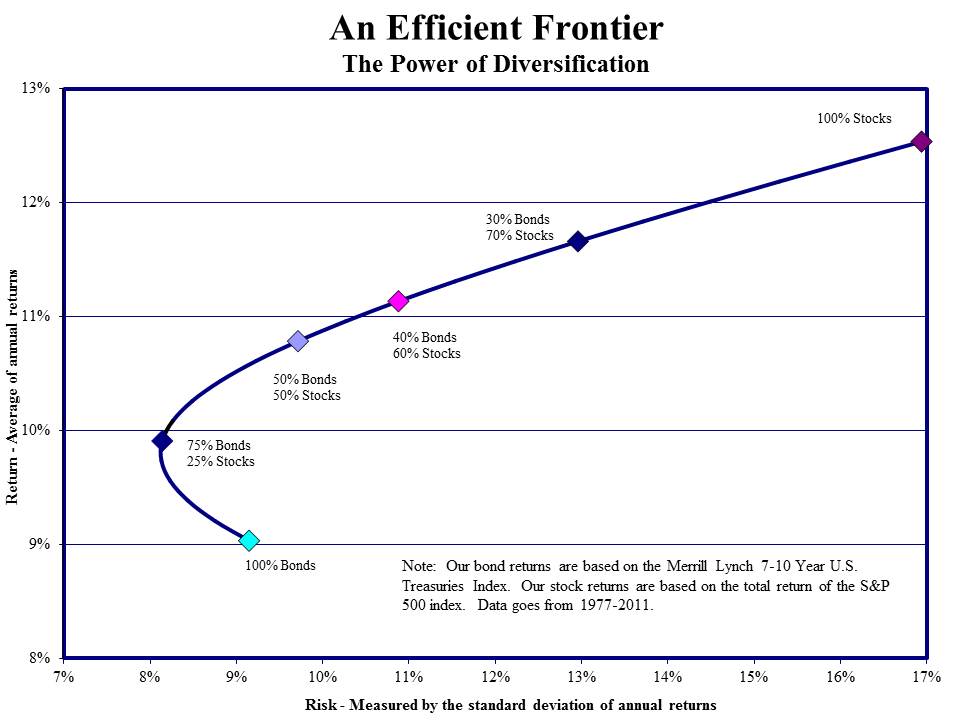 |
| (from Young Research & Publishing) |
As an example, Index Fund Advisors calculates that the long term average return for a portfolio of 50% stocks and 50% bonds is 8.15% with a standard deviation (risk) of 11.42%. Lowering the stock allocation from 50% to 40% reduces the expected return to 7.39% (9.33% lower) but reduces the standard deviation to 9.28% (an 18.7% reduction of risk).
Another reason to own bonds is that they can provide a safe, predictable amount of future income. Let's say you predict that you will need $30,000 in 2019, five years from now, and you can find TIPs bonds in the market that mature in 2019 that currently offer a real yield-to-maturity of 2%. Let's simplify matters by assuming that the TIPs bond you find is a zero coupon bond (there aren't any, for some reason). If you invest $27,172 in such bonds, you can be pretty sure that the bond will be worth $30,000 in 2013 dollars when it matures in 2019.
Do that for the next 30 years (or any number of consecutive years) and you have a bond ladder. You also have a safe, predictable, inflation-protected income stream.
Why buy bonds, then? Because they improve your risk/reward profile if you decide to go the stocks route and they can provide safe, predictable, inflation-protected income if you decide to go with a TIPs ladder. Remember these two benefits, because which you desire will be a determinant of whether you should buy a fund or individual TIPs. More on that later.
Go the annuity route and you probably don't need bonds. In fact, a fixed annuity is a lot like a bond, issued by an insurance company, with a lifetime coupon and no remaining value when you die.
Unless you annuitize all your retirement savings, you're probably going to want to own some bonds to reduce your stock portfolio volatility, or to ensure income for living expenses for some future years.
Probably both.
Unless you annuitize all your retirement savings, you're probably going to want to own some bonds to reduce your stock portfolio volatility, or to ensure income for living expenses for some future years.
Probably both.
Wade's original question, though, was whether to build a TIPs ladder or to buy a fund, but we're not there, yet. Now that we've discussed why to buy bonds at all, the next question is "Why TIPs bonds"?
Subscribe to:
Posts (Atom)