Thursday, January 30, 2014

Untangling Retirement Strategies: Systematic Withdrawals

The large number of funding strategies available to someone planning retirement can be overwhelming. We've got sustainable withdrawal rates (“the 4% Rule”), floor-and-upside, bucket strategies, dividend strategies, cash reserve strategies and then there's the strategy economists love and consumers hate, purchasing life annuities.

No one says you have to limit yourself to one strategy, so you can combine these and others to generate an enormous range of hybrid strategies to fit your specific financial situation. Retirement planning isn't simple.

It sounds like a lot of choices, but I think of all of these as variations of four basic strategies. The rest are either combinations of these four strategies or variations on a theme:
  • Systematic withdrawal strategies
  • Floor-and-upside strategies
  • Time-segmentation or “bucket” strategies, and
  • The “purchasing life annuities” strategy
Let's compare these strategies using eight criteria. First, who are the biggest advocates of the strategy, economists or the financial services industry? I'm always skeptical that the latter has something to sell me (stocks), but some economists are employed by financial services companies and insurance companies, so there's reason to question credibility on both sides. A vital component of critical thinking is considering the source.

Each strategy has a spending plan that determines how much the retiree can withdraw annually. Each strategy also has its own investment strategy, another key consideration.

Liability-matching is identifying current financial resources that will be used to pay for a future expected amount of spending. We might set aside funds now to invest to pay for college in 15 years, or identify funds that will pay for each individual year of our future retirement. A liability we may have to pay off in twenty years may be one best funded by stocks, while a liability we will need to pay in the next couple of years might be better paid with funds invested in a money market account. Some retirement strategies match liabilities with available resources and others don't.

The greatest financial risk of retirement is longevity risk, the risk that we will live so long that we run out of money. Some retirement strategies provide better guarantees against longevity risk than others.

Some strategies provide for a secure minimum “floor” of annual income that you will be able to spend no matter how the market performs. Others have no floor.

Some strategies offer the possibility of improving our initial standard of living in retirement if our equity investments perform well, while other strategies offer no such “upside potential”. And lastly, most retirement strategies leave us in control of our own retirement savings, though life annuities do not.

Let's look at the four major strategies using these eight criteria starting with systematic withdrawal strategies.

The most popular systematic withdrawal strategy is the Safe Withdrawal Rates (SWR) strategy, sometimes referred to as the “4% Rule”. It is the most commonly recommended retirement funding strategy and, since it proposes the retiree invest heavily in stocks and bonds, it is quite popular with the financial services industry. Most economists believe it is deeply flawed (I agree with them).

The amount you can spend with SWR changes depending on how much longer you expect to live in retirement and your current portfolio balance. The studies show that the annual "safe" spending rate ranges from about 4.5% of your portfolio balance the first year of retirement to nearly 10% of your remaining portfolio balance when you expect about 10 more years in retirement.

The SWR studies are often purported to show that you can spend a constant dollar amount throughout retirement that is about 4.5% of your initial portfolio value, but this is an incorrect interpretation of the study results. If you continue to spend a constant dollar amount after your portfolio decreases significantly in value, you increase the risk of depleting your savings before you die. The reverse is true if your portfolio value increases.

In practice, financial advisers will advise you to spend more when your portfolio value increases and less when it falls. Hence, the amount you can spend annually using systematic withdrawal strategies varies with major moves of the stock market, up or down.

Recently, the 4.5% “safe” rate has been revised downward to about 4% by new studies and researchers like Wade Pfau now suggest that the rate may be closer to 3.5%. A reduction from 4.5% to 3.5% may not sound like a lot at first glance, but in actuality it is a 22% decrease in the amount of money you can spend. The former provides spending of $4,500 annually from a $100,000 portfolio, compared to $3,500 a year for the latter rate.

Looked at differently, if you can safely spend 4.5% of your initial savings annually and want to spend $10,000 a year in retirement, you would need to save $222,222. If you can only spend 3.5% in retirement, you need to save $285,714. You would have to save 29% more. That 1% in question is actually a huge difference.

Even these low spending rates result in a predicted 5% to 10% portfolio failure rate. The longevity risk mitigation mechanism for these strategies is to trust back-testing that shows had you lived in 90% to 95% of rolling 30-years periods of stock market history you wouldn't have gone broke.

The spending plan for systematic withdrawal strategies is to spend an unpredictable (market-determined) 3.5% to 4.5% of current portfolio value annually with a 5% to 10% chance of going broke in old age. Reducing the spending rate improves portfolio survival chances.

Note that this spending plan is also used, at least in part, by some of the other three retirement strategies.

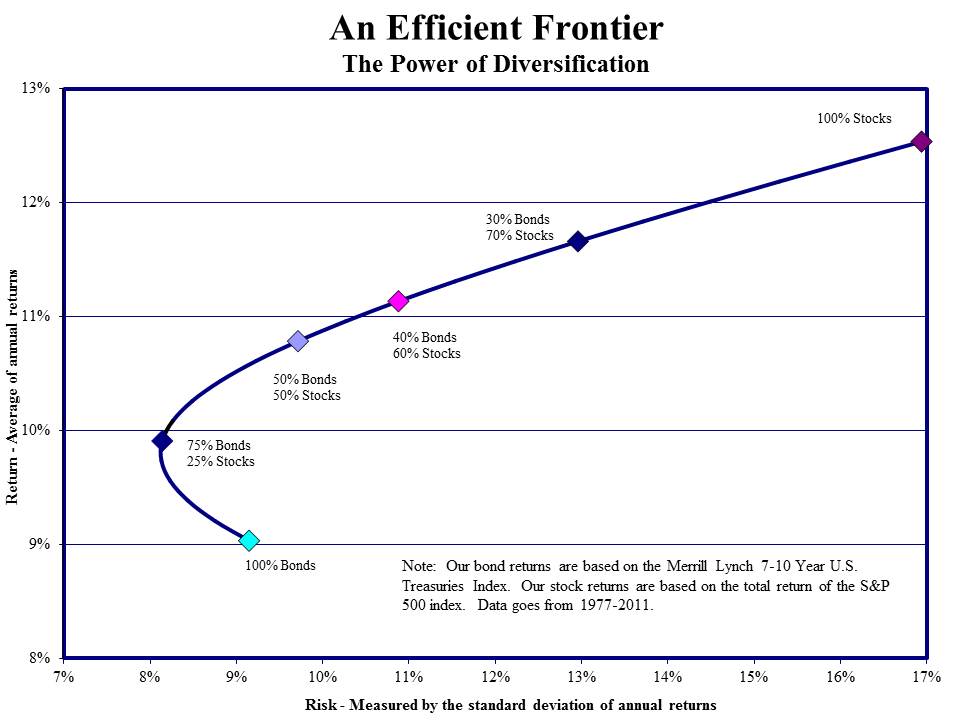
The investment strategy for systematic withdrawal strategies is sometimes referred to as a “total return strategy”. Rather than allocate portions of the portfolio to match various future liabilities, the strategy attempts to create a single pool of wealth, typically using modern portfolio theory's mean-variance optimization. In other words, it seeks a portfolio stock/bond allocation on the efficient frontier appropriate for the retiree's attitudes toward risk, hoping to achieve the highest possible portfolio return available for a given amount of portfolio volatility (risk).

To oversimplify, the systematic withdrawal strategies assume that if you can create a large enough single pile of capital, your other financial problems longevity risk, a spending floor, liability matching will take care of themselves. Systematic withdrawal strategies map all future liabilities to a single portfolio.

You always maintain control of your investment capital with systematic withdrawal strategies and there is a possibility that your investment results will be so good that you will be able to increase your standard of living in the future. Along with that comes the possibility that your investments will perform poorly and that your future standard of living will decline.

So, to sum up systematic withdrawal strategies, invest all your savings in a portfolio of stocks and bonds with an asset allocation based on how much volatility you can stand. Forty or fifty percent stocks would be about right for many people.

Spend 4.5% of the remaining portfolio value each year, which is an unpredictable dollar amount. (Maybe it's only 3.5%, though.) Increase the percentage gradually to about 10% when you're 85 or 90, though your portfolio balance will likely be declining as the withdrawal percentage increases.

Your future standard of living might improve or worsen, depending on your investment results. People who sell stocks and bonds will love you and you will always have control of whatever's left of your savings.

Who would be attracted to a pure systematic withdrawal strategy?

Someone who is comfortable with a 5% to 10% chance of running out of money in retirement. Someone who believes the stock market will always go back up if we wait long enough and who isn't panicked by large swings in his net worth. And someone who doesn't need guaranteed consistent annual income or a floor beneath which her spending will not drop. Perhaps someone whose income floor is adequately provide by Social Security retirement benefits and other pensions.

Some people like a dividend strategy. They buy stocks that yield high dividends and plan to spend only those dividends. They hope their stock prices will preserve their principal.

This is a variation of the systematic withdrawal strategy theme with no bond allocation and not much equity diversification, either. Due to this lack of diversification, it is riskier than the run-of-the-mill systematic withdrawal strategy but otherwise shares the same characteristics.

I'll talk about the life annuities strategy in my next post.


Monday, January 27, 2014

TIPS and RISK

If you build a ten-year TIPS ladder to secure retirement income instead of a 30-year ladder, why would you invest the funds for years 11 through 30 in stocks instead of short term Treasuries?

That's the question a reader posted after my last blog, How Many Rungs?, and it's a great question. I like it because it gives me an opportunity to talk about risk. Risk is as important as return, but it seems to me it gets far less ink (or fewer pixels, as the case may be).

My last post suggested that instead of investing in a 30-year bond ladder, a retiree might build a ten-year ladder and invest the funds for future years in a bond fund or stocks. A reader asked why it wouldn't be safer to invest that money in 2- or 3-year TIPS instead of stocks.
 
The answer depends on which risks you're trying to avoid.

And here's a key point. No financial strategy is without risk.

Some strategies have downsides that are more likely than others and some have downsides that are more devastating than others, but all have risks. Even deciding not to invest at all has risks. You have to choose which risks you want to accept and which risks to avoid or mitigate.

Long TIPS ladders are a component of the floor-and-upside retirement income strategy, the one I prefer. This strategy recommends that we first make sure our critical income needs are provided safely before investing any remaining capital in a risky portfolio. If the market is kind to us in retirement, we improve our standard of living. If the market fails us, at least we still have lunch money.

Another strategy, referred to as time-segmentation or the "bucket strategy" and preferred by about a fourth of advisers, recommends allocating capital to different time periods of retirement (buckets) and investing the retiree's portfolio in assets appropriate for each time period.

For instance, retirement savings might be invested in cash to provide income for the nearest five years of retirement, bonds for 6 to 10 years in the future, and stocks for the 11- to 30-year bucket. The theory here, based on the length of time those three asset classes have historically needed to recover from losses, is that five years isn't long enough for bonds or stocks to recover from a downturn, and ten to fifteen years is long enough for bonds to recover before you need to sell them, but possibly not long enough for stocks.

Building a shorter TIPS ladder and investing the capital for the more distant future in bond funds or stocks is a hybrid of these two strategies that provides a compromise among the risks of the two.

Let's consider this in light of the reader's question.

The amount of capital required to fund years 11 through 30 of your retirement is probably quite large. Short term TIPS are basically cash investments and won't provide much more return or risk than a money market fund. My first question would be whether I wanted to tie up a large portion of my portfolio in low-yielding cash investments for a long time. The bucket strategy theorizes that bonds or stocks would be more appropriate assets for that time period than cash.

My next question would be what holding this much cash would do to my overall portfolio allocation. Holding a lot of cash would lower the portfolio's expected return and reduce its risk. Is this the portfolio allocation that fits the rest of my retirement plan?

I noted the risks of a 30-year bond ladder in my last post: the possibility (probability, actually, when you consider mortality) of not being able to hold those bonds to maturity, the poor risk-adjusted return of long bonds, and the possibility of locking in low returns. Wade Pfau pointed out that we don't lower risk much by building the ladder beyond 20 years.

What are my risks if I build a 10-year TIPS ladder and put the money for years 11 through 30 in short TIPS/cash? Primarily, there is the opportunity risk of investing in a low-return asset for ten years. There is also a risk that my overall portfolio will have less than optimal equity exposure if I hold this much cash.

The retiree could also invest that money in intermediate TIPS bond funds. (If you're wondering why I would prefer bond funds to simply extending the bond ladder, see my previous post, Funds and Ladders.) What are the risks of that approach?

Again, there is a risk of opportunity lost by not investing in higher-returning equities, though the expected return of intermediate TIPS bond funds would be higher than that of short TIPS. There is a risk that interest rates will rise significantly and the bond funds will lose value. Bond fund volatility is similar to stock fund volatility. If I invest this money in either type of fund, there is a risk that fund will lose value and I will need to sell shares at a loss.

And finally, what are the risks of investing that money in equities? Obviously, there is a risk that the equities will decline in value. That's a problem if we have to sell them after a downturn but before the market recovers, but we don't have to sell stocks for a long time with this strategy because we have the next decade of income secured by the TIPS ladder.

The reader also asked if my approach using equities would introduce sequence of returns (SOR) risk.

Absolutely. Any time your strategy involves selling stocks at some point in the future there is SOR risk. That's what SOR risk is: variance of future stock prices when those future sales occur. That risk is mitigated, again, by the fact that I don't have to sell stocks for up to 10 years, thanks to my  bond ladder. For example, I wouldn't have sold stocks in 2008 to replace a rung of the ladder. The risk is there, though.

Normally, I wouldn't recommend equities for the secure "flooring" portion of a retiree's portfolio, and I'm not really doing that now. I'm holding the funds in equities that I will use to buy secure flooring at some future date.  By having the next ten years of my spending secured by the TIPS ladder, I am personally more willing to accept that market risk and wait out a downturn.

You might not be.

Your overall portfolio allocation also comes into play, because investing that much money in bonds or cash might limit your equity or bond allocations. I needed the additional equity exposure, which factored into my decision to invest in stocks. Had my portfolio needed less equity exposure, I would have invested that money in intermediate TIPS bond funds.

Still, as the reader pointed out, there is a possibility that money I have designated to secure future guaranteed income flooring is at risk when invested in stocks if the market falls and won't recover for a very long time. There is a similar risk of interest rates rising and not recovering if I invest in a bond fund.

If you want to ensure 30 years of inflation-protected retirement income, the safest way to guarantee that income is to build a 30-year TIPS ladder.

You will need to accept the risk that you might be forced to sell long bonds at a loss after a rise in interest rates (because you have a financial emergency or because most people won't live 30 years after retiring). You will need to accept the opportunity risk that you might have profited more from stocks, to accept the risk that you are locking in low interest rates for the next three decades, and you will have to accept the risk of the increased volatility of longer bond prices. You will need to accept a poor risk-adjusted return on your long bonds, and perhaps to accept the risk that your portfolio will have suboptimal equity exposure.

But your income will be as safe as it can be for as long as you live, up to 30 years.

It comes down to which risks you want to avoid, because you're going to have some risks not matter which strategy you choose.

Friday, January 24, 2014

Bonds Now?

After my last few columns on TIPS bonds, beginning with Why Bonds?, several people have asked what I would recommend they do to implement a bond portfolio for retirement income today. One reader asked if I could recommend funds.

(That reader posted a comment while I was on vacation and I somehow lost the post. I apologize. I try to respond to every reasonable comment.) 

I don’t generally recommend specific products. I am a firm believer in index funds, so I look for mutual funds and exchange-traded funds with low cost. However, I have read that iShares Barclays TIPS Bond Fund (symbol TIP) and Vanguard Inflation-Protected Securities fund (symbol VIPSX), together hold half of all TIPS dollars invested through fund companies. I have owned both at one time or another. Charles Schwab also offers Schwab Treasury Inflation Protected Securities Index Fund (symbol SWRSX).

I would head to Treasury Direct for TIPS bonds to be held in a taxable account with no purchase fee, though that is often the worst place to hold them because of their tax problems. To hold TIPS in a retirement account, you need to buy them on the secondary market though a brokerage that offers retirement accounts. Treasury Direct does not.

You can find a list of all outstanding Treasury bonds, strips (zero-coupon bonds) and Treasury inflation-protected securities (TIPS) at The Wall Street Journal’s Market Data Center. That doesn't mean all of those bonds are available to purchase, however. Check with your brokerage's bond desk for available issues. (The Fidelity and Vanguard bond desks have been extremely helpful in answering questions and helping find the kind of bonds I want.)

So, what would I do about securing future income with bonds today?

I'd wait.

Interest rates are at historical lows today. They have been held down artificially by Federal Reserve Board actions responding to the 2007 global financial crisis. While I don’t believe anyone can predict future interest rates, it would seem that there’s is a lot more room for rates to go up than further down at this point. The Fed has announced it’s intentions to let rates rise in the near future.

Buying bonds today would lock in historically low interest rates. Wade Pfau recently provided an analysis showing that rates are currently so low that a retiree can only buy about 27 years of income today with a 4% annual withdrawal rate.

Purchasing future guaranteed income is historically expensive today and if I were you, I would wait until it is cheaper. (I wonder if the Fed realizes how badly their actions have impacted older Americans.)

Furthermore, as rates rise, bond values will sink. Although I prefer TIPS ladders to funds, funds would likely be the better bet if you insist on purchasing them today because they will take better advantage of rising interest rates than a ladder will.

I recommend you stay in short term, high quality bond funds (which, themselves, provide inflation protection) and cash until rates move up closer to the historical 2% real return for TIPS.

Monday, January 20, 2014

How Many Rungs?

You could build a bond ladder that lasts as long as you think you might live, say 35 years. But, should you?

You could buy TIPS bonds, for example, that mature in 2015, 2016 and so on out to 2049. Each year when bonds matured you would spend that principal. That’s a 35-year ladder.
If TIPS returns match their long-term real average of 2%, you could spend 3.9% of the initial value of your total investments in the bond ladder each year and your bond ladder should last exactly 35 years, at which time you would have spent all the interest and all the principal. A 30-year ladder under the same circumstances would have an annual payout of 4.46%1.

In comparison, systematic withdrawal strategies estimate a payout of about 4%, though you might end up with some capital to leave to heirs, and an inflation-protected single-payment fixed annuity currently offers a 65-year old couple with 100% survivor benefits about 4%.

(TIPS bond yields are significantly lower than 2% right now, as the graph below shows, so you can’t do that today. I’m guessing you will be able to again within the next few years as the Fed stops holding rates down. As a matter of fact, purchasing secure future retirement income, or "flooring", either with bonds or annuities, is extremely expensive right now.)

You could also build a rolling ladder of any shorter length. For example, you could build a 10-year ladder with bonds that matured in 2015 through 2024. You could set aside capital to fund living expenses after age 74 in a stock index mutual fund. 

When the 2015 bonds mature, you would spend the principal and interest and purchase 2025 bonds with funds from your stock portfolio, keeping the ladder length at ten years.
The next year, you would spend the interest and principal from the matured 2015 bond and purchase a bond maturing in 2025 with funds from the stock account.

Why build a ladder shorter than the length of life you might live?

Because long bonds are very sensitive to interest rates and behave more like stocks than bonds of shorter maturity and because stocks have a better risk-adjusted return than long bonds.

Let’s look at the short end of the ladder first. You probably want a couple of years of expense money, three at the most, in cash or short term bonds. Inflation isn’t my greatest concern; persistent inflation is. The money I keep in cash or short term bond funds will compensate for inflation in the short term. So, I prefer cash and bond funds for the first three years of the ladder. Individual bonds aren’t as liquid and, frankly, aren't worth the effort.

Now, let’s look at the long end of the ladder.  Long bonds suck. Their return doesn’t reward their extra risk.

A 4% return earned from a small cap growth stock isn't the same as a 4% return from a blue chip stock because you took much more risk to earn the former. We can measure risk-adjusted return with the Sharpe ratio. The higher the Sharpe ratio, the better the investment's returns are relative to the amount of risk taken. Vanguard Small Cap Growth Index has a Sharpe ratio of 1.0, while the S&P 500's is 1.3.

Vanguard Intermediate-Term Bond Index Fund Investor Shares has a Sharpe ratio of 1.24, and Vanguard Short-Term Bond Index Fund Investor Shares sports a Sharpe ratio of 1.64. But, the Sharpe ratio for Vanguard Long Term Bond Index Fund is a measly 0.7. You get a tiny bit more return from long bonds but you take a lot more risk.
As you can see from the table above, the volatility of long-term bonds, as measured by standard deviation of returns, is much closer to the volatility of an S&P 500 stock dividend index fund than to that of an intermediate-term bond fund2.

As the chart below from a recent Wade Pfau paper entitled, "How Do I Build a TIPS Bond Ladder for Retirement Income?" demonstrates, interest rates rise quite rapidly with bond maturity up to about ten years. The return curve flattens out from 10 to 20 years, before becoming quite flat at 20 years. As you can see, the return for a 30-year bond isn’t much higher than that of a 20-year bond.

As Wade points out from his analysis, "One conclusion which does emerge is that there is relatively little additional safety to be gained from extending the bond ladder beyond about 20 years."

The sweet spot appears to be the intermediate range of bonds with maturities longer than 3 years but less than 7 to 10 years. Stocks, on the other hand, rarely lose money if you hold them 10 years or more. I’d prefer to hold my “secure floor capital” in stocks for floors beyond 10 years (though I would also be OK with holding that capital in an intermediate-term bond fund if I needed to do so to maintain my overall portfolio allocation).

As my ladder rolls forward, I will spend the maturing bonds and add an additional rung at the top of the ladder with funds from this stock allocation. 

As I have discussed in recent blogs, TIPS bond ladders are relatively free of interest rate risk if we hold individual bonds to maturity. The problem with this strategy is that we might be forced to sell bonds from the ladder before they mature. If interest rates rise, the value of our bond ladder will decline. Should a medical emergency or the need for long term care, for example, force us to sell bonds we intended to hold to maturity after rates have risen, we might take a loss on the bonds sold.

We have to plan for a long retirement because the results of planning for an average life span and then living a long time could be disastrous. Still, most people won’t live into their nineties and those with long bond ladders who don't live a long life won’t be around to hold those bonds to maturity.

Long bonds are much more sensitive to interest rates than intermediate or short bonds. A long bond might have a duration of 16 years, while an intermediate bond has a duration of 6.7 years and a short bond 2.7 years. That means a 1% increase in overall interest rates might result in a 2.7% decline in the price of a short bond, a 6.7% drop in the price of an intermediate fund and a decline of 16% in the value of a long bond.

The greatest bond risk, then, is at the long end of the ladder and that is also the end that has the lowest risk-adjusted return. The longer your bond ladder, the worse its risk-adjusted return and price volatility, and the greater likelihood that you will be forced to sell long bonds before they mature.

One last idea you might consider. We often have discussions about whether annuities or bond ladders are better, but they aren't mutually exclusive. If fixed annuities interest you, the sweet spot for purchasing them is around age 70 to 72, when mortality credits are higher, making the payouts larger. You could build a TIPS bond ladder to cover your income to age 70 or so and then purchase a fixed annuity.

I like a 10-year ladder with the capital for future rungs held in stocks until needed. That way I avoid the worst interest rate risk and lower risk-adjusted return of long bonds and add some upside potential from the stocks. I keep cash to cover the first year of the ladder and use high-quality, short-term bond funds for years 2 and 3.

There are any number of ways to create a rolling bond ladder, or a single long ladder, or a combination of a ladder and fixed annuity, depending on your resources and your attitude toward risk.

But this is how I roll.


--------------------------------
1The present value of a 35-year annuity paying $1.02 a year and discounted at 2% is $25.49. A $1.02 annual payout on a $25.49 investment is 3.9%. A 30-year ladder under the same circumstances would have a payout of 4.46%.


2This doesn't mean you should replace the long bonds in your portfolio with stocks. While long-term bonds may have volatility similar to stocks and a worse risk-adjusted return, bonds have a relatively low correlation to stock returns, which means bonds are still vital to reduce the volatility of your portfolio. My point is that intermediate-term bonds are probably a better bet for maintaining your portfolio allocation than long-term bonds.


Monday, January 13, 2014

Funds and Ladders

Retirees who decide they want to fund at least some of their retirement income with Treasury Inflation-Protected Securities, or TIPS bonds, have a choice between investing in a ladder of individual bonds or a fund of TIPS bonds. Wade Pfau recently asked at his blog which retirees should prefer.

I first tried to answer the question “Why Bonds?” and then the question “Why TIPS bonds?” before mulling the choice between individual bonds or a fund of bonds. The most important thing to know about these two investments is that an individual bond (or a ladder of individual bonds) is in many ways a very different animal than a bond fund.

The second most important thing to understand is that neither is a better tool than the other in every application. For some purposes, individual bonds will be better and for others a fund will be more suitable.

The topic of bond funds versus ladders has been discussed at length at the Bogleheads website, with the general conclusion that bond funds are no worse than ladders and probably better. When interest rates rise, the fund's value will decline, but the fund will reinvest in bonds that pay higher interest and in the long run, all will be well.

On the other hand, William Bernstein has a well-known dislike for TIPS bond funds because they can't be held to maturity like an individual bond. Their net asset value fluctuates over time so bond funds behave a lot like stock funds. Bernstein believes that our risk-free portfolios should be totally risk-free, so he prefers ladders for retirement income and other known future liabilities.

How do we rationalize two distinctly different views of people who really know what they're talking about? By recognizing that they're talking about two different uses of bonds.

Individual bonds (and ladders of individual bonds) have the unique ability to provide a risk-free, inflation-protected amount of capital at some future date if they are held to maturity. Funds can't do that. That makes bonds an ideal way to fund a future liability, such as a year of retirement income.

Bond funds, on the other hand, do a better job of reinvesting interest without you having to buy an entire $1,000 bond and of rolling into higher return bonds when interest rates rise. That makes funds a great alternative if your goal is to reduce portfolio volatility.

Using a bond ladder to diversify with no targeted future liability, you would purchase a new bond each year with the proceeds of a maturing bond. You would find reinvesting the interest challenging.

Using a ladder to fund retirement, you would spend the interest and spend the principal from matured bonds, so reinvestment isn't an issue. New bonds would be purchased at the long end of the ladder with funds from your stock portfolio.

They're two very different scenarios. I agree with Bernstein when we're talking about generating retirement income (use a ladder) and the Bogleheads when we don't have a specific target date (go with a fund).

Let's look at how each tactic compares in some critical ways.

Holding to Maturity. A bond has a single maturity date when you can be assured that your principal will be returned in full, and TIPS bond principal will be increased at maturity to compensate for the inflation you have experienced. A fund has many bonds with many maturity dates that may or may not be held to maturity by the fund's managers.

Like funds, the value of your bond ladder will rise and fall opposite of interest rates over time, but you have the option of holding bonds to maturity and knowing their values at that future date. The value of a bond fund at any specific date in the future will be unknown. It might be higher or lower than an individual bond would have been.

For example, let's assume I can choose between a $1,000 TIPS bond that pays 2% real interest and matures in ten years on January 15th, 2024 and a TIPS bond fund that holds similar bonds. On January 15th, 2024, the TIPS bond will be worth $1,000 in 2014 dollars. I would be able to sell the fund on that date at its net asset value, which might be more or less than $1,000 in 2014 dollars, depending on interest rates between now and then.

Reinvestment Risk. The interest paid by an individual bond ladder may be difficult to reinvest optimally because it won't typically be enough to buy another $1,000 bond. The interest will probably end up in a low-return cash fund.

Bond funds reinvest easily. Bond funds are a better solution to reinvestment risk if your bonds are intended to mitigate portfolio volatility. Interest from bonds purchased to provide retirement income, however, will be spent, not reinvested.

Minimum Investment. TIPS bonds are issued with $1,000 face value. Investors with small amounts to invest will find a fund easier to deal with.

Capital Gains. Jane Quinn argues that if you buy and hold a bond ladder to maturity, you can't take advantage of capital gains if interest rates decline, while a managed fund could. True as stated, but no one says you must hold individual bonds to maturity and that you can't change your mind.

I purchased TIPS two years ago and was amazed to see the tremendous price increase in such a short time for a risk-less investment. I purchased the bonds to hold, but sold when I realized I had probably benefited from a relatively temporary run-up of prices.

(For the opposite side of the Quinn arguments, see Larry Swedroe's response.)

Maintenance. Of course, it's easier to buy a fund and let someone else do the work if you're OK with the disadvantages of a fund, but I don't find maintenance of a TIPS ladder onerous. A Fidelity representative helped me set up a ladder several years ago and did most of the legwork for free. He called me occasionally with a few choices and we had it set up in about three days. Since then, major brokerages, including Fidelity, have provided online tools that simplify the process. After the ladder is set up, you buy one more rung every year.

Diversification. Owning diverse securities is usually a huge benefit of mutual funds. TIPS, however, have no credit risk, so diversification is not an issue as it would be for municipal and corporate bonds.

Cost. TIPS are a cheap asset to purchase in any form. You can buy individual bonds for free online at Treasury Direct. Several large brokerages sell them with no fee. Of course, you will pay half the bid-ask spread when you purchase them on the secondary market, but that is a one-time cost.

You could pay an advisor to set up a ladder for you. I recently read about a service that charges 35 basis points to do so.

iShares TIP fund (symbol TIP) has a net expense ratio of 0.20%, but that is a recurring annual expense. It's also 10% of the expected real return (2%) of the fund. Compare that to SPY (S&P 500) with a net expense ratio of 0.09% and a possible average return of say, 6%, and it looks expensive. SPY expenses are maybe 1.5% of expected returns, not 10%.

If you're willing to do the work yourself, ladders look cheaper. Even if you pay an advisor 0.35% for the initial purchase, you still come out ahead.

Inflation Protection. Individual TIPS bonds will return additional principal at maturity to compensate for increases in the CPI. Funds make no such promise. Interestingly, Morningstar reports that iShares TIP fund returns are not highly correlated with inflation. Isn't that the point?

TIPS fund prices may outperform inflation and they may not. They should compensate for inflation that exceeds market expectations, however.

Taxes. TIPS have a “phantom income” tax problem whether you buy individual bonds or a fund. You have to report accrued principal annually and interest payments are subject to Federal income tax, but not state tax. Hold them in a Roth account and these problems go away.1

(Interest from TIPS and other Treasuries is taxable as federal income but exempt from state tax when held in a taxable account. Hold them in a traditional tax-advantaged account and you convert them to taxable (state and federal) ordinary income when funds are withdrawn. So, if you have low Federal taxes but very high state taxes, beware.)

Many complaints about bond ladders are legitimate if you're investing in bonds to reduce portfolio volatility, or investing in bonds with credit risk, or not spending the income and matured principal. But, most of them just don't apply to a retirement income ladder.

If you're investing in bonds to improve your portfolio allocation, funds may be just the ticket. I would also recommend a fund if you're unwilling to do the initial setup. After that, it's a little more work once a year.

But, if you're investing for certain annual income, want the lowest cost, prefer to know exactly how much money you will have to spend at a future time and want to be certain you will outpace inflation, I prefer a ladder of individual TIPS bonds held in a retirement account, and preferably a Roth.

How should you set up a TIPS ladder? Please check out my next post, How Many Rungs?


---------------------------
1You can't purchase bonds from Treasury Direct from a retirement account to take advantage of their no-fee feature. Treasury Direct will only work with taxable accounts. You can, however, purchase TIPS bonds on the secondary market from a tax deferred retirement account.


Thursday, January 9, 2014

Why TIPS Bonds?

William Bernstein is a fan of TIPs bonds as a retirement income investment.

TIPS, or Treasury Inflation-Protected Securities, are U.S. Treasury bonds that compensate for inflation. The U.S. Treasury is considered the safest bond issuer in the world and many consider TIPS the safest of the safe, because unlike all other Treasuries, TIPs also protect against inflation.

TIPS bonds pay their coupon rate of interest semi-annually. At maturity, the Treasury increases the amount of principal you are repaid to compensate for inflation over the life of the bond.

My last post discussed why retiree's might want to own bonds, but bonds come in many different flavors. They are issued by financially sound governments, developing nation governments, government agencies, blue chip corporations and risky, small companies (junk bonds). They are also issued by cities (muni's) and many other entities. The more financially sound the issuer, the safer the bond and the lower the interest rate paid.

When interest rates go up, bond prices go down, and vice versa. Bonds that will mature soon are safer than bonds that won't pay back their principal for a long time. A change in interest rates will have a much greater impact on the price of long bonds than it will on short or intermediate maturity bonds. Longer bonds can be quite risky.

Bonds can be exempt from Federal income taxes (municipal bonds) or exempt from state taxes (U.S. Treasury bonds).

What would constitute a perfect bond for retirement income?

That bond would be nearly risk-free. As Bernstein says, the riskless portion of your portfolio should be totally riskless. Long bonds and junk bonds are examples of bonds with considerable risk. TIPS, particularly short and intermediate maturity TIPS, are the safest bonds available.

The perfect bond would be available in a wide range of maturities, as TIPS currently are, from short term to 30 years.

Since retirement may last a long time, the perfect bond would compensate for inflation. While perhaps imperfect in this respect, depending on how well you believe the CPI tracks actual inflation, TIPS compensate for inflation better than any other fixed-income security.

Long term investments with relatively low returns also need to have low transaction costs. Even a small recurring cost can be a significant percentage of the stingy total real return of a TIPS bond. You can buy TIPS bonds directly from the U.S. government at Treasury Direct for no fee. Several large brokerages will also sell them for no fee.

So, lowest risk, inflation protection, wide range of maturity dates and low cost. Why aren't TIPS the perfect retirement income investment?

TIPS have a tax problem, "phantom income", resulting from having to pay taxes on accrued principal as you go. The solution to this problem may be to hold them in a retirement account like an IRA or 401(k).

(TIPS are not subject to state income tax and if you hold them in a tax-deferred account, you will lose that feature. Withdrawals will be treated as ordinary income for tax purposes. So, if you have low Federal taxes but high state taxes, beware.)

TIPS are safe and that typically means low volatility, but TIPS have a strange volatility characteristic. TIPs can be volatile in the short term during an economic crisis because of liquidity issues, though they exhibit low volatility over the long run. This isn't a problem, of course, unless you are forced to sell them in a crisis. If you can hold them, the volatility problem will subside.

TIPS bonds may not be available in every maturity you desire. For example, there are no TIPS currently maturing in 2024, 2030-31, or 2033-2039.  This problem can be mitigated by buying twice as many bonds maturing in 2025, for example, but I would prefer to buy half of my allocation to replace 2024 bonds in 2023 bonds and half in 2025 bonds to get the average duration and return.

TIPS aren't a perfect solution for secure income in retirement, but they are clearly the best alternative in my opinion, and apparently in William Bernstein's opinion.

You can decide which endorsement means more to you, but I'm personally going with Bill's.

Now, on to the original question: should you buy individual TIPs bonds or invest in a TIPS bond fund?

Tuesday, December 31, 2013

Why Bonds?

Wade Pfau recently posted a nice piece on how to build a TIPs ladder for retirement. A discussion ensued on the topic of whether one should build a ladder of individual TIPs bonds or instead buy a fund of TIPs bonds.

I'll chime in on the topic, but first let's talk about why a retiree should own bonds at all.

There are three basic alternatives for investing your savings after retirement. You can buy a life annuity from an insurance company that will pay you periodic amounts (let's assume monthly) for as long as you live. You will continue to receive these payments if you live to age 150, but you will stop receiving them when you die, even if that's next year. 

The best thing about a life annuity is that you will never run out of money. The worst thing may be that you could end up with nothing left for your heirs.

(There are options you can buy to protect yourself against losing your investment if you don't live at least 10 years, to continue payments to a surviving spouse, and you can even purchase inflation protection, but let's not get into the weeds at this point.)

The second major alternative is to buy bonds. As William Sharpe and Jason Scott showed in "A 4% Rule -- At What Price?", you can invest in a ladder of TIPs bonds and, if interest rates follow long-term average returns of 2%, you can spend 4.46% of your initial portfolio value every year and your capital should last exactly 30 years. In other words, you can withdraw a constant $44.60 adjusted for inflation every year for 30 years for every $1,000 invested.

There are at least two major differences between these alternatives. First, the TIPs ladder will last exactly thirty years, at which time your account balance will be zero.  The annuity pays for the remainder of your life, which could be significantly more or less than 30 years.

Second, you give your principal to the insurance company up front for an annuity, but you always own the bonds in your bond ladder. If you live less than 30 years, you can leave the surplus bonds to heirs. Depending on the options you choose, there may be nothing left of an annuity to bequeath.

The third major alternative for your post-retirement investment dollars is a stock portfolio. You could invest in stocks and spend from the portfolio each year. Maybe you could pay your annual expenses and end up with a large portfolio to leave your heirs. Or maybe you will completely run out of money long before you die. There's a lot of upside potential with this approach, and a roughly equal downside.

A commenter on the Pfau thread suggested that he prefers investing in dividend-generating stocks, with a goal of spending dividends of around 4% and, unlike the annuity or TIPs ladder approach, being able to preserve his capital. Preserving capital is, in fact, one possible outcome. Going broke in old age is another. Stocks don't always go up.

Another commenter on the Pfau thread asked why you would invest in risky stocks and spend 4% a year when you could invest in a TIPs ladder and spend 4.5%. Part of the answer is that at the end of 30 years, the TIPs ladder is completely spent, principal and all. The value of the stock portfolio, on the other hand, could be enormous after 30 years, or it might not last 20 years.

The other part of the answer is that 4.5% is a pretty predictable spend rate for the TIPs ladder, while 4% for the stock portfolio is merely a guess.

Of course, you can bet some of your retirement on a combination of two or three of these alternatives, and that is probably the more common strategy.

So, back to why a retiree should own bonds. If you decide to go the stock portfolio route, you should probably also own some bonds. As Modern Portfolio Theory predicts, bonds can decrease the risk of a portfolio a lot while lowering its return just a little. Deciding how much of your portfolio should be held in bonds at what age is still hotly debated.
(from Young Research & Publishing)
As an example, Index Fund Advisors calculates that the long term average return for a portfolio of 50% stocks and 50% bonds is 8.15% with a standard deviation (risk) of 11.42%. Lowering the stock allocation from 50% to 40% reduces the expected return to 7.39% (9.33% lower) but reduces the standard deviation to 9.28% (an 18.7% reduction of risk).

Another reason to own bonds is that they can provide a safe, predictable amount of future income. Let's say you predict that you will need $30,000 in 2019, five years from now, and you can find TIPs bonds in the market that mature in 2019 that currently offer a real yield-to-maturity of 2%. Let's simplify matters by assuming that the TIPs bond you find is a zero coupon bond (there aren't any, for some reason). If you invest $27,172 in such bonds, you can be pretty sure that the bond will be worth $30,000 in 2013 dollars when it matures in 2019.

Do that for the next 30 years (or any number of consecutive years) and you have a bond ladder. You also have a safe, predictable, inflation-protected income stream.

Why buy bonds, then? Because they improve your risk/reward profile if you decide to go the stocks route and they can provide safe, predictable, inflation-protected income if you decide to go with a TIPs ladder. Remember these two benefits, because which you desire will be a determinant of whether you should buy a fund or individual TIPs. More on that later.

Go the annuity route and you probably don't need bonds. In fact, a fixed annuity is a lot like a bond, issued by an insurance company, with a lifetime coupon and no remaining value when you die.

Unless you annuitize all your retirement savings, you're probably going to want to own some bonds to reduce your stock portfolio volatility, or to ensure income for living expenses for some future years.

Probably both.

Wade's original question, though, was whether to build a TIPs ladder or to buy a fund, but we're not there, yet. Now that we've discussed why to buy bonds at all, the next question is "Why TIPs bonds"?

Sunday, December 29, 2013

Saving Excess Tax Deductions at the Last Minute

I’m not a tax specialist. I have my taxes done by an expert IRS-enrolled agent. Keeping track of tax laws is a full time job and one I'm delighted to outsource.

I do have a tax idea to pass along that sometimes works for retirees. Please discuss this with a tax expert if you’re interested. 

Retirees can find themselves in the position of not only owing no federal taxes (because they’re no longer working), but actually having more deductions than they can use. Health care and health insurance costs, for example, can generate far more tax deductions than you might have considered when you were budgeting for retirement. 

Health care costs have been the second largest financial shock of my retirement (right after learning that kids don’t actually grow up, go to college and then support themselves, anymore).

This may especially be the case if you’re spending first from your taxable accounts, and thus not generating taxable income from IRA’s and 401(k)’s. You might just find that you have no taxable federal income and, in fact, you have more itemized deductions than you can use.

Here's an example. Joe retired at the beginning of 2013 and paid his living expenses from his taxable retirement savings. $10,000 interest and dividends from his taxable accounts makes up his only taxable income. He has no taxable income from Social Security (he hasn't claimed, yet) and no taxable withdrawals from IRA's or 401(k) accounts.

Joe has $30,000 in mortgage interest and deductible property taxes and paid another $30,000 for deductible medical costs and private health insurance, and of course, exemptions for himself and his spouse.

According to the TurboTax online tax estimator, Joe should expect to report $10,000 of taxable income, $59,250 deductions and $15,600 exemptions. He should expect to pay no federal taxes.

No federal taxes sounds good, but Joe could have had another $65,000 of taxable income and still paid no federal taxes because he has unused tax deductions.

Now, you can carry forward capital gains losses and net operating losses to future years when you do owe taxes, but you can’t carry forward unused itemized deductions.

So, how can a retiree make use of all those deductions? By generating more income. And, how do you do that the last week of the year when you didn’t do it for the previous 51?

Convert a traditional IRA to a Roth. The conversion amount will be reported on IRS Form 8606 and claimed as an IRA withdrawal in the Income section near the top of IRS Form 1040. The amount will be taxed as regular income, so the trick is to convert the amount of your IRA account to a Roth account that will be offset by your excess deductions and leave your taxes at zero, or thereabouts.

The TurboTax estimator tells us that if Joe converts $75,000 from his traditional IRA to a Roth IRA, increasing his taxable income from $10,000 to $75,000, he will still pay no taxes. (The estimator says $4, but let's not quibble.)

You don't pay income tax on Roth IRA withdrawals, but traditional IRA withdrawals are taxed as ordinary income. Leave the money in an IRA and you will eventually be taxed when you take it out. The funds you convert to a Roth will no longer be subject to income tax when you spend them and you will have achieved this by paying the current taxes dues on the IRA withdrawal, which, if you do it right, will be zero.

The amount you convert doesn’t need to be exact because, should you convert too much, you can undo all or part of the conversion in 2014 with a Roth recharacterization. I suggest you estimate your taxes, guess the amount of excess deductions you will have, and convert that amount or a little more. (You can put money back into your IRA in 2014, but you can’t take out more.)

Let's say Joe converts $75,000 by the end of 2013 but his tax preparer points out another $10,000 in taxable income that Joe didn't realize would be treated as taxable income. Joe can simply put $10,000 back in his IRA through a recharacterization.

As I said, you can undo all of this in 2014, but the conversion has to be done by the end of 2013 to offset taxes this year.

There are deadlines for the recharacterization, the earliest of which is the day your 2013 taxes are due but this can be extended to October 15.

What happens if Joe only converts $30,000 and finds out after his taxes are prepared next April that he could have converted $75,000? Too bad. You can put converted dollars back after the end of the tax year, but you can't take out more.

Of course, there are many reason to do a Roth conversion, or not to, and retirees aren't the only potential beneficiaries. Maybe you were unemployed for part of 2013, but still had high medical bills and deductible mortgage interest. You still might find yourself with more deductions than you can use.

I can’t say this enough: I am not a tax expert. Roth conversions, like many tax maneuvers, have subtleties that need to be considered.  I am not suggesting that you do this, I am suggesting that you might want to discuss this with a tax expert.

You'll have to act quickly to do it this year. You have until close of business Tuesday to convert. It 's pretty easy at websites like Fidelity's. It takes just a few minutes.

Of course, there's always next December.

Happy New Year to all my fellow (and future) retiree readers.

Wednesday, December 4, 2013

Does Retirement Get Cheaper as We Age?

A reader noted last week that living expenses tend to decline as we age and suggested that tendency offers some comfort as we look at the cost of a long retirement. That is true in one respect, but there are a couple of important considerations to keep in mind.

First, let’s look at the true part. Expenses typically decline with age, even when we include health care costs.

According to a 2012 study, Expenditure Patterns of Older Americans, 2001‒2009 by Sudipto Banerjee, Employee Benefit Research Institute, "Household expenses steadily decline with age. With the age 65 expenditure as a benchmark, household expenditure falls by 19 percent by age 75, 34 percent by age 85, and 52 percent by age 95.

Here’s a chart of household expenditures by age from the study1. It's almost linear.
What doesn’t get cheaper as we age? Health care. The cost of every other category in the study (home, food, clothing, etc.) decreased with age.

According to Banerjee, “Health-related expenses are the second-largest component in the budget of older Americans. It is the only component which steadily increases with age. Health care expenses capture around 10 percent of the budget for those between 50–64, but increase to about 20 percent for those age 85 and over.

Health care expenses probably won't steadily decline with age. They're more likely to come in bunches. Studies have shown that many retirees will spend most of their total lifetime medical expenses near the end of their life.

So, yes, living expenses tend to decline as we age but growing healthcare expenses offset those savings to some degree. 

The real wild card among retirement expenses is long term care. 

It is estimated that about 60% of Americans will need some form of long term care in their lifetime and this care is not covered by Medicare. That’s the scary number LTC insurance providers use to sell insurance policies but, in reality, the costs of long term care range from several thousand dollars that might be easily covered out of pocket all the way up to "catastrophic".

As I showed in a previous blog on Long Term Care Insurance, more than 40% of retiree’s can expect no long term care costs at all and another 19% can expect costs less than $10,000. An additional 8% can expect costs between $10,000 and $25,000. So, arguably about 70% of retirees will have LTC costs that might well be managed without insurance.

Still, that leaves 30% of retirees that can expect to have very large, perhaps catastrophic long term care costs.

The following chart shows the percentages for those who will need long term care at various cost levels.
You may not have long term care needs at all, or you may only need care for a short time and experience manageable costs, but the possibility remains that you or your spouse might have catastrophic long term care needs that will destroy your financial plans for late retirement. 

LTC insurance is available, but costly. Wealthy people can self-insure. Those with scarce resources won’t be able to afford it. That leaves a group in the middle with a decision to make about purchasing insurance.

There is another major unknown factor in the cost of our retirement, of course: how long we will live. A shorter retirement will cost less, perhaps far less, than one that takes us into our late nineties. While you might derive some consolation from the fact that expenses tend to decline as we age, the factor that really increases or decreases the cost of retirement is longevity. 

Given the possibilities of a very long life and catastrophic LTC costs, expenses in retirement can be wildly unpredictable. Part of that risk depends on how you choose to finance it. Those who choose to forgo (or cannot afford) LTC insurance and choose to fund retirement with a stock and bond portfolio will have little control over those risks. The range of potential outcomes is quite large.

Households that insure against LTC and longevity risk by purchasing LTC insurance and life annuities will have less money to spend elsewhere, but will avoid the worst-case outcomes and have more predictable expenses.

So, will your total expenses decline as you age? If you stay healthy they probably will.

If you have high health care costs and uninsured long term care costs, expenses can explode.


1A lot of retirement income calculators treat income and expenses as static throughout retirement. "You need to replace 70% of your pre-retirement income." As this chart shows, expenses are not static, and income isn't typically static, either. A good retirement plan takes these changes over time into consideration. I prefer a consumption-smoothing tool like E$Planner.


Tuesday, November 19, 2013

The $241,000 Kid (College Not Included)

I often wonder how the more than 95% of American workers who aren’t able to save enough for retirement will get by and what other strategies might be available to households who recognize that they probably won’t win the “Save 22 Times Your Required Income after Social Security Benefits 401(k)” Lotto1.

A few weeks back, I asked readers for their thoughts on the subject and I received some interesting comments.

A fellow financial planner, Mark Zoril, responded eloquently with what might be an obvious potential outcome, even if you don’t think of it as a strategy:
"I have been a financial advisor for 17 years and worked with many people that have very modest accumulations for retirement. However, what I have found is that over the years, their lifestyle, what they need to spend, has adapted to their limited income and modest means. They simply do not lead, in any way, extravagant lifestyles.
Mark identifies an outcome (a “strategy” in the game theory or evolution sense) that is important because it will be the most common scenario for families that can’t save enough: their standard of living will decline considerably after they retire.

Another strategy for funding retirement if you can't save enough is to limit your family size. This is not a strategy that I readily recommend, but then neither is the one that Mark notes.

I'm simply pointing out that having children may have a large impact on your ability to save enough for retirement. I also want to reinforce the thread that the decisions you make and your life experiences before you retire largely determine your standard of living after you retire.

I have three grown children and I can tell you two things about child-rearing: it’s expensive beyond belief and it’s rewarding beyond belief. 

How much does it cost to raise a kid? According to a 2013 U.S. Department of Agriculture report, it will cost an estimated $241,080 for a middle-income couple to raise a child born in 2012 for 18 years. That's up almost 3% from 2011.

But wait, there's more.

Despite this study's assumption, kids don’t leave home and support themselves at 18, anymore, like my wife and I did. Jobs are hard to find and a lot of kids "boomerang". Bump up that price tag a few more years.

Second — and this one is going to break your heart — the Dept. of Agriculture estimate of over $240,000 per child doesn’t include college costs. Add in an average $22,261 per year for a four-year public college and that $241,000 climbs to $330,000 per child.

(I’d personally feel blessed with these costs. One of mine is in med school and the others are taking the scenic route through college. Does any kid graduate in four years, anymore?)

If you’re interested in a cost more tailored to your specific household, the Dept. of Agriculture provides a “childcare cost calculator” with which you can further ponder the dollar cost of parenthood, but if you don’t have Internet access, you can achieve roughly the same experience by shaving your head with a cheese grater.

I had an economics professor in college who said that the ultimate form of birth control would be to show young couples the lifetime cost of raising a child.

(That’s how economists think. I’m pretty sure he had 2.3 children.)

So, the average cost of raising a single child far exceeds the typical retirement savings for 95% or more of American households. It's easier to fund retirement with a spare $330,000 or two lying around the house than it is with a couple of twenty-somethings lying around the house.

I’m not suggesting that you forego children to secure retirement, but you need to understand that there is a correlation. If you weren't able to save enough for your golden years but raised a happy, successful family of children and grandchildren, then pat yourself on the pack. Yours was the nobler accomplishment.

And every time someone writes me that they were able to save plenty of money for retirement and anyone who didn’t is one of those 47% slackers, I know the odds are quite good that the writer never had a family medical or other financial catastrophe.

And he probably doesn’t have children.


____________________________________________
1If you can generate a 4.5% payout from your savings, through TIPs ladders, annuities, or stock and bonds portfolios, for example, you will need to save about 22 times (1 / .045) the amount of retirement income you will need less any income you will receive from Social Security benefits or pensions. For example, if you will need $40,000 a year to retire on and Social Security benefits will total $25,000, you will have a "gap" of $15,000. With a 4.5% payout, you will need to save about $333,000. If you will only be able to generate a 3.5% payout, you would need to save about $429,000.

Friday, November 15, 2013

Deep Risk, Discipline and a Punch in the Mouth

William Bernstein’s new e-book, Deep Risk: How History Informs Portfolio Design (Investing for Adults), is introduced with the story of Lucie White and Mark Villa, a couple who sold at the bottom of the market in 2009 and bought back in after missing the great run-up that followed. Sadly, not an uncommon story.

The passages that caught my eye in the first few pages of Deep Risk describe the couple’s plight:
“This story speaks volumes about risk. All investors experienced it during 2008–2009; if you did not lose sleep then, you’re not human. But the outcomes varied greatly from investor to investor, depending on their individual level of discipline
and. . .
“For the rest of this booklet, I’m going to assume that, like all investment adults, you’re disciplined and thus not vulnerable to the routine but serious buy high/sell low loss of capital.”
Let me repeat that. “You’re disciplined and thus not vulnerable.”

Notice how sweetly that rolls off the tongue.

Bernstein seems to say here that investment discipline is independent of context, but I know from his previous writings that he understands just how difficult that discipline is in bad times.  It's unbelievably difficult.

I have been young and old, dirt-poor and well off, through incredible booms like the 1990’s and horrendous crashes, like Black Monday and the Great Recession, and through the grinding stagflation of the 1970’s and, when it comes to decision-making, context matters.

Investment discipline is a function of risk tolerance and we know that our risk tolerance isn’t constant.

How difficult it is to maintain investment discipline depends on what’s going on around you, how much you have to lose and your prospects for earning it back and not just on some personal level of discipline you might have been born with or developed over the years.

Stock market discipline came easy throughout the nineties, but was a far different story come the end of 2007.

Bob is 25 and has $10,000 in his retirement portfolio. Discipline isn’t that hard to come by. His standard of living for the rest of his life isn’t at risk from a market crash and he has decades to recover from losses. Frankly, Bob doesn’t really expect that retirement day will ever come, so retirement savings aren’t quite real to him. In the words of that great finance sage and rolling stone, Bob Dylan, “When you got nothing, you got nothing to lose.”

Sam is 50 and his retirement savings account holds a lot to lose. On the other hand, he still has a decade and a half to recover from a loss and his salary is probably as high as its ever going to be. He can still save a lot. A big loss probably won’t change his lifetime standard of living. Discipline is more difficult for Sam than for Bob, but not as difficult as it will become.

At 64, Joe is about to retire. The prospects for earning back your losses are quite attractive when you’re young and have a lifetime of human capital on your balance sheet, less so when retirement is a year or two away. As I wrote in Even Your Portfolio Heals More Slowly as You Get Older, rebuilding your wealth is far easier when you’re earning a lot of money and saving for retirement than when you retire, have no earnings, and are spending 4% or so of your portfolio every year.

Donald is 70 and has been retired for three years. Returning to the workforce at anywhere near his old salary isn’t in the cards. His standard of living for perhaps the next 30 years depends on his retirement savings. Patiently waiting out a bear market and wondering if his standard of living is permanently declining before his very eyes requires more discipline from Donald than from all the others combined.

The salient point, I believe, is not that discipline comes cheap for 25 year-old Bob but dear for retired Donald, or easier for Sam in his fifties than for Joe at 64, but that you are, at various times in your life, Bob and John and Sam and Joe and Donald.

That discipline you found when you had twenty years until retirement and were packing away a large percentage of your peaking salary might not carry the day when you are 70 and watching your lifestyle flow into the black hole of a bear market, perhaps permanently.

Bernstein’s point about portfolio risk is that it will remain shallow risk — usually — if the investor doesn’t panic. The insurance against shallow risk becoming deep risk in this scenario, he says, is simple. Don’t panic. Adult investors don’t panic.

Getting out is usually the wrong decision. Of course, you never know. Maybe it's 1929 and getting out is the right move. If it were always the wrong decision, it wouldn't require much discipline.

My point is that avoiding panic is easier in some circumstances than others, and your capacity to avoid it before you retired may not suffice after you retire and have far less capacity to rebuild wealth. I suggest you rely on something safer than self-discipline.

If you have one safe “standard-of-living” portfolio that generates enough income to live on  and a separate risky “wealth” portfolio to possibly improve your standard of living or leave a bequest, you will be less likely to panic in a market crisis than if you depend on self-discipline. Your standard of living won’t be at risk.

Planning on self-discipline for protection is over-rated.

As that other great financial sage, Mike Tyson famously said, “Everyone has a plan 'till they get punched in the mouth.”


Tuesday, November 12, 2013

Deep Risk: Wealth versus Standard of Living

Standard of living and wealth are closely related but they aren’t exactly the same thing.

You can buy the same standard of living at dramatically different prices, for example, depending on which city you choose to live in. Your current standard of living in Manhattan would cost you less in San Francisco, much less in Wichita.

Even if you retire in place, you will no longer pay FICA taxes or need to save for retirement, so you can have exactly the same standard of living at a significantly lower cost without even relocating.

If you play around with consumption smoothing at E$Planner.com, you begin to see a number of things that can raise or lower your standard of living (discretionary spending) with a given level of wealth. You can delay Social Security benefits, for example, or pay off your mortgage and perhaps be able to spend more with the same amount of wealth.

That’s the benefit of consumption smoothing, arranging all your assets, borrowing power, and income streams to provide the highest consistent discretionary spending level, though these might not be the optimum strategies to maximize your portfolio value.

Consumption smoothing has convinced me that standard of living is a better metric for retirement planning than wealth. That thought hit home as I was reading William Bernstein’s new e-book, Deep Risk: How History Informs Portfolio Design (Investing for Adults).

(If you want to understand retirement finance, read this book. Then read the rest of Bernstein’s books, magazine articles and his posts from long ago at http://www.efficientfrontier.com. When you finish, you will know more about the subject than 99% of the population. Heck, you’ll know more than 99% of financial planners.)

Bernstein distinguishes between “shallow risk” and “deep risk” based on the amount of the potential loss and its duration, or how long it would take the investor to recover that loss. Normal portfolio variance is shallow risk, for example, and a major depression would be a deep risk.

I think of it a little differently. I think of shallow risk as financial risk that won’t impact my long-term standard of living, while deep risk can.

Bernstein identifies four major types of deep risk: long-term inflation, deflation, confiscation and destruction. He notes that deflation is actually a symptom of economic depression and not the disease. A year or two of deflation probably won’t destroy you, but long term deflation associated with an economic collapse (think Japan) might well do the trick.

Confiscation refers to the government seizing your assets. While taxation always does this to some extent, Bernstein is thinking more along the lines of Russia and Argentina. Massive confiscation is pretty unlikely in a developed nation like the U.S. and as Bernstein points out, it’s difficult, expensive and perhaps felonious to protect yourself against it.

Destruction is loss due to a war or a natural disaster and again, there is no reasonable way to protect yourself, unless you are ridiculously wealthy.

(I’m not sure where Bernie Madoff fits among the four horsemen, but theft and fraud have cost more retiree’s their life savings in the U.S. over the past 75 years than deflation, confiscation and destruction combined. Not covered in Deep Risk, it certainly warrants your consideration as a major risk to your standard of living.)

If you're a long-time reader of Bernstein, you know that he believes a retiree can't expect more than an 80% probability of successfully funding retirement. That's not because he thinks the safe withdrawal rates math is wrong, but because he thinks there are larger risks, like these four, that may render the withdrawal rate moot.

What actionable information did I take away from Deep Risk?  Perhaps not a lot, but then I was pretty much a Bernstein guy to begin with.

Perhaps I feel a little better knowing that, while I have done nothing to protect myself against destruction and confiscation, there is little I could do. Stashing gold bars in various banks around the world or buying real estate in those places probably isn’t in the cards for me. These are highly unlikely events in the U.S., anyway.

Since most countries moved away from the gold standard, instances of deflation around the world have greatly diminished. Still, deflation in the U.S. is possible and far more likely than losses due to war or a cataclysmic natural disaster.

The problem with protecting against deflation risk, as Bernstein explains, is that the solution (long term bonds) is a really bad one if we experience inflation, instead, and that is a far more likely possibility. Bernstein estimates that the likelihood of destructive, pervasive inflation is an order of magnitude greater than that of a depression.

That leaves inflation as the most likely of the four risks and not the 3% or 4% we typically see, but a long, grinding period like we experienced in the seventies. Deep Risk suggests two solutions, depending on whether you’re trying to protect yourself for the next 10 to 20 years, or the next 20 to 30. TIPs work better for the former, but Bernstein believes a globally diversified stock portfolio better protects us against inflation for money we probably won’t need in the next two decades.

Bernstein also writes that shallow portfolio risk can turn into deep risk if an investor chooses (or is forced) to sell assets at low prices during a market crash. In fact, he believes it is the most common way that people experience a real loss of standard of living.

And that brings me back to my initial thought about a standard of living metric. Bernstein often suggests two retirement portfolios, along the lines of Life Cycle Finance Theory, with one to provide the income we need to maintain our standard of living (he refers to this as a “liability matching portfolio”) and the remainder of our assets, if we are so fortunate to have any, allowed to grow in a risky portfolio.

This approach secures your standard of living while perhaps giving up some potential to grow your overall wealth. In essence, you have a “standard of living” portfolio that you don’t put at risk and a “wealth” portfolio in which major losses won’t impact your standard of living.

And, here’s the actionable information I gleaned from Deep Risk. Instead of thinking of my retirement assets as two portfolios, I’ll think of three. My risky portfolio will remain the same, but I may start thinking of my 20-30 year standard-of-living liabilities as being met by a larger stock allocation to mitigate the risk of a long bout of inflation and as a better solution than long bonds.

Thinking of wealth and standard of living as two separate but closely related financial metrics brings me greater clarity when I think about retirement planning.

So does reading Bernstein.